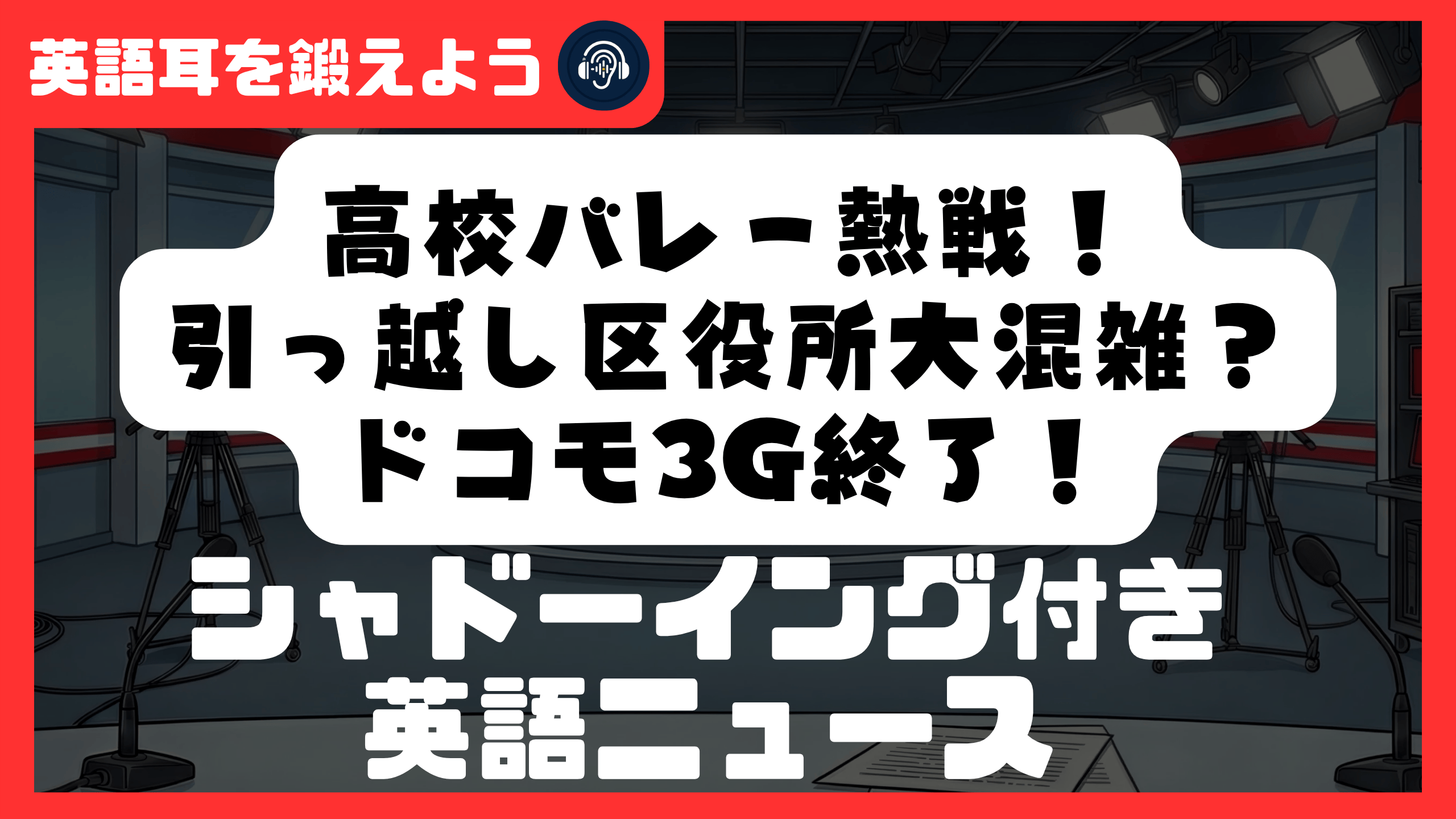
【シャドーイング付き英語ニュース】高校バレー熱戦!引っ越し区役所大混雑?ドコモ3G終了! | リスニング強化
【シャドーイング付き英語ニュース】高校バレー熱戦!引っ越し区役所大混雑?ドコモ3G終了! | リスニング強化
YouTube「スキマ時間で英語を学ぼう」の英語ニュース解説です。
動画と合わせてリスニング・シャドーイングにご利用ください。
スクリプト
Welcome to Sukima English News! I'm Sarah. (スキマ英語ニュースへようこそ!サラです。)
And I'm Marc. (そして、マークです。)
Today, we're looking at a high school volleyball tournament, long waits at city hall, and NTT Docomo phasing out 3G. (今日は、高校バレーボール大会、市役所の長い待ち時間、そしてNTTドコモの3Gサービス終了についてお伝えします。)
A busy news day for sure! (まさに、盛りだくさんのニュースですね!)
Our first story is about the Aranmare Cup SAKATA 2025, a high school girls' volleyball tournament in Akita and Yamagata. (まずは、秋田と山形で行われる高校女子バレーボール大会、「アラマレカップ SAKATA 2025」についてです。)
It features 16 teams with professional-level production planned for the matches. (16チームが出場し、試合ではプロレベルの演出が予定されています。)
Professional-level production for a high school event? That sounds impressive. What does that entail? (高校の大会でプロレベルの演出ですか?それはすごいですね。具体的にはどんなことをするんですか?)
The goal is to boost player motivation and spectator entertainment, creating an atmosphere like professional games. (選手のモチベーション向上と観客のエンターテイメント性を高め、プロの試合のような雰囲気を作り出すことが目的です。)
The tournament aims to promote volleyball, regional sports development, and discover future athletes. (この大会は、バレーボールの普及、地域スポーツの振興、そして未来の選手の発掘を目指しています。)
It also hopes to contribute to the local economy. (地域経済への貢献も期待されています。)
So, it's about competition, building excitement, and inspiring the next generation. Any stats on economic impact or participation? (つまり、競技だけでなく、盛り上がりを作り、次世代を育成するということですね。経済効果や参加者数に関するデータはありますか?)
Unfortunately, no specific data is released yet. Information is from news and sports organizations' websites. (残念ながら、現時点では具体的なデータは公表されていません。情報はニュースやスポーツ団体のウェブサイトからです。)
However, similar events typically bring economic benefits through tourism and local spending. (しかし、同様のイベントは通常、観光や地元での消費を通じて経済的な恩恵をもたらします。)
That makes sense. Even without exact figures, sporting events can energize a local community. (なるほど。正確な数字がなくても、スポーツイベントは地域社会を活性化させることができますね。)
Exactly. Beyond economics, there are social benefits like healthy youth development and community activation. (まさにその通りです。経済的な側面だけでなく、青少年の健全な育成や地域活性化といった社会的なメリットもあります。)
We can find general data on high school girls' volleyball participation nationwide from sports associations. (スポーツ団体から、全国の高校女子バレーボールの参加者に関する一般的なデータは入手できます。)
But for this specific tournament, detailed data is still limited. (しかし、この特定の大会に関する詳細なデータはまだ限られています。)
It's a shame, but the potential benefits are clear. What experience do you think the players will gain? (残念ですが、潜在的なメリットは明らかですね。選手たちはどのような経験を積むことができると思いますか?)
It's a valuable chance to compete at a high level. The professional-style production could elevate their awareness and help them envision a professional future. (高いレベルで競い合える貴重な機会です。プロのような演出は、彼らの意識を高め、プロとしての将来を思い描く助けになるでしょう。)
That's a powerful motivator for young athletes. (若いアスリートにとって、それは強力なモチベーションになりますね。)
Right. For local communities, it's expected to increase sports interest and create interaction opportunities. (ええ。地域社会にとっては、スポーツへの関心を高め、交流の機会を創出することが期待されます。)
There's also potential for economic revitalization through tournament operations. (大会運営を通じた地域経済の活性化の可能性もあります。)
So, it's a win-win for athletes and the local area. (では、選手にとっても地域にとっても、まさにウィンウィンですね。)
Ideally, yes. Continued hosting could foster a stronger sports culture and talent discovery. (そうなると理想的ですね。継続的な開催は、より強いスポーツ文化の醸成や才能の発掘につながる可能性があります。)
More data on outcomes and local impact will be useful for future events and regional revitalization strategies. (今後のイベントや地域活性化戦略のためには、成果や地域への影響に関するさらなるデータが役立つでしょう。)
It sounds like a well-rounded initiative. I hope more regions adopt similar models. (よく考えられた取り組みのようですね。他の地域でもこのようなモデルが採用されることを願っています。)
That's a great aspiration. This event could serve as a good example of how sports can catalyze broader development. (それは素晴らしい目標ですね。このイベントは、スポーツがより広範な開発を促進する触媒となりうる良い例となるでしょう。)
We'll be watching for further details. (今後の詳細に注目していきましょう。)
Definitely. It’s inspiring to see these initiatives and the positive impact sports can have. (ええ。こうした取り組みや、スポーツがもたらすポジティブな影響を見るのは、本当に刺激的です。)
True. For listeners, it's a reminder of how sports events connect communities, boost economies, and offer young athletes a platform for their skills and dreams. (そうですね。リスナーの皆さんにとっては、スポーツイベントが地域社会を繋ぎ、経済を活性化させ、若いアスリートにスキルと夢のプラットフォームを提供するということを改めて思い出させてくれます。)
Let's discuss the intense congestion at local government offices during Japan's moving season. (引っ越しの時期の役所の混雑について、ちょっと話しましょうか。)
Yes, extremely long waiting times. What causes this "over five-hour wait" phenomenon? (ええ、本当に待ち時間が長いですよね。この「5時間待ち」みたいな現象って、何が原因なんでしょう?)
The main culprit is the annual moving rush in March and April, when many relocate for jobs, school, or a fresh start. (主な原因は、3月と4月の毎年の引っ越しラッシュですね。仕事や学校、新しい生活のために引っ越す人が多いんです。)
Procedures like changing your registered address – tenshutsu todoke, tennyu todoke, and kyokyo todoke – all pile up. (転出届とか転入届、それに虚偽届とか、手続きが全部積み重なってしまうんですよ。)
So, it's a seasonal paperwork surge. Can people avoid these waits with online applications? (なるほど、季節的な書類の山ですね。オンライン申請で、この待ち時間を避けたりはできないんでしょうか?)
Online applications using the My Number card are possible, but not all local governments have fully implemented these digital services. (マイナンバーカードを使ったオンライン申請は可能ですが、全ての自治体でデジタルサービスが完全に導入されているわけではないんです。)
Plus, there's a gap in My Number card adoption and digital literacy, so many still prefer to go in person. (それに、マイナンバーカードの普及率やデジタルリテラシーにも差があるので、やっぱり直接窓口に行く人が多いのが現状です。)
That makes sense. Japanese administrative procedures can be quite paper-based. (それは分かります。日本の行政手続きって、結構紙ベースなところが多いですからね。)
Exactly. The reliance on paper forms and manual checks slows things down and contributes to congestion. (そうなんです。紙の書類や手作業での確認に頼っていると、どうしても時間がかかって、混雑の原因になってしまいます。)
How many people move each year, and is this issue worsening? (年間にどれくらいの人が引っ越していて、この問題は悪化しているんでしょうか?)
In 2024, around 4.6 million moves occurred. The problem is the concentration of these moves into a short period. (2024年には、約460万件の引っ越しがありました。問題は、この引っ越しが短期間に集中してしまうことなんです。)
For example, in Tokyo's wards, there was a net inflow of over 79,000 people in 2024, about 10,000 more than the previous year. (例えば、東京23区では、2024年に7万9千人以上の転入超過がありました。これは去年の1万人増くらいです。)
That's a significant increase. What's driving this higher inflow into Tokyo? (それは大きな増加ですね。東京への流入が増えている要因は何なんでしょうか?)
A major factor is the rise in foreign residents. In Tokyo's wards, they accounted for 71.6% of total population growth. (大きな要因の一つは、外国人住民の増加です。東京23区では、総人口増加の71.6%を占めています。)
This social increase directly translates to more address change procedures needed. (この社会増が、そのまま住所変更手続きの増加につながっているわけですね。)
So, it's a mix of domestic and international migration. What's the status of online administrative services? (国内外からの人の移動が重なっているんですね。行政のオンラインサービスは、どんな状況なんでしょうか?)
The Digital Agency is pushing for online solutions, but progress varies. You can file a moving-out notification online. (デジタル庁はオンライン化を推進していますが、進捗は自治体によって様々です。転出届はオンラインで出せます。)
However, for a moving-in notification, you generally need to visit the office. Uptake for online services is low, around 5.5%. (ただ、転入届は、基本的に窓口に行く必要があります。オンラインサービスの利用率は、5.5%くらいと低いんです。)
That's surprisingly low. It suggests online systems aren't as widely used as expected. (それは意外と低いですね。予想されているほど、オンラインシステムが広く使われていないということでしょうか。)
Indeed. Digital transformation faces hurdles like a shortage of digital talent, workload pressures, and insufficient public awareness. (ええ。デジタル化は、デジタル人材の不足や、業務の負担、そして国民の認知不足といった課題に直面しています。)
The deep-rooted "analog culture" among staff and residents also acts as a barrier. (職員や住民の間に根強い「アナログ文化」も、障壁になっているんです。)
What are the real-world consequences of this congestion for citizens? (この混雑が、住民にとって具体的にどんな影響があるんでしょうか?)
It makes accessing essential public services difficult, causing stress and wasting time. (公共サービスへのアクセスが難しくなり、ストレスや時間の無駄につながります。)
Delayed procedures can disrupt people's plans for starting a new life. (手続きの遅れは、新しい生活を始めようとしている人たちの計画を狂わせる可能性があります。)
And being in crowded spaces for hours could raise health concerns. (それに、何時間も混雑した場所にいるのは、健康面でも心配ですね。)
That's a valid point. Looking ahead, what can be done to alleviate this? (それは確かにそうですね。今後、この状況を改善するために、どんなことができるんでしょうか?)
Further promotion of online services is crucial. The Digital Agency aims to expand smartphone-based applications. (オンラインサービスのさらなる推進が重要です。デジタル庁は、スマートフォンを使った申請の拡大を目指しています。)
Initiatives like "paperless counters" and the use of AI and RPA are also being introduced. (「ペーパーレス窓口」のような取り組みや、AIやRPAの活用も導入されています。)
Hopefully, these efforts will lead to smoother, more efficient processes. (これらの取り組みが、よりスムーズで効率的な手続きにつながることを期待したいですね。)
Ultimately, this highlights the challenge of modernizing public services for a changing population. (結局、これは変化する人口に対応するために、公共サービスを近代化する上での課題を浮き彫りにしていますね。)
It shows how vital it is for administrative systems to adapt to contemporary lifestyles and technology. (行政システムが現代のライフスタイルやテクノロジーに適応することの重要性を示しています。)
Now, let's shift gears to a story about technology and its evolution in Japan. NTT Docomo, one of Japan's major mobile carriers, is ending its 3G service. (さて、ここで日本のテクノロジーとその進化に関するお話に移りましょう。日本の主要な携帯キャリアの一つであるNTTドコモが、3Gサービスを終了します。)
Oh, the 3G service, often associated with feature phones, or "garakei" as they're called. When exactly is this happening? (ああ、フィーチャーフォン、いわゆる「ガラケー」とよく結びつけられる3Gサービスですね。いつ頃のことですか?)
The service officially ends at the end of March. This affects users who are still on 3G plans, and there are still quite a few of them. (サービスは正式には3月末に終了します。これはまだ3Gプランを利用しているユーザーに影響しますが、まだかなりの数がいます。)
How many users are we talking about, approximately? (大体、何人くらいのユーザーの話ですか?)
Well, the data shows that as of late 2025, there were still around 2.9 million 3G contracts. (そうですね、データによると、2025年末時点で、まだ約290万件の3G契約があったとのことです。)
That’s still a significant number. What’s the breakdown between personal and business users? (それでもかなりの数ですね。個人と法人ユーザーの内訳はどうなっていますか?)
For personal contracts, it's estimated to be about 500,000 lines. The total number of lines, including business, was around 3.5 million at one point. (個人契約では、約50万回線と推定されています。法人を含めた総回線数は、一時期約350万回線でした。)
And this is happening because 4G and 5G are so much more prevalent now, right? (そしてこれは、4Gや5Gが今やはるかに普及しているからですよね?)
Exactly. The report mentions that smartphone penetration is over 90%, even among seniors. (まさにその通りです。レポートによると、高齢者でもスマートフォンの普及率は90%を超えています。)
It's interesting how quickly that shift has happened, especially for older generations. (特に高齢者層において、その変化がどれほど速かったのか、興味深いですね。)
It is. For example, in January 2025, smartphone ownership was 94% for people in their 60s and 85% for those in their 70s. (ええ、そうなんです。例えば、2025年1月時点で、60代のスマートフォン所有率は94%、70代では85%でした。)
So, what's the main impact on these remaining 3G users? (では、残りの3Gユーザーにとって、主な影響は何ですか?)
The primary concern is that their phones will stop working. They need to switch to a 4G or 5G compatible device and plan. (主な懸念は、携帯電話が使えなくなることです。4Gまたは5G対応の端末とプランに切り替える必要があります。)
And Docomo is encouraging them to make the change before the end of March? (そしてドコモは、3月末までに変更するよう促しているのですね?)
Yes, they are strongly urging users to change their models or contracts within March. They’re offering various support measures. (はい、3月中に機種変更や契約変更をするよう強く促しています。様々なサポート策も提供しています。)
Like what kind of support? (どのようなサポートですか?)
They're providing discounts on plans and devices. They're also offering in-person guidance to help people transition smoothly. (プランや端末の割引を提供しています。また、スムーズな移行を支援するための対面での案内も行っています。)
That sounds necessary, especially for users who might find the technology change challenging. (テクノロジーの変化に苦労する可能性のあるユーザーにとっては、特に必要そうですね。)
Indeed. It's a significant transition for a portion of their customer base. This move also frees up valuable frequency bands. (まさに。顧客の一部にとっては大きな移行です。この動きは、貴重な周波数帯域を解放することにもつながります。)
For what purpose? (何のためにですか?)
Those freed-up frequencies can be used for more efficient 4G and 5G services, improving network capacity and speed for everyone. (解放された周波数帯域は、より効率的な4Gおよび5Gサービスに使用でき、ネットワーク容量と速度をすべての人にとって向上させることができます。)
So, it’s about upgrading the infrastructure and moving towards the next generation of mobile communication. (つまり、インフラをアップグレードし、次世代のモバイル通信へと移行していくということですね。)
That’s the core idea. It’s a global trend, with many carriers worldwide phasing out older technologies. (それが核心です。世界中の多くのキャリアが古い技術を段階的に廃止しており、これは世界的なトレンドです。)
It makes sense from a technological advancement perspective. But what about the cost for users who have to upgrade? (技術進歩の観点からは理にかなっています。しかし、アップグレードしなければならないユーザーの費用はどうなりますか?)
Docomo is trying to mitigate that with their promotional offers and support. The goal is to make the transition as painless as possible. (ドコモは、プロモーションやサポートでそれを軽減しようとしています。目標は、移行を可能な限りスムーズにすることです。)
It’s a reminder that technology doesn't stand still, and we all eventually have to adapt. (テクノロジーは止まらないということを思い出させてくれますし、私たちも最終的には適応しなければなりません。)
Absolutely. And for those in Japan still using 3G phones, this is a very concrete deadline to be aware of. (まったくです。そして、日本でまだ3G携帯電話を使っている人々にとっては、これは非常に具体的な期限となります。)
It’s a clear example of how older services are retired to make way for newer, faster ones. (古いサービスが新しい、より高速なサービスのために引退していく様子がよくわかる例です。)
Exactly. The shift from 3G to 4G and 5G is a major part of the current mobile landscape. (まさに。3Gから4G、5Gへの移行は、現在のモバイルランドスケープの主要な部分です。)
And this action by Docomo is a significant step in that direction for Japan. (そして、このNTTドコモの取り組みは、日本にとってその方向への大きな一歩と言えます。)
It certainly is. It reflects the ongoing evolution of telecommunications technology. (まさにそうですね。通信技術の進化を反映しています。)
It’s always fascinating to see these technological shifts play out in real life. (こうした技術的な変化が現実世界で展開されるのを見るのは、いつも興味深いですね。)
It really is. And it impacts so many aspects of our daily lives. (本当にそうですね。そして、私たちの日常生活の多くの側面に影響を与えています。)
今日のキーワード

Our first story is about the Aranmare Cup SAKATA 2025, a high school girls' volleyball tournament in Akita and Yamagata. (まずは、秋田と山形で行われる高校女子バレーボール大会、「アランマーレカップ SAKATA 2025」についてです。)
It features 16 teams with professional-level production planned for the matches. (16チームが出場し、試合ではプロレベルの演出が予定されています。)
Professional-level production for a high school event? That sounds impressive. What does that entail? (高校のイベントでプロレベルの演出ですか?それはすごいですね。具体的にはどのようなことをするのですか?)
The goal is to boost player motivation and spectator entertainment, creating an atmosphere like professional games. (選手のモチベーション向上と観客のエンターテイメント性を高め、プロのような雰囲気を創り出すことが目的です。)
The tournament aims to promote volleyball, regional sports development, and discover future athletes. (この大会は、バレーボールの普及、地域スポーツの振興、そして将来の選手の発掘を目指しています。)
It also hopes to contribute to the local economy. (地域経済への貢献も期待されています。)
So, it's about competition, building excitement, and inspiring the next generation. Any stats on economic impact or participation? (つまり、競技性、盛り上がり、そして次世代の育成ということですね。経済効果や参加者に関する具体的なデータはありますか?)
Unfortunately, no specific data is released yet. Information is from news and sports organizations' websites. (残念ながら、まだ具体的なデータは公表されていません。情報はニュースやスポーツ団体のウェブサイトからです。)
However, similar events typically bring economic benefits through tourism and local spending. (しかし、同様のイベントは通常、観光や地域での消費を通じて経済的な恩恵をもたらします。)
That makes sense. Even without exact figures, sporting events can energize a local community. (なるほど。正確な数字がなくても、スポーツイベントは地域社会を活性化させることができますね。)
Exactly. Beyond economics, there are social benefits like healthy youth development and community activation. (まさにその通りです。経済的な側面だけでなく、青少年の健全な育成や地域活性化といった社会的なメリットもあります。)
We can find general data on high school girls' volley (高校女子バレーに関する一般的なデータは見つけられます。)
Now let's look at some key vocabulary from today's stories. (さて、今日のニュースからいくつか重要な語彙を見ていきましょう。)
First, from our volleyball story, we have "professional-level production" . (まず、バレーボールのニュースから、「プロレベルの演出」です。)
This means the event is staged with the quality and sophistication seen in professional sports. (これは、プロスポーツで見られるような質と洗練さでイベントが演出されることを意味します。)
For example: The high school tournament will feature professional-level production to excite the crowd. (例えば、「高校の大会では、観客を盛り上げるためにプロレベルの演出が予定されています。」)
That really sets the bar high for a high school event. (高校のイベントとしては、かなりハードルが高いですね。)
Next, let's move to the story about moving season. A useful phrase is "paperwork surge" . (次に、引っ越しシーズンのニュースに移りましょう。役立つフレーズは「書類の急増」です。)
This describes a sudden, large increase in the amount of paperwork that needs to be processed. (これは、処理する必要のある書類の量が突然、大幅に増加することを表します。)
For example: The end of the fiscal year causes a paperwork surge at accounting firms. (例えば、「年度末は会計事務所で書類の急増を引き起こします。」)
That certainly explains the long waits at government offices. (それで、役所の窓口が混雑する理由がよくわかりますね。)
Now, from the NTT Docomo story, we have the term "shift gears" . (さて、NTTドコモのニュースから、「ギアチェンジする」という言葉です。)
This idiom means to change direction or focus, often from one topic or activity to another. (この慣用句は、方向性や焦点を変えることを意味し、しばしばある話題や活動から別のものへと移ります。)
For example: Let's shift gears and talk about the new project proposal. (例えば、「ギアチェンジして、新しいプロジェクトの提案について話しましょう。」)
A good way to transition between different news topics. (ニュースのトピックを切り替えるのに良い方法ですね。)
Back to the volleyball tournament, another useful phrase is "regional sports development" . (バレーボール大会に戻りますが、もう一つ役立つフレーズは「地域スポーツの振興」です。)
This refers to efforts to improve and promote sports within a specific geographic area. (これは、特定の地域内でのスポーツの振興や普及に向けた取り組みのことです。)
For example: The city is investing in regional sports development to encourage youth participation. (例えば、「市は若者の参加を促すために、地域スポーツの振興に投資しています。」)
It’s good to see that focus on local growth. (地域に根差した発展に力を入れているのは良いことですね。)
For our next phrase, from the moving season story, we have "administrative procedures" . (次のフレーズは、感動的な季節の話から、「行政手続き」です。)
These are the official processes and rules followed by government or official organizations. (これは、政府や公的機関が従う公式な手続きや規則のことです。)
For example: Understanding administrative procedures is key to navigating bureaucracy. (例えば、「行政手続きを理解することは、官僚主義を乗り切る鍵となります。」)
Yes, those can be quite complex sometimes. (ええ、時にはかなり複雑になりますよね。)
And our last one, from the NTT Docomo story, is "smartphone penetration" . (そして最後の、NTTドコモの話から、「スマートフォンの普及率」です。)
This measures the percentage of people who own or use smartphones within a given population. (これは、特定の人口におけるスマートフォンの所有者または利用者の割合を測るものです。)
For example: Smartphone penetration is rapidly increasing worldwide. (例えば、「スマートフォンの普及率は世界中で急速に増加しています。」)
It's amazing how quickly that has become the norm. (それがあっという間に当たり前になったのは驚きですね。)
シャドーイング用セクション
A: Now let's practice some of the vocabulary. (さあ、語彙の練習をしましょう。)
A: The high school volleyball tournament will feature professional-level production to excite the crowd. (高校バレーボール大会は、観客を興奮させるためにプロレベルの演出が施されます。)
B: Let's try that one more time at normal speed. (もう一度、通常のスピードでやってみましょう。)
A: The high school volleyball tournament will feature professional-level production to excite the crowd. (高校バレーボール大会は、観客を興奮させるためにプロレベルの演出が施されます。)
A: The end of the fiscal year causes a paperwork surge at accounting firms. (会計事務所では、年度末に書類作成が殺到します。)
B: Okay, let's repeat that sentence. (はい、その文を繰り返しましょう。)
A: The end of the fiscal year causes a paperwork surge at accounting firms. (会計事務所では、年度末に書類作成が殺到します。)
A: Let's shift gears and talk about the new project proposal. (気分を変えて、新しいプロジェクトの提案について話しましょう。)
B: Good, now at regular speed. (よし、では通常のスピードで。)
A: Let's shift gears and talk about the new project proposal. (気分を変えて、新しいプロジェクトの提案について話しましょう。)
A: The city is investing in regional sports development to encourage youth participation. (市は若者の参加を促すために、地域スポーツの振興に投資しています。)
B: Your turn to say that again. (あなたの番です、もう一度言ってみてください。)
A: The city is investing in regional sports development to encourage youth participation. (市は若者の参加を促すために、地域スポーツの振興に投資しています。)
A: Understanding administrative procedures is key to navigating bureaucracy. (行政手続きを理解することは、官僚主義を乗り切る鍵となります。)
B: Let's say that again, please. (もう一度、お願いします。)
A: Understanding administrative procedures is key to navigating bureaucracy. (行政手続きを理解することは、官僚主義を乗り切る鍵となります。)
A: Smartphone penetration is rapidly increasing worldwide. (スマートフォンの普及率は世界中で急速に増加しています。)
B: One more time at normal speed. (もう一度、通常のスピードで。)
A: Smartphone penetration is rapidly increasing worldwide. (スマートフォンの普及率は世界中で急速に増加しています。)
That's all the news we have for today. (今日のニュースは以上です。)
We hope you enjoyed learning English with us. (私たちと一緒に英語を学ぶのを楽しんでいただけたら嬉しいです。)
Remember to practice your English every day. (毎日英語の練習をすることを忘れないでくださいね。)
And don't forget to subscribe to Sukima English News. (そして、スキマ英語ニュースのチャンネル登録も忘れずにお願いします。)
See you next time! (また次回お会いしましょう!)
Bye for now! (それでは、また!)

関連記事
【シャドーイング付き英語ニュース】人材重視企業は伸び悩み?危険運転に数値基準!埼玉地下鉄25周年 | リスニング強化
【シャドーイング付き英語ニュース】人材重視企業は伸び悩み?危険運転に数値基準!埼玉地下鉄25周年 | リスニング強化
【シャドーイング付き英語ニュース】生活制度変更!空港開業延期?高市首相のSNS発言! | リスニング強化
【シャドーイング付き英語ニュース】生活制度変更!空港開業延期?高市首相のSNS発言! | リスニング強化
【シャドーイング付き英語ニュース】広島城ガイド85歳!石炭火力増強へ?イージス艦トマホーク発射能力! | リスニング強化
【シャドーイング付き英語ニュース】広島城ガイド85歳!石炭火力増強へ?イージス艦トマホーク発射能力! | リスニング強化