【シャドーイング付き英語ニュース】AIで管理職解雇?アイヌ遺骨返還!国論二分政策? | リスニング強化
【シャドーイング付き英語ニュース】AIで管理職解雇?アイヌ遺骨返還!国論二分政策? | リスニング強化
YouTube「スキマ時間で英語を学ぼう」の英語ニュース解説です。
動画と合わせてリスニング・シャドーイングにご利用ください。
スクリプト
Welcome to Sukima English News! I'm Sarah. (スキマ英語ニュースへようこそ!サラです。)
And I'm Marc. (マークです。)
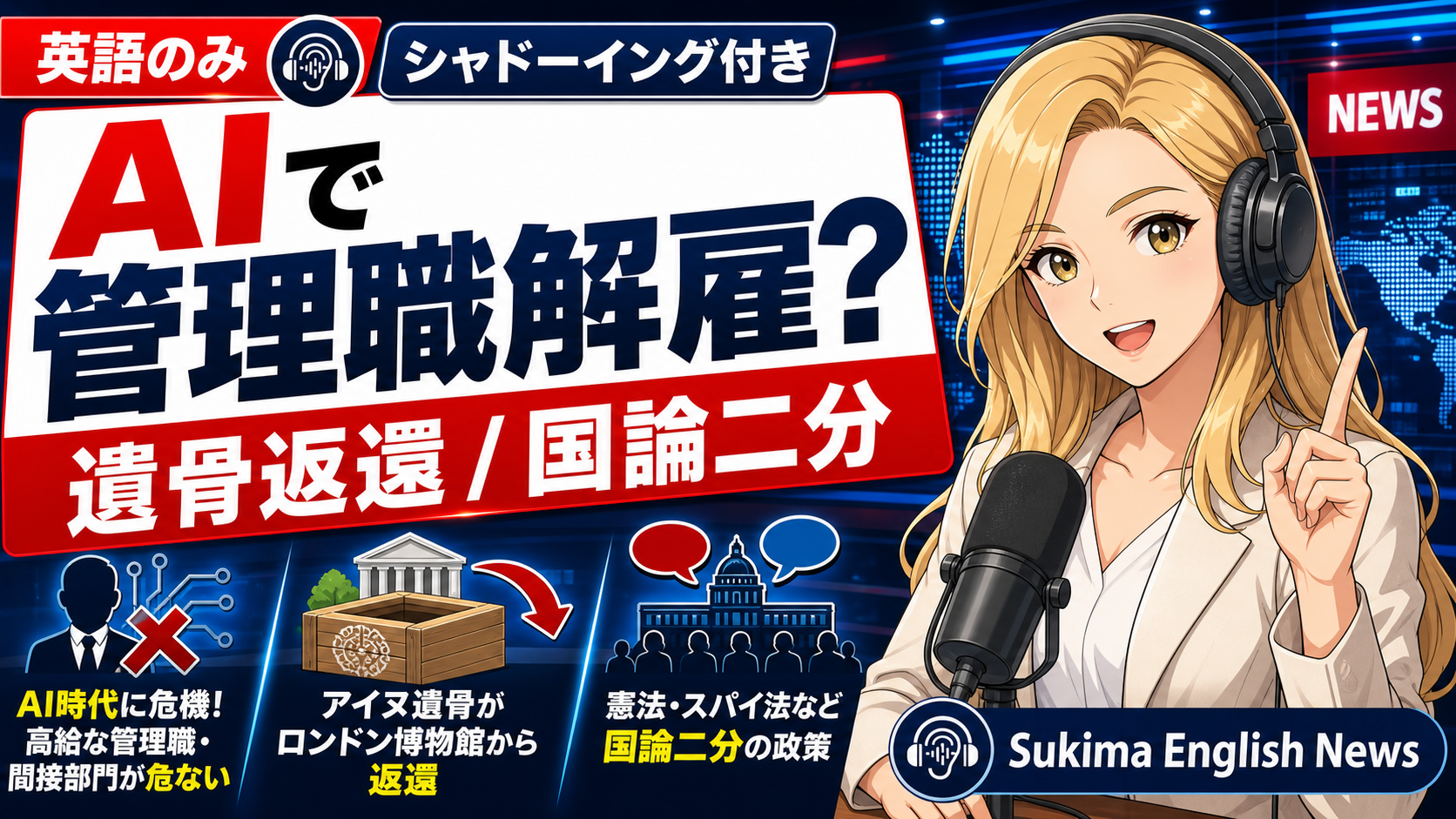
Today, we're looking at high-paying management jobs at risk in the AI era, the return of Ainu remains from London, and political debates over the constitution and spy laws. (今日は、AI時代に危うくなる高給の管理職、ロンドンからのアイヌの遺骨返還、そして憲法とスパイ防止法をめぐる政治論争を取り上げます。)
Plus, we'll help you learn some great English along the way! (もちろん、役立つ英語も一緒に学んでいきましょう!)
Our story today looks at how AI might be impacting jobs, specifically in indirect departments. It asks which roles are most at risk and what's needed to survive. (今日のニュースは、AIが仕事、特に間接部門にどんな影響を与えうるかを取り上げます。どの職種が最も危ないのか、そして生き残るには何が必要なのかを問いかける内容です。)
That sounds important, especially with AI's rapid development. What kind of indirect departments? (AIの急速な発展を考えると、重要な話ですね。間接部門というと、どんな部署ですか?)
Roles involving routine tasks and management. Gartner predicts over half of middle managers could be reduced by the end of 2026. (定型業務や管理業務に関わる職種です。ガートナーは、2026年末までに中間管理職の半数以上が削減される可能性があると予測しています。)
Half? Why can AI replace those roles? (半数ですか? なぜAIがその仕事を肩代わりできるんですか?)
AI can handle schedule management, performance reviews, and basic task supervision, which are core middle management duties. (AIは、スケジュール管理や業績評価、基本的な業務の監督をこなせます。これらはまさに中間管理職の中心的な仕事です。)
So, AI can do the administrative side. Does that mean all those jobs disappear? (つまり、AIは管理的な部分を担えるということですね。では、そうした仕事はすべてなくなってしまうんですか?)
Not necessarily. The article suggests a shift. Managers might become collaborators, strategists, or coaches. (必ずしもそうではありません。記事では、役割の変化が示唆されています。管理職は、協力者、戦略家、またはコーチになるかもしれません。)
So, the focus shifts from managing tasks to empowering people and using AI to enhance team capabilities? (つまり、業務の管理から、人の力を引き出し、AIでチームの能力を高めることへと重点が移るわけですね?)
Exactly. AI can free up time for managers to focus on human-centric activities like talent development. (その通りです。AIのおかげで管理職に時間の余裕が生まれ、人材育成のような人間ならではの活動に集中できるようになります。)
That makes sense. Leveraging AI for repetitive work so humans can focus on complex, creative, and interpersonal aspects. (なるほど。反復作業はAIに任せて、人間は複雑で創造的な仕事や、人と関わる部分に集中するわけですね。)
Right. The article also mentions manufacturing, where AI is showing results in productivity and knowledge transfer. (ええ。記事では製造業にも触れていて、そこではAIが生産性の向上や技術の継承で成果を上げています。)
What results in manufacturing? (製造業では、どんな成果が出ているんですか?)
AI is used for automated quality control and autonomous machinery control by learning from technicians. (AIが技術者から学習し、品質検査の自動化や機械の自律制御に使われています。)
Fascinating. It's not just cost-cutting, but improving quality and efficiency. (興味深いですね。単なるコスト削減だけでなく、品質と効率の向上にもつながるのですね。)
True. However, Japanese companies are slower in AI adoption compared to others. (そうです。しかし、日本の企業は他国に比べてAIの導入が遅れています。)
Is that across the board, or certain types of companies? (それは全体的な傾向ですか、それとも特定の種類の企業に限った話ですか?)
It seems particularly true for small and medium-sized enterprises, where AI decisions take longer. (特に中小企業では、AIの導入決定に時間がかかるため、その傾向が強いようです。)
Interesting. Despite slower adoption, do companies see the benefits? (興味深いですね。導入は遅れていますが、企業はメリットを感じていますか?)
Oh, definitely. Many expect AI to improve efficiency and help with labor shortages. Future use expectations are high. (ええ、間違いなく。多くの企業がAIによって効率が向上し、人手不足の解消に役立つと期待しています。将来的な活用への期待は高いです。)
So, potential is recognized. What about productivity data? How does Japan compare internationally? (つまり、可能性は認識されているわけですね。生産性のデータはどうですか? 日本は国際的に見てどうなんでしょう?)
Japan's labor productivity is a concern. In 2022, hourly added value was about 52.3 dollars, similar to Poland or Portugal. (日本の労働生産性は懸念事項です。2022年の時間当たり付加価値は約52.3ドルで、ポーランドやポルトガルと同程度でした。)
That sounds low. What position is Japan in among OECD countries? (それは低いですね。OECD諸国の中で日本は何位ですか?)
It was 30th among OECD members in 2023, a historical low. In 2024, hourly productivity was 28th out of 38 countries. (2023年にはOECD加盟国中30位で、過去最低でした。2024年には、38カ国中28位でした。)
Wow, a significant gap. And the actual use of generative AI? (わあ、大きな差ですね。そして、生成AIの実際の利用状況はどうですか?)
By fiscal year 2024, about 49.7% of companies had a generative AI use policy, an increase but still lower internationally. (2024年度には、企業の約49.7%が生成AIの利用ポリシーを持っており、増加傾向にはありますが、国際的にはまだ低い水準です。)
So, policy is one thing, but are employees using it? (とはいえ、ポリシーがあることと実際に使うことは別ですよね。従業員は使っているんですか?)
About 55.2% of companies reported using generative AI for some tasks in 2024. Again, lower internationally. (2024年には、企業の約55.2%が一部の業務で生成AIを使っていると答えました。こちらも国際的には低い水準です。)
What tasks are they using it for? (どのような業務に使っているのでしょうか?)
Most common is assisting with emails, meeting minutes, and document creation, at about 47.3%. (最も多いのは、メール作成、議事録作成、書類作成の補助で、約47.3%です。)
Practical application. AI can really streamline everyday office tasks. (実践的な活用ですね。AIは日常的な事務作業を本当に効率化できます。)
It can. As AI tools become widespread, many companies are considering reviewing staffing structures. (そうなんです。AIツールが普及するにつれて、多くの企業が人員体制の見直しを検討しています。)
So, efficiency gains leading to potential job changes are on the table for many businesses. (つまり、効率化による人員配置の変更が、多くの企業で検討されているということですね。)
Yes, 28.9% of companies are considering staffing adjustments due to efficiency gains from generative AI. (はい、生成AIによる効率化を受けて、人員配置の見直しを検討している企業は28.9%です。)
It seems the AI revolution is about a fundamental shift in how we work and manage organizations. (AI革命は、働き方や組織のあり方を根本的に変えるものになりそうですね。)
Absolutely. Individuals need to adapt and develop skills that complement AI, not compete. (まさに。個人は、AIと競合するのではなく、補完するスキルを身につけ、適応していく必要があります。)
Crucial takeaway. It's about understanding AI's capabilities and integrating it for better outcomes. (重要なポイントですね。AIの能力を理解し、うまく取り入れてより良い成果につなげることが大切なんですね。)
Precisely. For Japan, bridging the AI adoption and productivity gap will be vital for economic competitiveness. (その通りです。日本にとっては、AI導入と生産性のギャップを埋めることが、経済競争力のために不可欠になるでしょう。)
A challenge, but also an opportunity to rethink work. (課題ですが、働き方を見直す機会でもありますね。)
Indeed. AI's potential to enhance human capabilities is immense, but requires strategic implementation and adaptation. (ええ。AIが人間の能力を向上させる可能性は計り知れませんが、戦略的な導入と適応が必要です。)
So, AI will change indirect departments, especially middle management, shifting focus to collaborative, strategic human roles. (つまり、AIは間接部門、特に中間管理職を変え、人が担う役割を協働や戦略へとシフトさせるということですね。)
Right. Japan is behind in adoption, but potential benefits for efficiency and labor shortages are pushing companies forward. (そうです。日本は導入が遅れていますが、効率化や人手不足対策というメリットへの期待が、企業の背中を押しています。)
A complex but exciting future. (複雑ですが、エキサイティングな未来ですね。)
Now, let's turn to a story of cultural heritage and historical justice. (さて、次は文化遺産と歴史的正義に関するお話に移りましょう。)
Seven Ainu ethnic group remains, stored at London's Natural History Museum, have been returned to Japan. (ロンドンの自然史博物館に保管されていたアイヌ民族の遺骨7体が、日本に返還されました。)
Remains? That sounds sensitive. (遺骨ですか?それはデリケートな問題ですね。)
It is. A ceremony was held in London for their return. This marks the fourth case of remains being returned from overseas institutions. (そうなんです。ロンドンでは返還式が行われました。海外の機関からの遺骨返還は、今回で4例目です。)
And how long were some of these remains kept there? (これらの遺骨は、長いものでどれくらいそこに保管されていたんですか?)
Some have been stored for as long as 160 years. (最長で160年間保管されていたものもあります。)
Wow, 160 years. (160年もですか。)
The background involves historical research practices. In the late 19th and early 20th centuries, there was a surge in anthropological and medical studies. (背景には、当時の学術研究の慣習があります。19世紀後半から20世紀初頭にかけて、人類学や医学の研究が盛んに行われました。)
I see. So researchers were actively collecting human remains? (なるほど。それで、研究者たちは積極的に人骨を収集していたのですね?)
Yes, often through unauthorized excavations. This was driven by prevailing evolutionary theories. (はい、多くは無許可の発掘によるものでした。背景には、当時主流だった進化論がありました。)
And this wasn't just happening in Europe, but also in Japan? (そして、これはヨーロッパだけでなく、日本でも行われていたのですか?)
Exactly. Japanese researchers also collected Ainu remains, and some were sent overseas. (その通りです。日本の研究者もアイヌの遺骨を収集し、一部は海外に送られました。)
So it was a global trend for scientific research back then. (つまり当時は、科学研究のための世界的な流れだったんですね。)
For instance, remains at Edinburgh University were donated in 1913 by a British doctor. Some in Germany were exhumed from a Sapporo cemetery in 1879. (例えば、エディンバラ大学の遺骨は、1913年にイギリスの医師から寄贈されたものです。ドイツにあった遺骨の中には、1879年に札幌の墓地から掘り出されたものもあります。)
That must have been deeply distressing for the Ainu people. (アイヌの人々にとって、それは深く心を痛めることだったでしょうね。)
The Ainu have been requesting the return of these remains for a long time. (アイヌの人々は、これらの遺骨の返還を長い間求めてきました。)
Has there been any international framework supporting these requests? (こうした要求を支援する国際的な枠組みはありましたか?)
Yes, the UN Declaration on the Rights of Indigenous Peoples, adopted in 2007, mentions efforts for the repatriation of remains. (はい、2007年に採択された「先住民族の権利に関する国連宣言」には、遺骨の返還に向けた取り組みについての記述があります。)
That's a significant development. And Japan's government is now actively involved? (それは大きな進展ですね。そして、日本政府も今、積極的に関わっているのですか?)
They are. The 2019 Ainu Culture Promotion Act legally recognized the Ainu as an indigenous people. (はい、関わっています。2019年のアイヌ文化振興法で、アイヌの人々が先住民族であることが法的に認められました。)
So this repatriation is part of respecting their rights. (ということは、この遺骨の返還は、彼らの権利を尊重する一環なんですね。)
It is. This London museum return follows similar repatriations from Germany, Australia, and Edinburgh University. (そうです。このロンドンの博物館からの返還は、ドイツ、オーストラリア、エディンバラ大学からの同様の返還に続くものです。)
It's a part of a larger international movement then. (それは、より大きな国際的な動きの一部なんですね。)
Yes, and the returned remains are planned to be enshrined at a memorial facility in Hokkaido. (はい、そして返還された遺骨は、北海道にある慰霊施設に納骨される予定です。)
That sounds like a fitting resting place. (それはふさわしい安息の地になりそうですね。)
The facility is part of the National Ainu Museum and Park, also known as Upopoy. (その施設は、国立アイヌ博物館・公園、通称「ウポポイ」の一部です。)
Upopoy, the National Ainu Museum and Park. It's great that there's a dedicated space for this. (ウポポイ、国立アイヌ博物館・公園。こうした専用の場所があるのは素晴らしいですね。)
Now, regarding the Ainu population, obtaining precise statistics is challenging. (さて、アイヌの人口についてですが、正確な統計を得るのは難しいのです。)
Why is that? Is it because of how the data is collected? (なぜですか?それは、データの収集方法によるのですか?)
Partly. Surveys often rely on self-reporting, which can be incomplete. (それもあります。調査は自己申告に頼ることが多く、漏れが出ることがあるんです。)
So some people might not identify themselves as Ainu in such surveys? (ということは、そうした調査で、アイヌだと名乗らない人もいるということですか?)
That's right. A 2013 survey in Hokkaido recorded over 16,000 Ainu people. (その通りです。2013年の北海道の調査では、1万6000人以上のアイヌの人々が記録されました。)
That's a considerable number. (それはかなりの数ですね。)
However, this survey targeted those perceived as Ainu or living with them. The actual number is likely higher, including those who don't publicly identify as Ainu. (ただ、この調査の対象は、アイヌだと見なされる人や、アイヌと同居している人です。公にアイヌだと名乗らない人も含めれば、実際の数はもっと多いと考えられます。)
That makes sense. Identity is complex. (なるほど。アイデンティティは複雑ですからね。)
Some researchers estimate that perhaps 100,000 people might identify as having Ainu heritage. (研究者の中には、アイヌのルーツを持つ人が10万人ほどいるのではないかと推定する人もいます。)
A hundred thousand? That's a much larger figure than the survey indicated. (10万人ですか?それは、調査が示した数字よりもずっと多いですね。)
It is. And the total number of Ainu remains held in institutions is also hard to determine precisely. (はい。そして、施設に保管されているアイヌの遺骨の総数も、正確に特定するのは難しいのです。)
So, we're talking about more than just a few dozen, then? (ということは、数十体どころではないということですね?)
Based on past research and legal records, it's estimated there are at least a thousand, possibly more, Ainu remains in institutions worldwide. (過去の研究や法的な記録からすると、世界中の施設に少なくとも1000体、あるいはそれ以上のアイヌの遺骨があると推定されています。)
A thousand or more. That's a staggering number. (1000体以上ですか。驚くほどの数ですね。)
For example, Hokkaido University itself holds about a thousand Ainu remains. (例えば、北海道大学だけでも約1000体のアイヌの遺骨を保管しています。)
So this return from London, while significant, is just one piece of a much larger puzzle. (ということは、ロンドンからのこの返還は、重要ではありますが、もっと大きなパズルのほんの一部に過ぎないということですね。)
It is. It represents a step towards acknowledging past wrongs and respecting the rights of the Ainu people. (そうです。過去の過ちを認め、アイヌの人々の権利を尊重するための一歩です。)
And it highlights the importance of cultural heritage and repatriation for indigenous communities globally. (そして、世界中の先住民コミュニティにとって、文化遺産と遺骨返還がいかに大切かも浮き彫りにしていますね。)
Absolutely. It's a reminder of how historical research practices can have lasting impacts. (まったくその通りです。歴史研究のあり方が、どれほど長く影響を残しうるかを思い知らされます。)
And for Japanese people, it's about understanding and respecting a vital part of their nation's diverse history. (そして日本人にとっては、自国の多様な歴史の大切な一部を理解し、尊重することでもあります。)
That's a great point. It fosters reconciliation and a deeper appreciation for indigenous cultures. (大事な視点ですね。和解を促し、先住民の文化への理解も深まります。)
It's a sensitive issue, but a long process where each step matters. (非常にデリケートな問題ですが、一歩一歩が大切な長いプロセスです。)
This ongoing repatriation effort is crucial for healing and recognition. The seven sets of remains are now on their way to be respectfully placed at the memorial facility in Upopoy. (こうして続いている返還の取り組みは、傷を癒やし、存在を認めていくうえで欠かせません。7体の遺骨は、ウポポイの慰霊施設に丁重に納められるため、現在運ばれているところです。)
A place of remembrance and cultural preservation. It gives us a lot to think about regarding history and respect. (追悼と文化継承の場ですね。歴史や敬意について、いろいろと考えさせられます。)
Exactly. Understanding these issues helps us build a more inclusive future. (まさにその通りです。こうした問題を理解することが、より多様性を受け入れる未来づくりにつながります。)
A very important message to end this story on. (この話を締めくくるのにふさわしい、とても大切なメッセージですね。)
Let's shift gears to proposed constitutional amendments and a new espionage law in Japan. Prime Minister Takaichi is advocating for policies that could divide public opinion. (話題を変えて、日本の憲法改正案と新たなスパイ防止法の話です。高市首相は、世論を二分しかねない政策を推し進めています。)
What are the main points of contention regarding constitutional changes? (憲法改正に関して、主な論点は何でしょうか?)
The focus is on Article 9, the peace clause. Takaichi wants more constructive debate in the Diet's constitution research committees for early proposals. (焦点は、平和条項である第9条です。高市氏は、早期の改正案提示に向けて、国会の憲法調査会でより建設的な議論を求めています。)
So, potentially clarifying the role of the Self-Defense Forces, perhaps moving towards engaging in war? (ということは、自衛隊の役割を明確にし、もしかしたら戦争への関与に進むということでしょうか?)
Precisely. The discussion is about explicitly mentioning the SDF in the constitution, raising questions about Japan's security posture and its ability to "wage war." (その通りです。議論の中心は憲法に自衛隊を明記することで、日本の安全保障のあり方や「戦争を行う能力」をめぐって疑問が投げかけられています。)
And this espionage law? It seems related to national security. (スパイ防止法のほうはどうですか? 国家安全保障に関わるもののようですね。)
Takaichi stated the government intends to prevent "improper foreign interference." There was an attempt in 1985, but it failed due to concerns about civil liberties and press freedom. (高市氏は、政府として「不当な外国からの干渉」を防ぐ考えを示しました。1985年にも法案が出されましたが、市民の自由や報道の自由への懸念から頓挫しました。)
Didn't the 2013 Protection of Specified Secrets Act address this? (2013年の特定秘密保護法で、この問題には対応していたのではないですか?)
That act punishes leaks by officials, but not espionage itself. So, a dedicated espionage prevention law is still sought. (あの法律は公務員による情報漏洩を罰しますが、スパイ行為そのものは罰しません。そのため、専用のスパイ防止法が依然として求められています。)
The ruling coalition included this in their agreement. Are there strong opinions against these proposals? (与党はこれを連立合意に盛り込みました。こうした提案には強い反対意見もあるんですか?)
Definitely. The Japan Federation of Bar Associations warned past proposals could infringe upon human rights, emphasizing the need to prioritize their protection. (間違いなくあります。日本弁護士連合会は、過去の提案が人権を侵害する可能性があると警告し、その保護を優先する必要性を強調しました。)
How are these issues being discussed or perceived online? (こうした問題は、ネット上ではどう議論され、受け止められていますか?)
Social media shows considerable interest in these "opinion-dividing policies" Takaichi is pursuing. (ソーシャルメディアでは、高市氏が進めるこれらの「世論を二分する政策」にかなりの関心が寄せられています。)
Let's look at public opinion. What do surveys say about constitutional reform? (世論を見てみましょう。憲法改正について、調査では何が示されていますか?)
Recent polls show rising support for reform. A Yomiuri Shimbun survey in May 2026 found 57% in favor, and 71% believe discussions should be more active. (最近の世論調査では、改正への支持が高まっています。2026年5月の読売新聞の調査では、賛成が57%、議論はより活発に行われるべきだと考える人が71%でした。)
A substantial majority want discussion. But what about specifics, like Article 9? (大多数の人が議論を求めています。しかし、第9条のような具体的なことについてはどうでしょうか?)
It's more divided on Article 9. A Kyodo News poll indicated 50% see a need to revise it, while 48% do not. An Asahi Shimbun survey showed 47% for reform and 43% against. (第9条については、より意見が分かれています。共同通信の調査では、改正の必要性を感じている人が50%、そうでない人が48%でした。朝日新聞の調査では、改正賛成が47%、反対が43%でした。)
So, while people want discussion, there isn't a clear consensus on changing core articles. (つまり、人々は議論を求めているものの、核心条項の改正については明確なコンセンサスがないということですね。)
Exactly. The Asahi survey also revealed 62% feel there's no need to rush reform. For Article 9 specifically, 63% prefer to keep it as is. (まさにその通りです。朝日新聞の調査では、改正を急ぐ必要はないと感じている人が62%でした。特に第9条については、63%が現状維持を望んでいます。)
That's a significant contrast. Now, regarding the espionage law, what's the current situation? (かなり対照的ですね。では、スパイ防止法について、現在の状況はどうなっていますか?)
Currently, there's no law directly punishing espionage. The Specified Secrets Protection Act targets leaks, not spying. (現在、スパイ行為を直接罰する法律はありません。特定秘密保護法は情報漏洩を対象としており、スパイ行為は対象外です。)
Are businesses concerned about espionage? (企業はスパイ活動を懸念していますか?)
Yes, a Reuters survey in August 2025 indicated over 80% of business leaders believe an espionage prevention law should be considered. (はい、2025年8月のロイターの調査では、経営者の8割以上がスパイ防止法の制定を検討すべきだと考えていることが示されました。)
What are their concerns about implementing such a law? (そのような法律を施行することについて、彼らはどのような懸念を持っていますか?)
The article mentions concerns about its practical application and enforcement. (記事では、その実務的な適用と施行に関する懸念に触れています。)
With so many people using social media, these topics gain traction online. (これだけ多くの人がソーシャルメディアを使っていると、こうした話題がネットで注目を集めますね。)
Indeed. In 2022, ICT Research & Consulting reported over 82.7 million social media users in Japan, an 82% penetration rate. (そうですね。2022年には、ICT総研が日本のSNS利用者を8270万人以上、普及率82%と報告しています。)
That widespread use means these debates reach many people quickly. (それだけ普及していれば、こうした議論も多くの人にすぐ届きますね。)
It highlights how crucial these discussions are for Japan's future, impacting international relations and citizens' rights. (それだけ、国際関係や国民の権利にも関わるこれらの議論が、日本の将来にとって重要だということです。)
It will be important to watch how these debates evolve, especially with the potential for significant societal impact. (特に社会に大きな影響を与える可能性があるため、これらの議論がどのように展開していくかを見守ることが重要になるでしょう。)
今日のキーワード

Now let's look at some key vocabulary from today's stories. (さて、今日の記事からいくつかの重要な語彙を見ていきましょう。)
First, from our AI and jobs story, we have "indirect departments" . This refers to parts of a company that don't directly produce goods or services, like HR or finance. (まず、AIと仕事の話から、「間接部門」です。これは、人事や経理のように、直接的な製品やサービスを生み出さない会社の部署を指します。)
So, the support functions rather than the core business operations. (つまり、中核事業ではなく、サポート機能ということですね。)
Moving on to the Ainu remains story, a useful phrase is "historical research practices" . This refers to the methods used for studying the past, which can sometimes be controversial. (アイヌの遺骨の話に移りましょう。ここで役立つフレーズは「歴史研究の慣行」です。これは、過去を研究するために使われた方法を指し、時には論争の的となることもあります。)
Like how they collected artifacts or samples in the past. (昔、遺物やサンプルをどのように収集したか、といったことですね。)
Exactly. Now, for our third story on constitutional changes, let's look at "public opinion" . This means the collective beliefs and attitudes of a population on a particular issue. (その通りです。では、憲法改正に関する3つ目の記事では、「世論」を見てみましょう。これは、ある問題に対する人々の集合的な信念や態度を意味します。)
Right, like how people feel about the proposed laws. (そうですね、例えば、提案されている法律について人々がどう感じているか、といったことです。)
Back to the AI story, a key concept is "collaborators" . In this context, it means managers who work alongside their teams, offering guidance rather than just giving orders. (AIの話に戻りましょう。重要な概念は「協力者」です。この文脈では、指示を出すだけでなく、チームに寄り添って指導を提供するマネージャーを意味します。)
So, a more supportive and partnership-based role. (つまり、より協力的でパートナーシップに基づいた役割ということですね。)
From the Ainu remains story, we have "prevailing theories" . This refers to ideas or explanations that are widely accepted or dominant at a particular time. (アイヌの遺骨の話から、「主流の説」です。これは、ある時代に広く受け入れられている、あるいは支配的な考え方や説明を指します。)
Like the scientific beliefs popular in the late 19th century. (例えば、19世紀後半に流行した科学的な考え方のようなものです。)
And our last one, from the constitutional changes story, is "civil liberties" . These are the basic rights and freedoms that all citizens are entitled to, such as freedom of speech. (最後は憲法改正の話から、「市民的自由」です。これは、言論の自由など、すべての市民が当然に持つ基本的な権利と自由のことです。)
Things like protecting individual freedoms from government overreach. (政府の行き過ぎた介入から個人の自由を守る、といったことですね。)
シャドーイング用セクション
A: Now let's practice using some of the key vocabulary. (では、いくつかの重要な語彙を使って練習してみましょう。)
A: Managers might become collaborators in the AI era, offering guidance instead of just orders. (マネージャーはAI時代に、ただ指示を出すのではなく、指導を行う協力者になるかもしれない。)
B: Let's try that one more time at normal speed. (もう一度、普通のスピードでやってみましょう。)
A: Managers might become collaborators in the AI era, offering guidance instead of just orders. (マネージャーはAI時代に、ただ指示を出すのではなく、指導を行う協力者になるかもしれない。)
A: Support teams and finance departments are considered indirect departments that might be affected by AI. (サポートチームや経理部門は、AIの影響を受けうる間接部門とされている。)
B: Let's try that one more time at normal speed. (もう一度、普通のスピードでやってみましょう。)
A: Support teams and finance departments are considered indirect departments that might be affected by AI. (サポートチームや経理部門は、AIの影響を受けうる間接部門とされている。)
A: Historical research practices from the past sometimes led to the unauthorized collection of human remains. (昔の歴史研究のやり方では、人骨が許可なく収集されることもあった。)
B: Let's try that one more time at normal speed. (もう一度、普通のスピードでやってみましょう。)
A: Historical research practices from the past sometimes led to the unauthorized collection of human remains. (昔の歴史研究のやり方では、人骨が許可なく収集されることもあった。)
A: The prevailing theories of evolution at the time influenced scientific research methods. (当時主流だった進化論が、科学の研究方法に影響を与えた。)
B: Let's try that one more time at normal speed. (もう一度、普通のスピードでやってみましょう。)
A: The prevailing theories of evolution at the time influenced scientific research methods. (当時主流だった進化論が、科学の研究方法に影響を与えた。)
A: Many citizens expressed their public opinion on Article 9 in recent surveys. (最近の調査で、多くの市民が憲法9条について意見を示した。)
B: Let's try that one more time at normal speed. (もう一度、普通のスピードでやってみましょう。)
A: Many citizens expressed their public opinion on Article 9 in recent surveys. (最近の調査で、多くの市民が憲法9条について意見を示した。)
A: The government is taking steps to protect civil liberties for all citizens. (政府は、すべての市民の市民的自由を守る措置を講じている。)
B: Let's try that one more time at normal speed. (もう一度、普通のスピードでやってみましょう。)
A: The government is taking steps to protect civil liberties for all citizens. (政府は、すべての市民の市民的自由を守る措置を講じている。)
Today we covered AI's impact on middle management, the return of Ainu remains from London, and Japan's constitutional and espionage law debates. (今日は、AIが中間管理職に与える影響、ロンドンからのアイヌの遺骨の返還、そして日本の憲法やスパイ防止法に関する議論について取り上げました。)
Three very different stories, all shaping how we live and work. (私たちの生活や働き方に影響を与える、全く異なる3つの話でした。)
That's all for today's Sukima English News. (今日のスキマ英語ニュースはここまでです。)
We hope you enjoyed learning English with us. (私たちと一緒に英語を学ぶのを楽しんでいただけたなら幸いです。)
Remember to practice your English every day. (毎日英語を練習するのを忘れないでくださいね。)
Subscribe to our channel for more lessons! (ほかのレッスンも見たい方は、ぜひチャンネル登録をお願いします!)
See you next time! (また次回お会いしましょう!)

関連記事

【シャドーイング付き英語ニュース】詐欺増加!漫画で注意喚起?ちいかわ大ヒット! | リスニング強化
【シャドーイング付き英語ニュース】詐欺増加!漫画で注意喚起?ちいかわ大ヒット! | リスニング強化

【シャドーイング付き英語ニュース】幻のモグラ発見!韓国映画で唐田えりか?羽田 小型機新規則! | リスニング強化
【シャドーイング付き英語ニュース】幻のモグラ発見!韓国映画で唐田えりか?羽田 小型機新規則! | リスニング強化

【シャドーイング付き英語ニュース】お菓子値上げ!冷しカプヌ秒殺?不発弾騒動解決! | リスニング強化
【シャドーイング付き英語ニュース】お菓子値上げ!冷しカプヌ秒殺?不発弾騒動解決! | リスニング強化
【シャドーイング付き英語ニュース】AI新時代!熊本豪雨!電池発火注意? | リスニング強化
【シャドーイング付き英語ニュース】AI新時代!熊本豪雨!電池発火注意? | リスニング強化

【シャドーイング付き英語ニュース】サムスン新Galaxy!山陽新幹線新デザイン?新世界夏祭り! | リスニング強化
【シャドーイング付き英語ニュース】サムスン新Galaxy!山陽新幹線新デザイン?新世界夏祭り! | リスニング強化
【シャドーイング付き英語ニュース】教科書用語減!減税反対!副首都構想にNO? | リスニング強化
【シャドーイング付き英語ニュース】教科書用語減!減税反対!副首都構想にNO? | リスニング強化