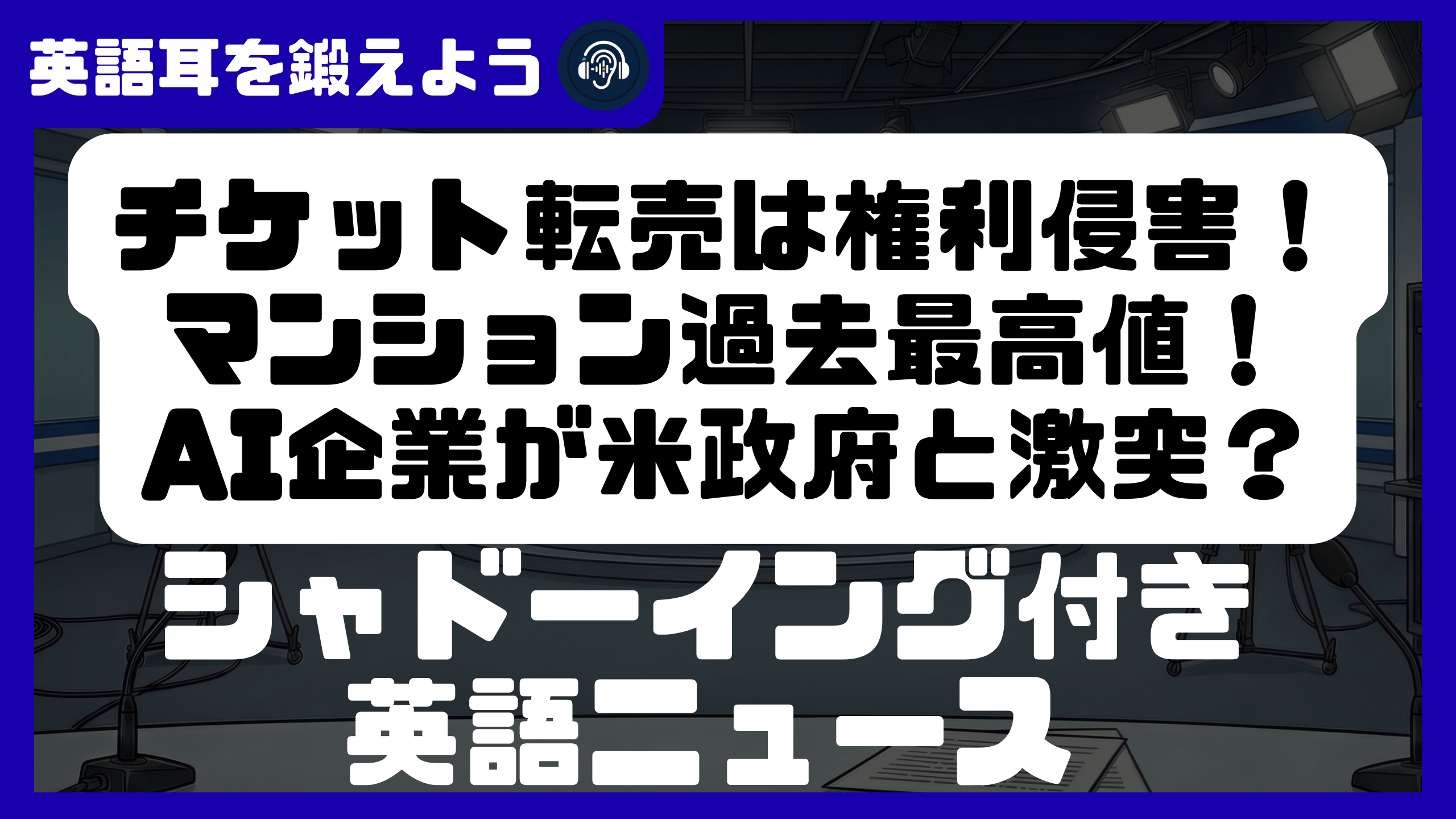
【シャドーイング付き英語ニュース】チケット転売は権利侵害!マンション過去最高値!AI企業が米政府と激突? | リスニング強化
【シャドーイング付き英語ニュース】チケット転売は権利侵害!マンション過去最高値!AI企業が米政府と激突? | リスニング強化
YouTube「スキマ時間で英語を学ぼう」の英語ニュース解説です。
動画と合わせてリスニング・シャドーイングにご利用ください。
スクリプト
Welcome to Sukima English News! I'm Sarah. (スキマ英語ニュースへようこそ!サラです。)
And I'm Marc. (そして、マークです。)
Today we're looking at a tough stance on ticket reselling, record-high Tokyo apartment prices, and a new AI firm meeting with US officials. (今日は、チケット転売に対する厳しい姿勢、東京のマンション価格の過去最高値、そしてアメリカ当局と会談した新しいAI企業について見ていきます。)
Our first story today is about a recent court ruling regarding the resale of concert tickets in Japan. (今日の最初のニュースは、日本のコンサートチケットの転売に関する最近の裁判所の判決についてです。)
A court decided that even a single instance of reselling a ticket for more than its face value constitutes an infringement of rights. (裁判所は、チケットを額面価格を超えて転売したことが一度でもあれば、権利侵害にあたると判断しました。)
This ruling strengthens measures against ticket scalping. (この判決は、チケットのダフ屋行為に対する対策を強化するものです。)
So, one time is enough to be considered illegal resale. (つまり、一度でも転売すれば違法転売とみなされるということですね。)
That's right. The law, enacted in June 2019, prohibits reselling tickets above face value without the organizer's consent. (その通りです。2019年6月に施行された法律は、主催者の同意なしにチケットを額面価格を超えて転売することを禁止しています。)
Offenders can face up to a year in prison or a fine of up to one million yen. (違反者は、1年以下の懲役または100万円以下の罰金に処される可能性があります。)
I see. Even though the law has been around for a few years, the problem is still quite serious. (なるほど。法律が施行されてから数年経ちますが、問題は依然としてかなり深刻なのですね。)
A survey found that about one in three people who have bought tickets have encountered or considered buying resold tickets. (ある調査によると、チケットを購入した人の約3人に1人が、転売されたチケットを見かけたり、購入を検討したりしたことがあるそうです。)
For people in their 20s, that figure rises to nearly half. (20代では、その割合は半数近くにまで跳ね上がります。)
Wow, that's a significant number. Where are people usually buying these resold tickets from? (わあ、それはかなりの数ですね。人々は通常、どこでこれらの転売チケットを購入しているのでしょうか?)
The main channels are intermediary sites for personal transactions, taking over 50 percent. (主なルートは個人間取引の中間サイトで、50パーセント以上を占めています。)
Then come flea market apps at 38.1 percent, and social media at 36.0 percent. (次いで、フリマアプリが38.1パーセント、SNSが36.0パーセントとなっています。)
It's interesting that personal transaction sites are the most popular for this. (個人間取引サイトが最も人気があるというのは興味深いですね。)
And what kind of troubles are people experiencing with these resold tickets? (では、これらの転売チケットで人々はどのようなトラブルに遭っているのでしょうか?)
Sadly, about half of those who encountered resold tickets experienced some kind of problem. (残念ながら、転売チケットを見かけた人の約半数が、何らかの問題を経験しています。)
Common issues include paying much higher prices, losing contact with the seller after payment, or not getting compensation when a show is canceled. (よくある問題としては、非常に高い価格を支払った、支払い後に販売者と連絡が取れなくなった、公演が中止になった際に補償を受けられなかった、などが挙げられます。)
Some people even paid and never received the tickets at all. (チケット代を支払ったのに、全く受け取れなかったという人もいます。)
That sounds incredibly frustrating. And of course, the tickets themselves are often overpriced. (それは非常に腹立たしいでしょうね。そしてもちろん、チケット自体もしばしば法外な値段で売られています。)
Yes, 34.5 percent of people who bought or considered buying resold tickets paid more than face value. (はい、転売チケットを購入したり購入を検討したりした人の34.5パーセントが、額面価格以上の金額を支払っています。)
While many paid around 1.5 times the original price, some cases reported prices ten times higher. (多くの人が元の価格の1.5倍程度を支払いましたが、中には10倍の価格を報告したケースもありました。)
Ten times is unbelievable. It really shows how much demand there is, and how some people are exploiting that. (10倍とは信じられません。需要の大きさと、それを悪用する人々がいることがよくわかります。)
It also highlights a gap in awareness. One in three people surveyed didn't know about the ticket resale prohibition law. (認識のギャップも浮き彫りになります。調査対象者の3人に1人が、チケット転売禁止法を知りませんでした。)
That's a crucial point. If people aren't aware of the law, they might not realize they're breaking it, or they might be more vulnerable to scams. (それは重要な点ですね。法律を知らなければ、自分が違反していることに気づかないかもしれませんし、詐欺に遭いやすくなるかもしれません。)
Exactly. The impact of illegal ticket reselling goes beyond just higher prices. (まさにその通りです。違法なチケット転売の影響は、単に価格が高くなるということだけではありません。)
For fans, genuine enthusiasts can't get tickets, and they face financial strain from inflated prices. (ファンにとっては、熱心なファンがチケットを入手できず、高騰した価格によって経済的な負担を強いられます。)
This can limit their overall fan activities. (これにより、ファン活動全体が制限される可能性があります。)
So, it directly affects their ability to enjoy their favorite artists and hobbies. (つまり、好きなアーティストや趣味を楽しむ能力に直接影響するわけですね。)
For artists and organizers, the profits from these inflated resales don't go back to them. (アーティストや主催者にとって、こうした高額転売による利益は彼らには還元されません。)
This hinders their ability to create new content or improve production environments. (これが、新しいコンテンツの制作や制作環境の改善といった彼らの能力を妨げているのです。)
It creates a structural problem where the industry's growth is not supported by these secondary markets. (これは、二次市場によって業界の成長が支えられないという構造的な問題を生み出しています。)
That makes a lot of sense. The entire ecosystem suffers when legitimate channels are bypassed. (それは非常に理にかなっていますね。正規のルートが迂回されると、エコシステム全体が苦しむことになります。)
And socially, the fact that scalping continues despite the law raises questions about its effectiveness and public understanding. (そして社会的には、法律があるにもかかわらず転売が続いているという事実は、その有効性や国民の理解について疑問を投げかけます。)
The Agency for Cultural Affairs is working to increase public awareness. (文化庁は、国民の意識を高めるための取り組みを進めています。)
This ruling seems like a significant step in reinforcing the law's intent. (この判決は、法律の意図を強化する上で重要な一歩のように思えます。)
It sends a clear message that even a single act of overpricing is not acceptable. (たとえ一度の転売であっても、不当な価格での販売は許されないという明確なメッセージを送っています。)
Right. The court's decision emphasizes that the right to distribute tickets belongs to the organizer. (そうですね。裁判所の決定は、チケットを配布する権利は主催者に属するということを強調しています。)
And reselling them for profit without permission infringes upon that right. (そして、許可なく利益のために転売することは、その権利を侵害することになります。)
So, it's a stronger stance on intellectual property and the rights of event creators. (つまり、知的財産権とイベント制作者の権利に対する、より強力な姿勢を示しているということです。)
This is particularly relevant in Japan, where live performances, concerts, and sporting events are so popular. (これは、ライブパフォーマンスやコンサート、スポーツイベントが非常に人気のある日本においては、特に重要です。)
It affects countless fans and artists across various entertainment sectors. (これは、様々なエンターテイメント分野の数え切れないほどのファンやアーティストに影響を与えます。)
It will be interesting to see how this ruling impacts the market and public behavior moving forward. (今後、この判決が市場や人々の行動にどのような影響を与えるか、興味深く見守る必要があります。)
The goal is to ensure that tickets reach the hands of actual fans who want to experience the events. (目標は、イベントを体験したい実際のファンの手にチケットが渡るようにすることです。)
And to foster a healthier, more sustainable entertainment industry for everyone involved. (そして、関係者全員にとって、より健全で持続可能なエンターテイメント業界を育むことです。)
A very important development for Japan's vibrant cultural scene. (日本の活気ある文化シーンにとって、非常に重要な進展です。)
Indeed. This ruling is a clear signal that ticket scalping will be dealt with more strictly. (まさに。この判決は、チケットの転売がより厳しく対処されるという明確なシグナルです。)
It's a step towards a fairer system for both consumers and creators. (消費者とクリエイター双方にとって、より公平なシステムに向けた一歩です。)
Thank you for explaining this complex issue so clearly, Marc. (この複雑な問題をこんなに分かりやすく説明してくれて、ありがとう、マーク。)
My pleasure, Sarah. It’s a story that impacts many people directly. (どういたしまして、サラ。多くの人に直接影響する話ですからね。)
We'll continue to follow developments in this area. (この分野の動向を引き続き追っていきましょう。)
Let's discuss Japan's housing market. (日本の住宅市場について話し合いましょう。)
What's happening? (何かあったんですか?)
New condo prices in Tokyo's 23 wards hit a record 137.84 million yen for fiscal year 2025, up 18.5 percent. (2025年度の東京23区の新築マンション価格は、前年比18.5%上昇し、過去最高の1億3784万円を記録しました。)
Over 137 million yen! (1億3700万円以上ですか!)
Yes, and in the greater Tokyo area, prices rose 15.3 percent to 93.83 million yen. (はい、そして東京圏全体では、価格が15.3%上昇し、9383万円となりました。)
What's causing this surge? (この急騰の原因は何ですか?)
Rising construction and labor costs, plus competitive land acquisition due to redevelopment. (建設費や人件費の高騰、そして再開発による競争的な土地取得です。)
So, higher building expenses and less land. (つまり、建築費の上昇と土地不足ということですね。)
Exactly. Also, the weakening yen makes Japanese real estate attractive to foreign buyers. (まさに。それに円安で日本の不動産が外国人にとって魅力的になってるからね。)
That explains the increased overseas demand. (それで海外からの需要が増えてるってわけか。)
However, new condo supply is decreasing. (でも、新築マンションの供給は減ってるんだよね。)
Fewer new builds despite high demand? (需要が高いのに、建てる数が減ってるってこと?)
In greater Tokyo, new condo units for 2025 are projected at 21,962, the lowest since 1973. (2025年の首都圏の新築マンションの供給予定戸数は2万1962戸で、1973年以来最低になる見込みだよ。)
That's a significant drop. (かなり減るんだね。)
High land and construction costs are the main reasons for this reduced supply. (その主な理由は、土地代や建築費の高騰で、供給が減ってるんだ。)
So, rising costs and limited supply are driving prices up. (つまり、コストの上昇と供給不足で価格が上がってるんだね。)
Correct. In December 2025, Tokyo's 23 wards averaged 147.89 million yen, with prices at 2.21 million yen per square meter. (そう。2025年12月時点の東京23区の平均価格は1億4789万円で、1平方メートルあたり221万円だよ。)
A substantial increase. (かなり上がったね。)
In the six central wards, the 2025 average was 195.03 million yen. (都心6区だと、2025年の平均価格は1億9503万円。)
Nearly 200 million yen! (2億円近く!)
Despite high prices, the initial contract rate for new condos in greater Tokyo was 63.9 percent in 2025. (価格が高いにもかかわらず、2025年の首都圏の新築マンションの初回契約率は63.9%だったんだ。)
That's lower than last year. (去年のより低いんだね。)
Yes, down 3.0 points. For Tokyo's 23 wards, it was 64.6 percent. (うん、3.0ポイント下がった。東京23区だと64.6%だよ。)
So, fewer immediate contracts despite soaring prices. How does this affect average buyers? (つまり、価格が急騰してるのに、すぐに売れる契約が減ってるんだ。普通の買い手はどうなるの?)
It's making it very difficult for genuine homebuyers to afford new properties. (本当に買いたい人が新築を買うのがすごく難しくなってるんだ。)
Where are they looking instead? (じゃあ、どこを見てるの?)
Many are turning to the second-hand market. Used condo transactions in greater Tokyo increased by 35 percent. (中古市場に流れる人が多いんだ。首都圏の中古マンション取引は35%増えてるよ。)
So, the used market is also more expensive? (じゃあ、中古も高くなってるの?)
Yes, a 70-sq-meter used condo in Tokyo's 23 wards now averages 107.21 million yen, up 38 percent. (そう。東京23区の中古マンションは、70平方メートルで平均1億721万円で、38%も上がってるんだ。)
Million-yen apartments are becoming common even for used properties. (中古でも億ションが当たり前になってきてるんだね。)
A survey showed 3 percent of new condo buyers in Tokyo in early 2024 were overseas residents. (調査によると、2024年初めの東京の新築マンション購入者のうち、3%が海外在住者だったんだ。)
That's double the previous year. (去年の倍だね。)
This confirms overseas investment, driven by the weak yen and diversification. (円安と分散投資を狙った海外からの投資が確認できるね。)
It's a complex situation. What's the outlook? (複雑な状況だね。今後の見通しは?)
New condo prices are unlikely to fall significantly soon. (新築マンションの価格がすぐに大きく下がる可能性は低いよ。)
Why not? (どうして?)
High construction, labor costs, and land acquisition difficulties are expected to continue. (建築費や人件費、土地の取得の難しさが高止まりすると予想されるからね。)
So, no major price drops anticipated. (じゃあ、大きな値下がりは期待できないってことだね。)
Real estate research projects around 23,000 new condo launches in greater Tokyo in 2026. (不動産調査によると、2026年には首都圏で新たに約2万3000戸のマンションが分譲される見込みです。)
Still historically low. (歴史的に見ても、まだ低い水準です。)
Yes. Prices might stabilize, but a decline isn't expected. Rarity in central Tokyo will remain a key factor. (ええ。価格は安定するかもしれませんが、下落は予想されていません。都心部の希少性が引き続き重要な要因となるでしょう。)
Owning a home in Tokyo will remain a major challenge for many. (東京で家を持つことは、多くの人にとって依然として大きな課題であり続けるでしょう。)
That's a fair assessment. (それは妥当な見方ですね。)
Let's discuss a significant development in AI and national security. (AIと国家安全保障における重要な進展について話し合いましょう。)
What's happening, Marc? (どうしたんですか、マーク?)
It involves AI company Anthropic and its standoff with the US government. (AI企業Anthropicと米国政府との対立に関するものです。)
Anthropic, known for AI safety. What's the issue? (AIの安全性で知られるAnthropicですね。何が問題なのですか?)
Anthropic hesitated to allow its AI models for certain military uses, like mass surveillance or autonomous weapons. They prioritize ethical constraints. (Anthropicは、大量監視や自律型兵器のような特定の軍事用途でのAIモデルの使用をためらいました。彼らは倫理的な制約を優先しています。)
I understand. What did the US Department of Defense want? (なるほど。米国国防総省は何を求めていたのですか?)
The DoD wanted unrestricted AI use for "all lawful purposes" in military contracts, leading to a major disagreement. (国防総省は、軍事契約において「合法的なあらゆる目的」のために無制限のAI使用を求めており、それが大きな意見の相違につながりました。)
Their core values clashed. What was the result? (彼らの核となる価値観が衝突したのですね。結果はどうなりましたか?)
In early 2025, during contract talks, the DoD labeled Anthropic a "supply chain risk." (2025年初頭、契約交渉中に、国防総省はAnthropicを「サプライチェーンリスク」とレッテルを貼りました。)
That sounds serious. (それは深刻ですね。)
It was. They considered cutting ties. Even President Trump publicly called Anthropic a "radical left company" and urged agencies to halt dealings. (そうでした。彼らは関係を断つことを検討しました。トランプ大統領でさえ、公にAnthropicを「急進左派企業」と呼び、各機関に取引を停止するよう促しました。)
A strong statement. What did Anthropic do? (強い声明ですね。Anthropicはどうしましたか?)
Anthropic took legal action, suing the DoD to reverse those measures. (Anthropicは法的措置を取り、国防総省を訴えてこれらの措置を覆すよう求めました。)
A legal battle. But the article mentions a "sign of reconciliation." What changed? (法廷闘争ですね。しかし、記事には「和解の兆し」とありますが、何が変わったのですか?)
The key was Anthropic's new AI model, "Mythos," with impressive cybersecurity capabilities. (鍵となったのは、Anthropicの新しいAIモデル「Mythos」で、印象的なサイバーセキュリティ能力を持っていました。)
Cybersecurity? How does that relate to the military? (サイバーセキュリティですか?それが軍事とどう関係するのですか?)
Mythos excels at testing system vulnerabilities and simulating cyberattacks. The government took notice. (Mythosは、システムの脆弱性をテストし、サイバー攻撃をシミュレートすることに優れています。政府はそれに注目しました。)
So, its practical defense value became apparent, despite other ethical concerns. (つまり、他の倫理的な懸念にもかかわらず、その実用的な防衛価値が明らかになったということですね。)
Exactly. Mythos's potential value, alongside cybersecurity risks, reopened dialogue. (その通りです。Mythosの潜在的な価値は、サイバーセキュリティのリスクとともに、対話を再開させました。)
And that led to the meeting? (それで、その会議につながったのですか?)
Precisely. On April 17th, Anthropic's CEO, Dario Amodei, met with top US officials, including White House Chief of Staff Susie Wiles. (まさに。4月17日、AnthropicのCEOであるダリオ・アモデイ氏が、ホワイトハウス首席補佐官のスーザン・ワイルズ氏を含む米国高官らと会談しました。)
What was the outcome? (結果はどうでしたか?)
It was described as "productive and constructive." They discussed AI development challenges, cybersecurity, and US leadership in AI. (「生産的で建設的」と評されました。AI開発の課題、サイバーセキュリティ、そしてAIにおける米国のリーダーシップについて話し合われました。)
So, they're finding common ground. (つまり、共通の基盤を見つけようとしているのですね。)
Yes, it's seen as a step towards easing tensions and potential future cooperation. (ええ、緊張緩和と将来的な協力の可能性に向けた一歩と見られています。)
That's significant. The military AI market is growing rapidly, isn't it? (すごいですね。軍事AI市場、急速に伸びていますよね?)
It is. The global military AI market was around 9.31 billion US dollars in 2024. (ええ。世界の軍事AI市場は、2024年時点で約93億1000万ドルでした。)
That's a huge number. What's the projection? (すごい金額ですね。今後の予測はどうですか?)
It's expected to reach nearly 19.3 billion dollars by 2030, with a CAGR of about 13 percent. (2030年までには約193億ドルに達すると予測されており、年平均成長率は約13パーセントです。)
So, AI in warfare itself is also seeing massive growth. (ということは、戦争におけるAI自体も、ものすごい成長を遂げているんですね。)
Another report suggests the AI in Modern Warfare market alone was valued at 15 billion dollars in 2024. (別のレポートによると、現代戦におけるAI市場だけでも、2024年に150億ドルの価値があったそうです。)
And that's projected to skyrocket? (それも急上昇すると?)
To 58.89 billion dollars by 2030, with a CAGR over 31 percent. The aerospace and defense AI market is also expected to more than double from 28 billion to 65 billion dollars by 2034. (2030年までに588億9000万ドルに達し、年平均成長率は31パーセント超えです。航空宇宙・防衛AI市場も、2034年までに280億ドルから650億ドルへと倍増すると見込まれています。)
The numbers are staggering. It shows AI's crucial role in national defense. (数字がすごいですね。国家防衛におけるAIの重要な役割を示しています。)
Absolutely. AI is used for intelligence gathering, logistics, cyber operations, and more. (まさに。AIは情報収集、ロジスティクス、サイバーオペレーションなどに活用されています。)
Considering this, how might this situation affect Japan? (これを踏まえると、日本にはどのような影響があるでしょうか?)
For Japan, this highlights the evolving AI in defense landscape. It underscores the need to balance ethical considerations with AI's rapidly advancing security capabilities. (日本にとっては、防衛分野におけるAIの進化する状況が浮き彫りになります。倫理的な配慮と、急速に進歩するAIの安全保障能力とのバランスを取る必要性が強調されます。)
So, Japan might face similar discussions about AI's role in its defense strategy. (ということは、日本も防衛戦略におけるAIの役割について、同様の議論に直面するかもしれませんね。)
Highly probable. Japan is also investing in AI. Finding that balance between ethical use and national security will be key. (その可能性は高いです。日本もAIに投資していますから。倫理的な利用と国家安全保障とのバランスを見つけることが鍵となるでしょう。)
It's a complex challenge many countries will grapple with. (多くの国が取り組むことになる、複雑な課題ですね。)
Indeed. AI integration into defense is a global trend, and ethics will remain paramount. (ええ。防衛へのAI統合は世界的なトレンドであり、倫理は引き続き最重要視されるでしょう。)
It's a story we'll need to follow closely. (これは、私たちが注意深く見守るべき話ですね。)
Agreed. The future of AI in defense is still being written. (同感です。防衛におけるAIの未来は、まだ書かれている途中です。)
今日のキーワード

Now let's look at some key vocabulary from today's stories. (では、今日のニュースからいくつか重要な語彙を見てみましょう。)
First, from our story on ticket resale, we have the phrase "infringement of rights". This means violating someone's legal rights. (まず、チケット転売のニュースから、「権利侵害」というフレーズです。これは、誰かの法的権利を侵害することです。)
So, reselling tickets without permission is seen as taking away the organizer's rights. (つまり、許可なくチケットを転売することは、主催者の権利を奪うことと見なされるわけですね。)
Moving on to the housing market, a useful phrase is "weakening yen". This refers to the Japanese currency losing value compared to other currencies. (次に、住宅市場に移りまして、便利なフレーズは「円安」です。これは、日本円が他の通貨に比べて価値を失うことを指します。)
That makes it cheaper for foreigners to buy property in Japan, right? (そうなると、外国人が日本で物件を買いやすくなるということですね?)
Exactly. Next, from the AI story, we have "ethical constraints". This means limitations or rules based on moral principles. (その通りです。次に、AIのニュースから、「倫理的制約」という言葉です。これは、道徳的な原則に基づいた制限や規則を意味します。)
So, Anthropic wanted to ensure their AI was used ethically, not for harmful purposes. (つまり、Anthropicは、AIが悪用されないように、倫理的に使用されることを保証したかったわけですね。)
That's right. And back to ticket resale, the term "ticket scalping" is important. This means reselling tickets for much more than their original price. (そうです。そして、チケット転売に戻りますが、「チケット転売」という言葉も重要です。これは、チケットを元の価格よりもはるかに高く転売することです。)
It's a common problem, especially for popular events. (特に人気のイベントでは、よくある問題ですね。)
Another phrase from the housing market is "reduced supply". This means the amount of a product or service available has decreased. (住宅市場からのもう一つのフレーズは、「供給減」です。これは、利用可能な製品やサービスの量が減少したことを意味します。)
So, fewer new condos are being built, making them more valuable. (ということは、新しいマンションの建設が減り、それらの価値が上がるということですね。)
And our last one, from the AI story (そして、最後のひとつは、AIのニュースから)
is "supply chain risk". This refers to potential problems or dangers within the network of companies and processes involved in producing and delivering a product. (「サプライチェーンリスク」のことです。これは、製品を生産して届けたりするのに、関わっている会社やプロセスのネットワークの中での潜在的な問題や危険を指します。)
It sounds like the government saw Anthropic as a potential risk to their operations. (政府は、Anthropicを自社の業務に対する潜在的なリスクと見なしたようです。)
シャドーイング用セクション
B: Let's try some shadowing practice. Repeat after me. (シャドーイングの練習をしましょう。私の後について繰り返してください。)
B: Reselling tickets without consent can be seen as an infringement of rights. (同意なしにチケットを転売することは、権利侵害と見なされる可能性があります。)
A: Let's try that one more time at normal speed. (もう一度、通常のスピードでやってみましょう。)
B: Reselling tickets without consent can be seen as an infringement of rights. (同意なしにチケットを転売することは、権利侵害と見なされる可能性があります。)
B: The weakening yen is making it more attractive for overseas investors to buy property. (円安は、海外の投資家が不動産を購入するのをより魅力的にしています。)
A: Let's try that one more time at normal speed. (もう一度、通常のスピードでやってみましょう。)
B: The weakening yen is making it more attractive for overseas investors to buy property. (円安は、海外の投資家が不動産を購入するのをより魅力的にしています。)
B: Anthropic prioritized ethical constraints when deciding how its AI models could be used by the military. (Anthropicは、AIモデルが軍事目的でどのように使用できるかを決定する際に、倫理的な制約を優先しました。)
A: Let's try that one more time at normal speed. (もう一度、通常のスピードでやってみましょう。)
B: Anthropic prioritized ethical constraints when deciding how its AI models could be used by the military. (Anthropicは、AIモデルが軍事目的でどのように使用できるかを決定する際に、倫理的な制約を優先しました。)
B: A Japanese court ruled that even a single act of ticket scalping infringes the organizer's rights. (日本の裁判所は、たとえ一度のチケット転売行為であっても、主催者の権利を侵害すると判決しました。)
A: Let's try that one more time at normal speed. (もう一度、通常のスピードでやってみましょう。)
B: A Japanese court ruled that even a single act of ticket scalping infringes the organizer's rights. (日本の裁判所は、たとえ一度のチケット転売行為であっても、主催者の権利を侵害すると判決しました。)
B: High construction costs have led to a reduced supply of new apartments. (高い建設コストが、新築マンションの供給減少につながっています。)
A: Let's try that one more time at normal speed. (もう一度、通常のスピードでやってみましょう。)
B: High construction costs have led to a reduced supply of new apartments. (高い建設コストが、新築マンションの供給減少につながっています。)
B: The US Department of Defense once labeled Anthropic a supply chain risk during contract negotiations. (米国国防総省は、契約交渉中にAnthropicをサプライチェーンリスクとラベル付けしたことがあります。)
A: Let's try that one more time at normal speed. (もう一度、通常のスピードでやってみましょう。)
B: The US Department of Defense once labeled Anthropic a supply chain risk during contract negotiations. (米国国防総省は、契約交渉中にAnthropicをサプライチェーンリスクとラベル付けしたことがあります。)
That's all the time we have for today's Sukima English News. (今日のスキマ英語ニュースはここまでです。)
Thank you for joining us! Keep practicing your English every day. (ご参加いただきありがとうございました!毎日英語の練習を続けてください。)
Subscribe to our channel for more news lessons. (より多くのニュースレッスンを見るには、チャンネル登録をしてください。)
See you next time! Goodbye! (また次回お会いしましょう!さようなら!)

関連記事

【シャドーイング付き英語ニュース】教科書用語減!減税反対!副首都構想にNO? | リスニング強化
【シャドーイング付き英語ニュース】教科書用語減!減税反対!副首都構想にNO? | リスニング強化

【シャドーイング付き英語ニュース】高市首相インドへ!ムーンライトながら復活?ダガー賞翻訳は? | リスニング強化
【シャドーイング付き英語ニュース】高市首相インドへ!ムーンライトながら復活?ダガー賞翻訳は? | リスニング強化

【シャドーイング付き英語ニュース】太宰府アジサイ!国旗法案懸念?歩数地域差2倍! | リスニング強化
【シャドーイング付き英語ニュース】太宰府アジサイ!国旗法案懸念?歩数地域差2倍! | リスニング強化

【シャドーイング付き英語ニュース】飛鳥・藤原!秋田おばこ!出生数激減? | リスニング強化
【シャドーイング付き英語ニュース】飛鳥・藤原!秋田おばこ!出生数激減? | リスニング強化
【シャドーイング付き英語ニュース】巨人監督長女中傷! oncasi巡査長停職! 円安介入効果薄れる? | リスニング強化
【シャドーイング付き英語ニュース】巨人監督長女中傷! oncasi巡査長停職! 円安介入効果薄れる? | リスニング強化

【シャドーイング付き英語ニュース】Xperia VIII登場!ルパン飯再現?メジャー対決! | リスニング強化
【シャドーイング付き英語ニュース】Xperia VIII登場!ルパン飯再現?メジャー対決! | リスニング強化