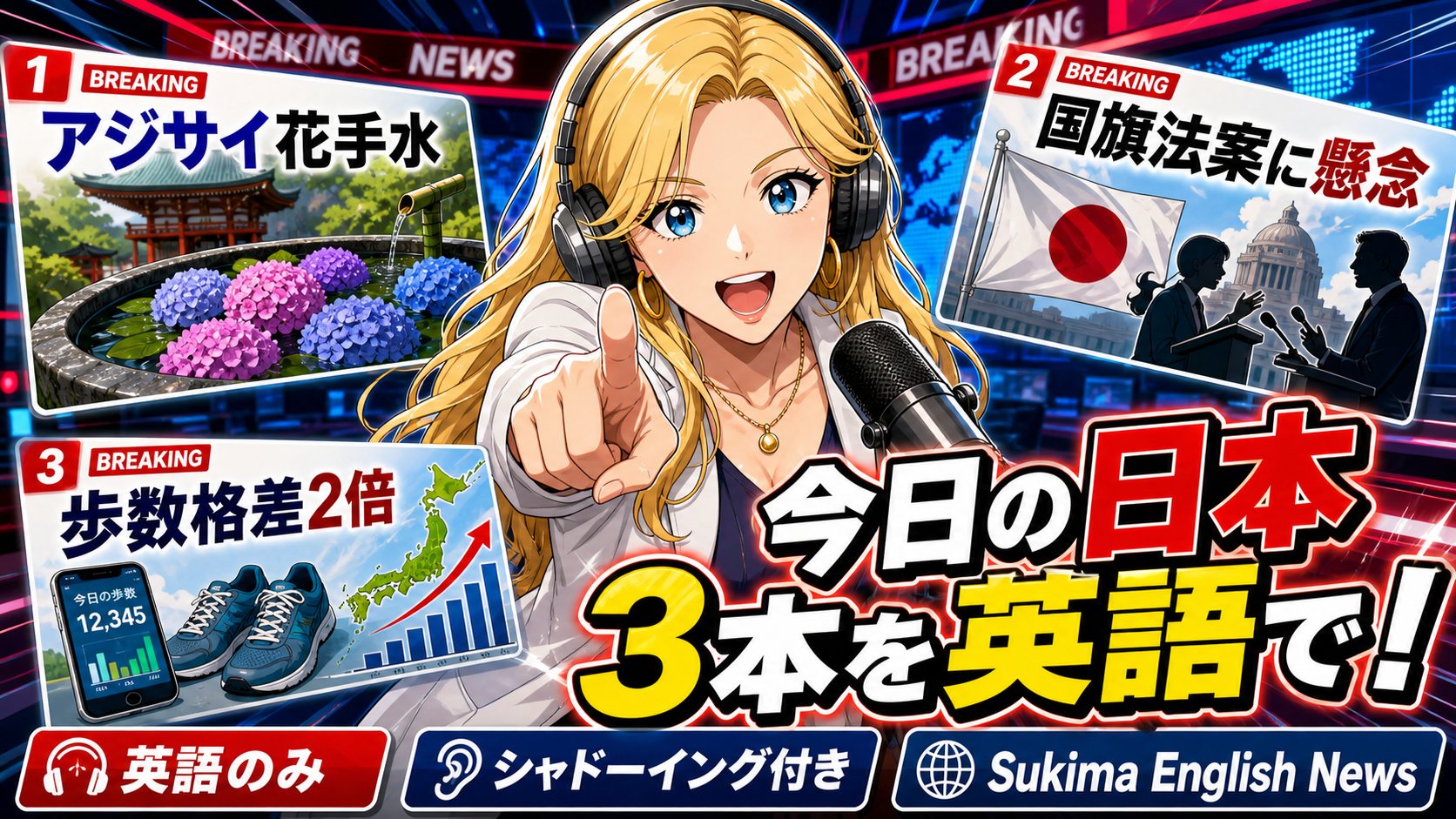
【シャドーイング付き英語ニュース】太宰府アジサイ!国旗法案懸念?歩数地域差2倍! | リスニング強化
【シャドーイング付き英語ニュース】太宰府アジサイ!国旗法案懸念?歩数地域差2倍! | リスニング強化
YouTube「スキマ時間で英語を学ぼう」の英語ニュース解説です。
動画と合わせてリスニング・シャドーイングにご利用ください。
スクリプト
Welcome to Sukima English News! I'm Sarah. (スキマ英語ニュースへようこそ!サラです。)
And I'm Marc. (マークです。)
Today, we'll explore a beautiful flower display at a shrine, a debate over a flag desecration bill, and surprising differences in daily steps across Japan. (今日は、神社の美しい花の展示、国旗損壊法案をめぐる議論、そして地域によって意外なほど違う1日の歩数を取り上げます。)
Sounds like a fascinating mix! (面白い組み合わせですね!)
Our story takes us to Dazaifu Tenmangu Shrine, where a new display of hydrangea flowers in the chozuya, the purification fountain, has captured attention. (最初の話題は太宰府天満宮です。清めの水場である手水舎で始まったアジサイの新しい展示が、注目を集めています。)
Hydrangea flowers, floating? That sounds unique. What is "Hana Chozu," or flower chozu? (アジサイの花が浮かんでいるんですか?ユニークですね。「花手水」とは、一体何なのでしょうか?)
Hana Chozu floats seasonal flowers in the chozuya's water basin, offering visitors a sense of healing and color. (花手水とは、手水舎の水盤に季節の花を浮かべ、訪れる人に癒やしと彩りを提供するものです。)
And it started at Dazaifu Tenmangu around 2020, right? Was it a pandemic response? (そして、これは2020年頃に太宰府天満宮で始まったんですよね?パンデミック対策だったのでしょうか?)
Correct. With the pandemic, ladles were removed for hygiene. This was a creative way to use that space. (そうです。パンデミックで、衛生面からひしゃくが撤去されました。その空いたスペースを工夫して生かしたのが、この花手水なんです。)
A clever idea. Hydrangeas are popular during the rainy season. (いいアイデアですね。アジサイは梅雨の時期に人気がありますし。)
This initiative helps attract visitors and revitalize the area, which struggled with fewer tourists. (この取り組みは、観光客の減少に苦しんでいた地域に人を呼び込み、活気を取り戻すのに役立っています。)
Dazaifu is known for "overtourism," but the pandemic must have hit hard. (太宰府は「オーバーツーリズム」で知られていますが、パンデミックは大きな打撃だったでしょうね。)
Tourist numbers plummeted, dropping by about 90% in 2020. (観光客数は激減し、2020年には約90%も落ち込みました。)
Wow, 90 percent. That's a huge decrease. (わあ、90パーセントですか。それはかなりの減少ですね。)
Yes. While numbers are recovering since late 2022, they seek new ways to attract visitors. (ええ。2022年後半から回復してきていますが、地元では新たな誘客の方法を模索しています。)
A visually appealing display like this would be popular on social media. (こういう見た目に美しい展示は、SNSでも人気が出そうですね。)
Exactly. It offers a fresh, healing experience for modern travelers. (その通りです。現代の旅行者に、新鮮で癒やされる体験を提供しています。)
Let's look at data. You mentioned tourist numbers dropped drastically. What's the situation now? (データを見てみましょう。観光客数が激減したとおっしゃいましたね。現在の状況はどうですか?)
In 2017, Dazaifu city welcomed over 10 million tourists. By 2020, that fell to around 2 million. (2017年には、太宰府市には1000万人以上の観光客が訪れていました。2020年には、それが約200万人にまで減少しました。)
That's a significant drop. (それは大きな落ち込みですね。)
By fiscal year 2023, it recovered to about 8.81 million visitors. Still over 100 times the city's population of 70,000. (2023年度には、約881万人まで回復しました。それでも、市の人口7万人の100倍以上です。)
So, while recovering, demand is still high. Are visitors spread out? (つまり、回復途上とはいえ、需要は依然として高いわけですね。観光客は年間を通じて分散しているんですか?)
Not entirely. January sees a spike for New Year's visits. Other months average 500,000 to 600,000 visitors. (そうでもありません。1月は初詣で観光客が急増します。ほかの月は、平均で50万から60万人ほどです。)
Makes sense, with Hatsumode. What about the flower market? Is it growing? (初詣がありますから、納得です。花の市場はどうですか? 伸びているんでしょうか?)
The global flower market is projected to grow, reaching 1.61 billion US dollars by 2025 and 2.12 billion by 2030. (世界の花市場は成長が見込まれており、2025年までに16億1000万ドル、2030年までに21億2000万ドルに達すると予測されています。)
Good news for the industry. (業界にとっては朗報ですね。)
However, domestic cut flower production has declined since a 1996 peak. (しかし、国内の切り花生産は、1996年のピーク以降減少しています。)
So, with growing demand, production shrinks. An interesting contrast. (つまり、需要は伸びているのに、生産は縮小しているわけですね。興味深い対照です。)
It is. But increased demand for flower chozu and event flower stands support the market. (ええ。しかし、花手水やイベント用スタンド花の需要増加が市場を支えています。)
Where do hydrangeas come from? Are they domestically grown? (アジサイはどこで作られているんですか? 国産なんでしょうか?)
Aichi Prefecture is Japan's top hydrangea producer, accounting for 57 to 64 percent of the domestic share. (愛知県は国内シェアの57〜64%を占める、日本一のアジサイの産地です。)
So, Dazaifu likely sources many flowers locally. (ということは、太宰府でも国内産の花を多く仕入れているのでしょうね。)
That's a reasonable assumption. Nationwide, there are about 80,000 shrines and 77,000 temples. (それはもっともな推測です。全国には、約8万の神社と7万7000の寺院があります。)
That's a lot of religious sites. (宗教施設がたくさんあるんですね。)
Many face challenges due to declining birthrates and fewer visitors, worsened by the pandemic. (少子化や参拝者の減少に、コロナ禍が追い打ちをかけ、多くの寺社が苦境に立たされています。)
So, these displays are vital for their survival. (つまり、こうした展示は寺社の存続にとって欠かせないんですね。)
Precisely. For shrines like Dazaifu Tenmangu, these initiatives enhance visitor satisfaction and draw people. (まさにその通りです。太宰府天満宮のような神社にとっては、こうした取り組みは参拝客の満足度を高め、人を呼び込むことにつながります。)
It's a great example of cultural sites adapting to challenges and expectations. (文化的な場所が、課題や人々の期待に合わせて変化している好例ですね。)
And it shows how a simple, beautiful idea can bring joy and economic benefit, especially in recovery. (そして、シンプルで美しいアイデアが、特に復興期において、喜びと経済効果をもたらすことを示しています。)
It truly does. A reminder of nature's power and thoughtful presentation to heal and reconnect communities. (本当にそうですね。自然の力と心を込めた演出には、人を癒やし、地域のつながりを取り戻す力があると改めて感じます。)
A bill to criminalize the damage of Japan's national flag is being debated. (国旗を傷つける行為を犯罪として罰する法案が議論されています。)
Three parties—the Constitutional Democratic Party, Komeito, and the Democratic Party for the People—have received explanations from the Liberal Democratic Party. (立憲民主党、公明党、国民民主党の3党が、自民党から説明を受けました。)
So, they're discussing penalties and potential concerns about freedom of expression. (ということは、罰則や、表現の自由をめぐる懸念について話し合っているわけですね。)
Exactly. This issue has a history. Back in 2012, the LDP proposed a similar bill, but it didn't pass. (その通りです。この問題には歴史があります。2012年にも自民党が同様の法案を提案しましたが、成立しませんでした。)
So, it's not a new idea. What reignited the discussion? (新しい発想ではないんですね。議論が再燃したきっかけは何ですか?)
The LDP has continued to discuss it internally. In 2021, a group requested the submission of such a bill. (自民党は党内で議論を続けてきました。2021年には、党内のグループがこうした法案の提出を求めました。)
And it seems to have gained momentum more recently. (そして最近になって、さらに勢いを増したようですね。)
Yes. In October 2025, the LDP and the Japan Innovation Party agreed to establish a "National Flag Damage Crime" law in the 2026 ordinary session of the Diet. (はい。2025年10月には、自民党と日本維新の会が、2026年の通常国会での「国旗損壊罪」の制定で合意しました。)
That's a specific timeline. When was the bill actually submitted? (具体的な時期まで決まっていたんですね。実際に法案が提出されたのはいつですか?)
On June 16, 2026, four parties—the LDP, Japan Innovation Party, Democratic Party for the People, and Sanseito—jointly submitted a bill to the House of Representatives. (2026年6月16日、自民党、日本維新の会、国民民主党、参政党の4党が共同で衆議院に法案を提出しました。)
What exactly does this bill propose to penalize? (この法案では、具体的にどのような行為を罰しようとしているのですか?)
It proposes punishment for anyone who publicly damages, removes, or defaces the Japanese flag in a manner that causes significant offense or disgust to others. (他人に著しい不快感や嫌悪感を与えるような方法で、公然と日本国旗を損傷、除去、または汚損した者を罰することを提案しています。)
That phrasing, "significant offense or disgust," sounds open to interpretation. (「著しい不快感や嫌悪感」という表現は、解釈の余地がありそうですね。)
It does. Initially, the bill also considered penalizing the posting of images of the damage on social media afterward. (そうですね。当初は、損壊の様子を撮った画像を後からSNSに投稿する行為も、罰則の対象として検討されていました。)
But that part was removed? (でも、その部分は削除されたんですか?)
Yes, following a point raised by the Democratic Party for the People. However, live streaming the act of damage would still be prohibited. (はい、国民民主党からの指摘を受けてです。ただし、損傷行為のライブ配信は引き続き禁止されるとのことです。)
That's an interesting distinction. What's the reasoning behind this push for a new law? (興味深い線引きですね。新しい法律を求める背景には、どんな理由があるんですか?)
One argument is the absence of a specific law against damaging one's own national flag, while a law exists for damaging foreign national emblems. (一つの論点として、外国の国章などを損傷した場合の法律は存在するのに、自国の国旗を損傷した場合の具体的な法律がないことが挙げられます。)
Right, the "Foreign National Emblem Damage Crime." (ええ、「外国国章損壊罪」ですね。)
This existing law, Article 92 of the Penal Code, applies when foreign flags or emblems are damaged with the intent to insult them (この既存の法律、刑法92条は、外国の国旗や国章を侮辱する目的で損壊した場合に適用されます。)
leading to up to two years of imprisonment or a fine of up to 200,000 yen. (刑罰は、2年以下の拘禁刑または20万円以下の罰金です。)
And how is that existing law interpreted? (その既存の法律は、どう解釈されているんですか?)
It's understood to protect Japan's diplomatic interests, rather than the honor of the foreign flag itself. (外国の国旗そのものの名誉というよりは、日本の外交上の利益を守るものだと理解されています。)
So, the proponents of the new bill want to protect the national flag's honor directly. (つまり、新しい法案を推進する人たちは、国旗の名誉を直接守りたいわけですね。)
Precisely. They also emphasize protecting the feelings of citizens who cherish the flag. (そうです。そして、国旗を大切に思う国民の感情を守ることも強調しています。)
But on the other side, there are significant concerns. (しかし、一方で、懸念も大きいんですよね。)
Absolutely. The Japan Federation of Bar Associations, several other bar associations, and constitutional scholars have expressed strong opposition. (その通りです。日本弁護士連合会や他のいくつかの弁護士会、そして憲法学者が強い反対を表明しています。)
What are their main worries? (彼らの主な懸念は何ですか?)
Their primary concerns revolve around potential infringements on freedom of expression and freedom of thought and conscience. (主な懸念は、表現の自由や、思想・良心の自由が侵害されるおそれがあることです。)
Those are fundamental rights. How does the proposed law potentially conflict with them? (どれも基本的な権利ですよね。提案されている法律は、それらとどうぶつかりうるんですか?)
Critics argue that the law could unduly restrict freedom of expression and lead to arbitrary application. (批判者たちは、その法律が表現の自由を不当に制限し、恣意的な適用につながる可能性があると主張しています。)
Arbitrary application... meaning it could be used unfairly? (恣意的な適用、つまり不公平に使われるおそれがあるということですか?)
That's the fear. They also worry about a "chilling effect," where people might self-censor for fear of violating the law. (そこが懸念されている点です。また、法律に触れるのを恐れて人々が自己規制してしまう「萎縮効果」も心配されています。)
Especially in artistic or protest contexts, I imagine. (特に芸術や抗議活動の文脈では、そうなるんでしょうね。)
Indeed. For instance, in the US, even burning the flag can be protected symbolic speech. (ええ。例えば、アメリカでは、国旗を燃やすことさえ、保護されるべき象徴的な言論になり得ます。)
That's a stark contrast to how some other countries handle it. (ほかの一部の国の扱い方とは、まったく対照的ですね。)
True. Countries like Germany and France have laws against damaging their national flags, but they must carefully balance this with freedom of expression. (そうですね。ドイツやフランスのような国には、国旗を損傷することに対する法律がありますが、表現の自由との慎重なバランスを取らなければなりません。)
And countries like South Korea and China, which prioritize national dignity, might have stricter enforcement. (そして、国家の威厳を優先する韓国や中国のような国は、より厳しい執行をしているかもしれませんね。)
That's generally the case. The bill proposes penalties of up to two years in prison or a 200,000 yen fine. (一般的にはそうですね。法案では、2年以下の拘禁刑または20万円以下の罰金が提案されています。)
And the focus is on the objective act of damage, not necessarily the intent? (そして、意図というよりは、客観的な損傷行為に焦点が当てられているんですか?)
The bill states it will be judged objectively. However, a provision for reviewing the law three years after its enforcement is included in the supplementary provisions. (法案では、客観的に判断されるとされています。ただし、施行後3年で見直しを行う規定が附則に盛り込まれています。)
That suggests they acknowledge the need for future adjustments. (それは、将来的な調整の必要性を認識していることを示唆していますね。)
It does. The debate highlights a tension between national symbols and individual freedoms. (そうですね。この議論は、国家の象徴と個人の自由との間の緊張関係を浮き彫りにしています。)
It’s a complex issue with deep implications for Japanese society. (日本社会に深い影響を与える、複雑な問題ですね。)
Let's shift gears to a fascinating study about our daily lives in Japan. (では、日本での私たちの日常生活に関する、興味深い研究の話に移りましょう。)
Researchers from the University of Tokyo analyzed smartphone data from about 1.5 million people. (東京大学の研究者たちが、約150万人のスマートフォンのデータを分析しました。)
They discovered a significant difference in daily step counts across regions, with some areas seeing nearly double the steps of others. (地域によって1日の歩数に大きな差があり、ほかの地域のほぼ2倍歩いている地域もあることが分かりました。)
Wow, nearly double? That's a huge difference. (へえ、ほぼ2倍ですか? すごい差ですね。)
So, where you live really impacts how much you walk? (つまり、住んでいる場所が、どれだけ歩くかに本当に影響するんですね?)
What were the actual numbers? (具体的な数字はどんな感じだったんですか?)
The study looked at 951 municipalities. (調査では951の自治体が対象となりました。)
The average daily step count ranged from a high of 7,750 steps in Toshima Ward, Tokyo, down to 4,026 steps in Kobayashi City, Miyazaki Prefecture. (1日の平均歩数は、東京都豊島区の7,750歩を最高に、宮崎県小林市の4,026歩まで様々でした。)
That's a difference of about 3,724 steps a day between the most and least active areas. (これは、最も活動的な地域と最も活動的でない地域との間で、1日あたり約3,724歩もの差があるということです。)
That's quite a gap. (かなり大きな差ですね。)
What factors do they think are contributing to this difference? (この違いに、どのような要因が関係していると考えられているのでしょうか?)
Is it cities versus rural areas? (都市部か地方かの違いでしょうか?)
The researchers found a strong link to "walkability," considering public transportation, facility density, and road connectivity. (研究者たちは、「歩きやすさ」との強い関連を見いだしました。公共交通、施設の密集度、道路のつながりやすさを考慮した指標です。)
Municipalities with higher walkability scores tended to have more steps. (歩きやすさのスコアが高い自治体ほど、歩数が多くなる傾向がありました。)
For instance, Tokyo's 23 wards, with excellent public transport and dense urban environments, averaged over 7,000 steps. (例えば、公共交通機関が充実し、街が密集している東京23区では、平均7,000歩を超えていました。)
That makes sense. If everything is close by, you're more likely to walk more. (なるほど。何でも近くにあれば、自然と歩く量も増えますよね。)
So, in areas with lower walkability, people probably rely more on cars. (つまり、歩きにくい地域では、車に頼ることが多いのでしょうね。)
Did they look at other factors besides the environment? (環境以外の要因も調べたんですか?)
Yes. Socioeconomic factors also played a role. (はい。社会経済的な要因も関係していました。)
Even in walkable areas, unemployed people tended to walk fewer steps than employed people. (歩きやすい地域でも、無職の人は有職の人よりも歩数が少ない傾向がありました。)
For men, this difference was about 1,500 steps, and for women, around 800 steps. (男性ではその差は約1,500歩、女性では約800歩でした。)
That's an interesting point. (それは興味深い点ですね。)
It suggests that having a job encourages more physical activity. (仕事があることが、より多くの身体活動を促すことを示唆していますね。)
Perhaps due to commuting or a more active routine. (通勤や、より活動的な日常のためでしょうか。)
Exactly. Previous national surveys provided prefecture-level data, but this new research offers much more granular, city-level insights. (その通りです。これまでの全国調査では都道府県単位のデータしかありませんでしたが、この新しい研究では、ずっと細かい市区町村レベルの実態が分かります。)
This detailed data is crucial for developing effective health promotion policies. (この詳細なデータは、効果的な健康増進政策を策定する上で非常に重要です。)
They aim to reduce health disparities and extend healthy life expectancy. (狙いは、健康格差を縮め、健康寿命を延ばすことです。)
So, this research could directly inform local government initiatives, right? (つまり、この研究は地方自治体の取り組みに直接役立つ可能性があるということですね?)
For example, improving pedestrian infrastructure or creating programs to encourage activity. (例えば、歩行環境の整備や、体を動かすことを促すプログラムづくりなどです。)
It highlights how interconnected our environment, lifestyle, and health are. (私たちの環境、ライフスタイル、そして健康がいかに相互に関連しているかを浮き彫りにしていますね。)
Absolutely. And it's especially relevant for Japan, facing an aging population and a shrinking workforce. (まったくです。そして、高齢化が進み、労働人口が減少している日本にとっては、特に重要なことです。)
Understanding these regional differences in physical activity can help create healthier communities. (身体活動におけるこれらの地域差を理解することは、より健康なコミュニティを作るのに役立ちます。)
The goal is to ensure all Japanese citizens can live long, healthy lives, regardless of where they reside. (目標は、すべての日本国民が、どこに住んでいても、長生きで健康な生活を送れるようにすることです。)
That's a great takeaway. (いいまとめですね。)
It emphasizes the importance of urban planning and social support systems for public health. (公衆衛生にとって、都市計画や社会的な支援の仕組みがいかに大切かがよく分かります。)
Thank you for sharing this insightful research. (示唆に富む研究を紹介してくれて、ありがとうございます。)
My pleasure. It's a compelling look at how our surroundings shape our health. (どういたしまして。身の回りの環境が健康をどう形づくるのか、とても説得力のある内容でした。)
This research provides valuable data for a healthier Japan. (この研究は、より健康な日本のためになる貴重なデータを提供しています。)
And that brings us to the end of today's Sukima English News. (さて、これで今日のスキマ英語ニュースは終わりです。)
今日のキーワード

Now let's look at some key vocabulary from today's stories. (では、今日のニュースからいくつかの重要な語彙を見ていきましょう。)
Our first phrase is "sense of healing" . This means a feeling of comfort or recovery from stress or illness. (まず最初のフレーズは「癒やしの感覚」です。これは、ストレスや病気からの心地よさや回復感という意味です。)
For example: The quiet garden provided a real sense of healing after her stressful week. (例文:「ストレスの多い1週間を過ごした彼女にとって、その静かな庭は本当の癒やしになった」。)
That's a lovely image. It sounds like the flower chozu offers that to visitors. (素敵な光景ですね。花手水も、訪れる人にそんな癒やしを与えてくれるようです。)
Moving on to our second story, we have "freedom of expression" . This refers to the right to express your opinions and ideas without fear of censorship or punishment. (2つ目のニュースに移りましょう。「表現の自由」です。これは、検閲や罰を恐れることなく、自分の意見や考えを表現する権利を指します。)
For instance: Many believe that freedom of expression is a fundamental human right. (例文:「多くの人が、表現の自由は基本的人権だと考えている」。)
That's a crucial concept, especially when discussing new laws. (それは、新しい法律を議論する上で特に重要な概念ですね。)
Indeed. And our third phrase is "significant difference" . This means a noticeable or important variation between things. (そうですね。そして3つ目のフレーズは「大きな違い」です。物事の間にある、目立つ、あるいは重要な差のことです。)
As an example: There's a significant difference in temperature between summer and winter here. (例文:「ここでは、夏と冬の気温に大きな違いがある」。)
That clearly shows the gap in step counts. (歩数の差を、まさによく表していますね。)
For our fourth item, from the first story, we have "attract visitors" . This means to draw people to a place or event. (4つ目の項目は、最初のニュースから「訪問者を惹きつける」です。ある場所やイベントに人々を引き寄せるという意味です。)
For example: The festival was designed to attract visitors from all over the country. (例文:「その祭りは、全国から訪問者を惹きつけるように企画された」。)
It's good that places are finding new ways to do that. (各地がそのための新しい方法を見つけているのは、いいことですね。)
Our fifth phrase is "gained momentum" . This means that something has started to develop or become more popular and is likely to continue developing. (5つ目のフレーズは「勢いを増す」です。何かが広がったり人気が高まったりし始め、今後も続きそうな状態を表します。)
For example: The campaign to reduce plastic waste has gained momentum in recent years. (例文:「プラスチックごみ削減の運動は、近年勢いを増している」。)
That makes sense for a bill that's been discussed for a while. (長い間議論されてきた法案としては、理にかなっていますね。)
And our last one, from the third story, is "walkability" . This refers to how easy and pleasant it is to walk in an area, considering factors like sidewalks and nearby destinations. (そして最後の項目は、3つ目のニュースから「歩きやすさ」です。歩道や近くの目的地などを踏まえて、その地域がどれだけ歩きやすく快適かを表します。)
As an example: Cities with high walkability often have healthier populations. (例文:「歩きやすさの高い都市は、住民が健康であることが多い」。)
So, it’s not just about distance, but the overall walking environment. (つまり、距離だけでなく、歩く環境全体が大事だということですね。)
シャドーイング用セクション
A: Now let's try some shadowing practice. We'll use some of the key vocabulary from today's stories. (さあ、シャドーイングの練習をしましょう。今日のニュースからいくつか重要な語彙を使います。)
A: The floating flowers in the fountain created a beautiful sense of healing for everyone. (水場に浮かぶ花が、訪れたすべての人に美しい癒やしをもたらした。)
B: Let's try that one more time at normal speed. (もう一度、普通のスピードでやってみましょう。)
A: The floating flowers in the fountain created a beautiful sense of healing for everyone. (水場に浮かぶ花が、訪れたすべての人に美しい癒やしをもたらした。)
A: Protecting freedom of expression is vital for a healthy democracy. (表現の自由を守ることは、健全な民主主義に欠かせない。)
B: Let's try that one more time at normal speed. (もう一度、普通のスピードでやってみましょう。)
A: Protecting freedom of expression is vital for a healthy democracy. (表現の自由を守ることは、健全な民主主義に欠かせない。)
A: There is a significant difference in how much people walk between urban and rural areas. (都市部と地方では、人々が歩く量に大きな違いがある。)
B: Let's try that one more time at normal speed. (もう一度、普通のスピードでやってみましょう。)
A: There is a significant difference in how much people walk between urban and rural areas. (都市部と地方では、人々が歩く量に大きな違いがある。)
A: The new park was designed to attract visitors and boost local tourism. (新しい公園は、訪問者を惹きつけ、地域の観光を盛り上げるために作られた。)
B: Let's try that one more time at normal speed. (もう一度、普通のスピードでやってみましょう。)
A: The new park was designed to attract visitors and boost local tourism. (新しい公園は、訪問者を惹きつけ、地域の観光を盛り上げるために作られた。)
A: The movement for renewable energy has gained momentum globally. (再生可能エネルギーを求める動きは、世界的に勢いを増している。)
B: Let's try that one more time at normal speed. (もう一度、普通のスピードでやってみましょう。)
A: The movement for renewable energy has gained momentum globally. (再生可能エネルギーを求める動きは、世界的に勢いを増している。)
A: This city's excellent walkability makes it a pleasure to explore on foot. (この街は歩きやすさが抜群なので、歩いて散策するのが楽しい。)
B: Let's try that one more time at normal speed. (もう一度、普通のスピードでやってみましょう。)
A: This city's excellent walkability makes it a pleasure to explore on foot. (この街は歩きやすさが抜群なので、歩いて散策するのが楽しい。)
That's all for today's Sukima English News. (今日のスキマ英語ニュースはここまでです。)
We hope you enjoyed learning English with us. (私たちと一緒に英語を学ぶのを楽しんでいただけたなら幸いです。)
Remember to keep practicing your English every day! (毎日英語の練習を続けるのを忘れないでくださいね!)
And don't forget to subscribe for more lessons. (ほかのレッスンも見逃さないよう、チャンネル登録もお忘れなく。)
Thanks for watching, and we'll see you next time! (ご視聴ありがとうございました。また次回お会いしましょう!)
Bye for now! (それでは、また!)

関連記事

【シャドーイング付き英語ニュース】詐欺増加!漫画で注意喚起?ちいかわ大ヒット! | リスニング強化
【シャドーイング付き英語ニュース】詐欺増加!漫画で注意喚起?ちいかわ大ヒット! | リスニング強化

【シャドーイング付き英語ニュース】幻のモグラ発見!韓国映画で唐田えりか?羽田 小型機新規則! | リスニング強化
【シャドーイング付き英語ニュース】幻のモグラ発見!韓国映画で唐田えりか?羽田 小型機新規則! | リスニング強化

【シャドーイング付き英語ニュース】お菓子値上げ!冷しカプヌ秒殺?不発弾騒動解決! | リスニング強化
【シャドーイング付き英語ニュース】お菓子値上げ!冷しカプヌ秒殺?不発弾騒動解決! | リスニング強化
【シャドーイング付き英語ニュース】AI新時代!熊本豪雨!電池発火注意? | リスニング強化
【シャドーイング付き英語ニュース】AI新時代!熊本豪雨!電池発火注意? | リスニング強化

【シャドーイング付き英語ニュース】サムスン新Galaxy!山陽新幹線新デザイン?新世界夏祭り! | リスニング強化
【シャドーイング付き英語ニュース】サムスン新Galaxy!山陽新幹線新デザイン?新世界夏祭り! | リスニング強化
【シャドーイング付き英語ニュース】教科書用語減!減税反対!副首都構想にNO? | リスニング強化
【シャドーイング付き英語ニュース】教科書用語減!減税反対!副首都構想にNO? | リスニング強化