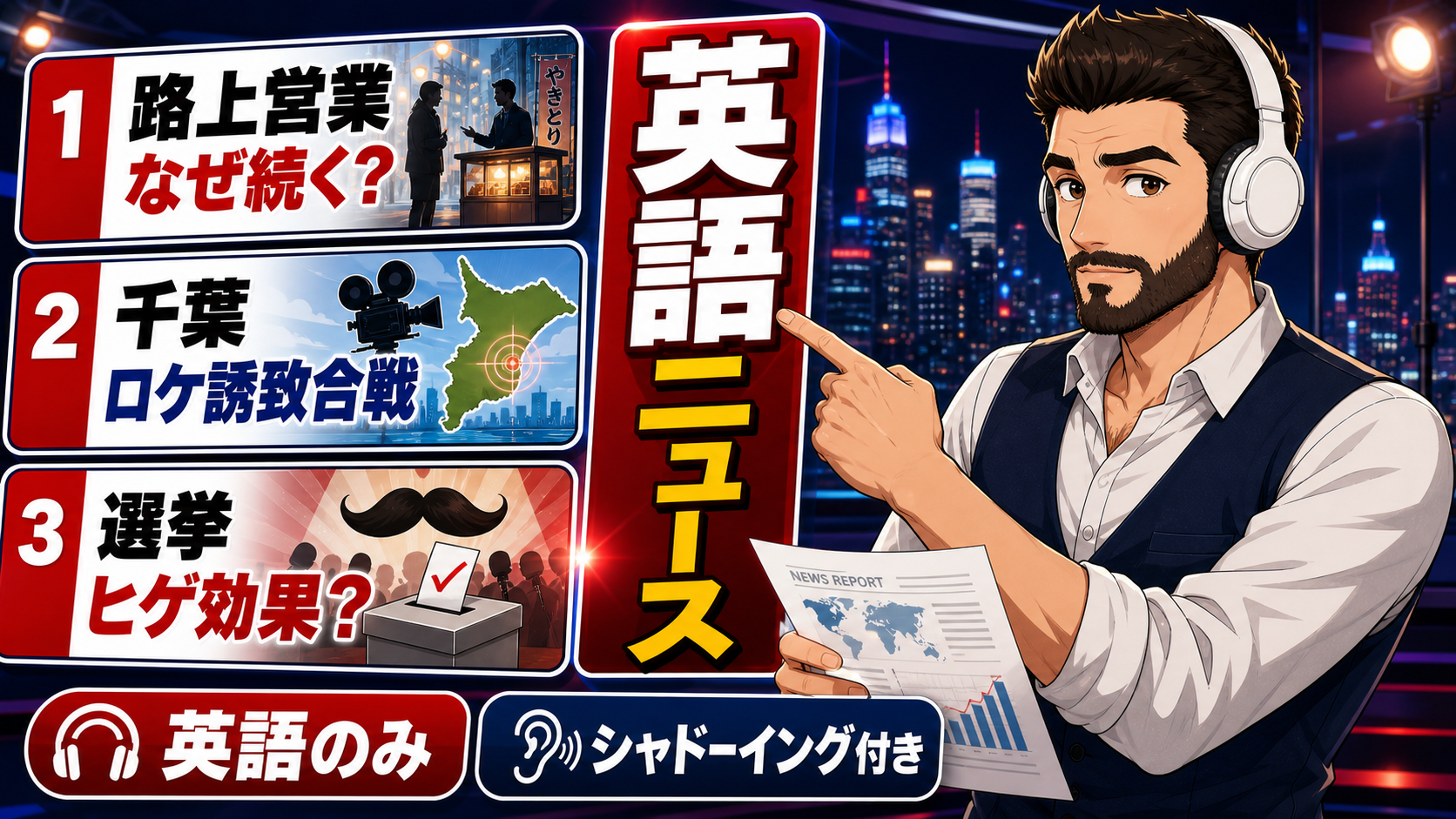
【シャドーイング付き英語ニュース】オープンハウス路上営業!千葉ロケ誘致合戦?選挙ヒゲ効果? | リスニング強化
【シャドーイング付き英語ニュース】オープンハウス路上営業!千葉ロケ誘致合戦?選挙ヒゲ効果? | リスニング強化
YouTube「スキマ時間で英語を学ぼう」の英語ニュース解説です。
動画と合わせてリスニング・シャドーイングにご利用ください。
スクリプト
Welcome to Sukima English News! I'm Sarah. (スキマ英語ニュースへようこそ!サラです。)
And I'm Marc. (そしてマークです。)
Today's theme: Japan doing things differently. (今日のテーマは「日本ならではのやり方」です。)
We've got flyers in the smartphone era, a whole prefecture fighting to be on screen, and a candidate's beard that may, or may not, be legal. (スマホ時代のチラシ、画面に映ろうと奮闘する県、そして合法かどうか微妙な候補者のひげ、の3本です。)
Three stories, one common thread: the unexpected rules behind everyday Japan. (3つの話に共通するのは、日本の日常の裏にある意外なルールです。)
We'll also look at the numbers, the history, and what these stories say about modern life here. (数字や歴史、そしてこれらの話が現代の日本について何を語っているのかも見ていきます。)
So grab a coffee, and let's get started. (さあ、コーヒーでも飲みながら始めましょう。)
Street flyers. Something your grandparents might remember. (街頭で配られるチラシ。おじいさんやおばあさんの世代なら覚えていそうなものですね。)
But one of Japan's fastest-growing real estate firms says flyers are still their secret weapon. Why, Marc? (でも、日本で最も急成長している不動産会社の一つが、チラシは今でも秘密兵器だと言っています。なぜでしょう、マーク?)
We're talking about Open House. Their direct, on-the-street approach accounts for about 30% of all their sales. (オープンハウスのことです。街頭で直接声をかける営業が、売上の約30%を占めているんです。)
Thirty percent? In 2026, with apps and AI everywhere? (30%ですか?アプリやAIがこれだけ普及した2026年に?)
Yes. And it's not random. Flyers are designed to feel local. A photo of a property three blocks from where you live, your nearest train station printed at the top, your kind of family in mind. (はい。しかも、やみくもに配っているわけではありません。チラシは地元らしさが感じられるように作られています。自宅から3ブロック先の物件の写真、いちばん上には最寄り駅の名前、そしてあなたのような家族を想定した内容です。)
So it's not a generic ad. It's a personal invitation. (つまり、ありきたりの広告ではなく、自分宛ての招待状なんですね。)
Exactly. Response rates are still low, around 0.01 to 0.03 percent. But with the right targeting, and enough repetition, those tiny percentages add up to thousands of leads a month. (そのとおりです。反応率は今も低く、0.01%から0.03%くらいです。でも、狙いを絞って何度も繰り返せば、そのわずかな割合が積み重なって、月に何千人もの見込み客につながるんです。)
A flyer is a slow-moving net. But across a city, it catches. (チラシは、ゆっくり広げる網のようなものですね。でも街全体でなら、ちゃんと獲物がかかります。)
And they're not just printing paper anymore. Open House uses AI to speed up flyer creation. The system pulls property data, neighborhood images, even local school information, and lays out a draft flyer in minutes. (しかも、もうただ紙を刷っているだけではありません。オープンハウスはAIを使ってチラシ作りを速めています。システムが物件データや周辺の写真、さらには地元の学校の情報まで集めて、数分でチラシの下書きを作るんです。)
So a job that used to take a designer half a day, now happens automatically. (つまり、以前はデザイナーが半日かかっていた仕事が、今では自動で行われるわけですね。)
Right. Old method, new tools. The street-sales staff still walks the neighborhood, but their materials are AI-generated. (そうです。昔ながらの手法に、新しい道具を組み合わせているんです。街頭営業のスタッフは今も近所を歩いて回りますが、配る資料はAIで作られています。)
That's the kind of detail that surprises people. What about the numbers behind the company? (そういう話を聞くと驚く人も多いでしょうね。会社の業績はどうなっていますか?)
For Q1 FY25, sales were over 32.9 billion yen, up 4.3 percent. Operating profit rose 17.3 percent, to over 4 billion yen. (25年度第1四半期の売上高は329億円を超え、4.3%増加しました。営業利益は17.3%増の40億円を超えました。)
Four billion yen in operating profit, in three months. Roughly the budget of a mid-sized Japanese city. The flyer guy is doing fine. (3ヶ月で営業利益40億円ですか。だいたい日本の中規模の市の予算くらいですね。チラシの会社は好調というわけです。)
They're also serious about digital. Open House now handles over 10,000 contracts every year through online consultations. (デジタルにも力を入れています。オープンハウスは今、オンライン相談を通じて年間1万件以上の契約を結んでいます。)
Ten thousand. So while the street team is knocking on doors, the back office is closing deals over video calls. (1万件。つまり、街頭チームが家々を回っている間に、バックオフィスはビデオ通話で契約をまとめているわけですね。)
It's a dual approach. Paper on the street, contracts in the cloud. (二本立ての戦略です。街頭では紙、契約はクラウドで。)
Why does the human side still work so well? (どうして人の手による営業が、今もそんなにうまくいくんでしょう?)
Imagine walking home in Tokyo and a young agent hands you a card for a property three blocks away. Not on any app. Listed nowhere online. (東京で家に帰る途中、若い営業担当者から3ブロック先の物件のカードを渡されたと想像してみてください。どのアプリにも載っておらず、ネットのどこにも掲載されていない物件です。)
That's a unique selling point. You feel like you're getting a hidden gem. (それは強力な売りですね。掘り出し物を見つけたような気分になります。)
And many of Open House's properties are exactly that. Off-market listings, smaller buildings, deals that never make it onto the big portals. (オープンハウスの物件の多くは、まさにそれなんです。市場に出回っていない物件や小さな建物、大手のポータルサイトには載らない取引です。)
So the street team is, in a sense, a discovery channel. (つまり、街頭チームは、ある意味で物件と出会うための窓口なんですね。)
Right. And the wider market backs them up. Japanese real estate stayed strong in 2023. Investment in the first three quarters was up 40 percent year-on-year. (そうです。そして、市場全体の動きもそれを後押ししています。日本の不動産は2023年も好調で、第1〜第3四半期の投資額は前年同期比40%増でした。)
A weak yen, low interest rates, and a stable legal system. Foreign capital saw a buying opportunity. (円安、低金利、そして安定した法制度。海外からの資本は、買いのチャンスを見出したのです。)
Meanwhile, awareness of real estate technology among the general Japanese public was only 3.9 percent back in 2020. (一方で、2020年時点では、日本の一般の人の不動産テックの認知度は、わずか3.9%でした。)
Just 3.9 percent. So most consumers don't even know the digital tools exist. A flyer might still be the fastest way to reach them. (たった3.9%ですか。つまり、ほとんどの消費者はデジタルツールがあることすら知らないんですね。チラシは今も、彼らに届く一番の近道かもしれません。)
It's a fascinating gap. The industry is digitizing fast, but the customer is not. Open House sits right in that gap. (興味深いギャップですね。業界は急速にデジタル化していますが、顧客はそうではありません。オープンハウスは、まさにそのギャップに位置しています。)
Old meets new, with a human touch. (昔ながらのやり方と新しいやり方が、人の温かみで結びついているわけですね。)
And with a flyer in your hand. (手渡しのチラシも添えて、ですね。)
Now let's head to Chiba, where an entire prefecture is fighting to play a starring role. (さて、千葉県に向かいましょう。県全体が、主役の座をかけて奮闘しています。)
A location scouting battle? (ロケ地争奪戦ですか?)
Exactly. Chiba is going hard to attract film and TV productions. (その通りです。千葉県は、映画やテレビの撮影誘致に力を入れています。)
What's their pitch? (千葉県は、何を売りにしているんですか?)
You could film a beach scene in the morning, a crowded downtown street by lunch, and a quiet rice paddy by sunset. All in Chiba. (午前中はビーチ、昼までににぎやかな繁華街、夕暮れには静かな田んぼで撮影できます。しかも、すべて千葉県内で。)
Coastal, urban, rural, all within an hour of Tokyo. That's a producer's dream. (海沿い、都市部、田舎、すべて東京から1時間以内。これは制作者にとって夢のような話です。)
And practical support too. The prefecture has a dedicated website, a film commission office, and a team helping with permits, road closures, and even local cast and crew arrangements. (そして、実質的なサポートもあります。県には専用ウェブサイト、フィルムコミッション事務局、そして許可、道路閉鎖、さらには地元のキャストやスタッフの手配まで支援するチームがあります。)
That removes a lot of friction. Filming usually means months of paperwork. (手間がかなり省けますね。撮影には普通、何ヶ月もの書類手続きが必要ですから。)
And here it could be done in weeks. (千葉なら、それが数週間で済むかもしれません。)
How big is the impact? (その影響はどれくらい大きいのですか?)
In fiscal year 2023, Chiba hosted 230 productions, generating over 5 billion yen. (2023年度、千葉県は230件の撮影を受け入れ、50億円以上を生み出しました。)
Five billion yen. Roughly what a single big-budget Japanese film might cost. The whole prefecture earns one blockbuster a year, just from being a backdrop. (50億円。日本の大作映画1本の制作費とほぼ同じですね。県全体が、撮影の舞台になるだけで、毎年大作1本分を稼いでいるわけです。)
And it's not just feature films. The 230 productions include dramas, TV commercials, music videos, and a growing number of international shoots. (そして、長編映画だけではありません。230件の撮影には、ドラマ、テレビCM、ミュージックビデオ、そして増加傾向にある海外からの撮影も含まれています。)
International too? (海外からもですか?)
Yes. With the weak yen, foreign producers are finding Japan more affordable than they used to. Chiba positions itself as the easy entry point, close to airports, close to Tokyo. (はい。円安で、海外の制作者は以前よりも日本を安く感じています。千葉県は、空港や東京に近い、入りやすい玄関口として自らを位置づけています。)
A smart pitch. (賢いアピールですね。)
And they're not the only ones competing. Other regions are offering production subsidies of 20 to 50 percent, faster permits, even help with accommodation and transport. (しかも、競争しているのは千葉だけではありません。ほかの地域も、20〜50%の制作補助金や、許可手続きの迅速化、さらには宿泊や移動の支援まで提供しています。)
A real arms race for cameras. (まさにカメラを巡る軍拡競争ですね。)
Hokkaido is famous for snow scenes. Okinawa offers tropical beaches. Kyoto sells history. Chiba sells convenience and variety. (北海道は雪景色で有名です。沖縄は南国のビーチを提供します。京都は歴史を売りにしています。千葉県は利便性と多様性を売りにしています。)
Each region carves out an identity. (各地域が独自のアイデンティティを確立しているのですね。)
Why does this matter beyond film budgets? (撮影の予算以外にも、どんな意味があるんですか?)
Drama tourism. When a popular show films somewhere, viewers want to visit. Local cafes, inns, shops, train stations, all benefit. (ドラマツーリズムです。人気の番組がどこかで撮影されると、視聴者はそこを訪れたくなります。地元のカフェ、宿、店、駅などがすべて恩恵を受けます。)
A famous example is the manga and drama "Slam Dunk." That one anime crossing scene in Kamakura still draws tourists from Korea, China, and Taiwan, almost thirty years later. (有名な例が、マンガとドラマの『スラムダンク』です。鎌倉にあるアニメの踏切のシーンは、30年近く経った今も、韓国や中国、台湾から観光客を呼び寄せています。)
A single shot can become a multi-decade revenue stream. (一つのシーンが、数十年にわたる収益源になり得るのです。)
So Chiba is selling itself as a movie set, and getting paid twice. Once by the production, once by the tourists who follow. (千葉県は映画のロケ地として自分を売り込み、二重に稼いでいるわけですね。制作側から一度、そしてそのあと訪れる観光客からもう一度。)
Are there downsides? (デメリットはありますか?)
Yes. Filming disrupts residents. Traffic, noise, crowds blocking access to local shops. Managing that balance is the hard part. (はい。撮影は住民の迷惑になります。交通渋滞、騒音、地元の店へのアクセスを遮る混雑など。そのバランスを取るのが難しいところです。)
And once an area becomes too touristy, the original charm can fade. (そして、ある地域が観光地化しすぎると、本来の魅力が失われてしまうこともあります。)
Some local governments now ask productions to film during off-peak hours, or to share location fees with the neighborhood association. (今では、撮影を人の少ない時間帯に行うよう求めたり、ロケ地の使用料を町内会と分け合うよう求めたりする自治体もあります。)
A clever model, with strings attached. (条件付きの、賢いモデルですね。)
From flyers in the street to cameras on the beach. Now let's turn to something stranger. (街中のチラシから、ビーチのカメラまで。さて、次はもっと風変わりな話です。)
Imagine a candidate in Japan whose nickname is "Mustache." They shout it from their campaign truck. (日本で「ヒゲ」というニックネームの候補者がいると想像してみてください。その候補者は、選挙カーからそのニックネームを連呼します。)
Legal? Illegal? (合法ですか?違法ですか?)
That's the debate. Now imagine another candidate. Their family runs a sweet bun shop, a manju shop, and they're known around town as "Manju-ya." (そこが議論になっているんです。では、別の候補者を想像してみてください。実家が甘いお菓子のお店、つまり饅頭屋を営んでいて、町では「饅頭屋」の名で知られています。)
Same question? (同じ質問ですか?)
Same question, different answer. And that's why this story made the news. (同じ問いでも、答えは違います。だからこそ、この話はニュースになったんです。)
So this is about Japan's Public Offices Election Act. (これは日本の公職選挙法に関するものですね。)
Right. The law has been around since 1950, and it aims for fairness, balancing free expression with preventing malpractice. (そうです。この法律は1950年からあり、自由な表現と不正行為の防止のバランスを取りながら、公平性を目指しています。)
What are the basic rules? (基本的なルールは何ですか?)
Loudspeakers are restricted to 8:30 AM to 8 PM. Quiet zones near hospitals and schools. House-to-house visits, offering food, and collecting signatures are all banned. (スピーカーの使用は午前8時30分から午後8時まで制限されています。病院や学校の近くは静穏区域です。戸別訪問、飲食物の提供、署名集めはすべて禁止されています。)
That last one always surprises people abroad. No door-to-door campaigning in Japan. (最後のルールには、海外の人はいつも驚きますね。日本では、戸別訪問による選挙運動ができないんです。)
Right. The reason is historical. After the war, lawmakers worried that door-knocking would lead to bribery, intimidation, or vote-buying behind closed doors. So the easiest solution was to ban it entirely. (そうです。理由は歴史的なものです。戦後、議員たちは戸別訪問が贈収賄や威圧、密室での票の買収につながることを懸念しました。そのため、最も簡単な解決策として、完全に禁止したのです。)
A blunt rule, but a clear one. (大ざっぱですが、わかりやすいルールですね。)
Online campaigning has been allowed since 2013. But only candidates and parties can send campaign emails. Regular voters cannot. (オンラインでの選挙運動は2013年から許可されています。しかし、選挙メールを送れるのは候補者と政党だけです。一般の有権者はできません。)
So I can post about a candidate on social media, but I can't email my friends asking them to vote for someone. (つまり、SNSで候補者について投稿するのはいいけれど、友人に誰かへの投票をメールで頼むのはダメ、ということですか。)
Exactly. The law tries to keep campaigning visible and public, not hidden in private inboxes. (そのとおりです。法律は、選挙運動を個人の受信箱に隠すのではなく、誰の目にも見える公の場で行わせようとしているんです。)
So where do "Mustache" and "Manju-ya" fit in? (では、「ヒゲ」や「饅頭屋」はどう関係してくるんですか?)
The legal question is whether a nickname counts as a recognized way to identify the candidate. "Mustache," tied to a candidate's visible physical feature, has been treated as a valid nickname in past cases. Courts have generally allowed it. (法的な問題は、ニックネームが候補者を識別する認められた方法とみなされるかどうかです。「ヒゲ」は、候補者の目に見える身体的特徴に関連付けられており、過去の事例では有効なニックネームとして扱われてきました。裁判所は一般的にそれを認めています。)
Because it helps voters recognize the person. (有権者が本人を見分ける助けになるから、ですね。)
And "Manju-ya"? (では、「饅頭屋」は?)
That one's trickier. It's tied to a family business name, not the candidate's policies or person directly. Election commissions and courts have to judge case by case. (そちらは判断が難しいんです。候補者の政策や人柄に直接結びつくのではなく、家業の名前に結びついていますから。選挙管理委員会や裁判所は、ケースごとに判断しなければなりません。)
There was a recent case in Kamisu City, Ibaraki Prefecture. A candidate's family ran a sweet bun maker, and the nickname was used during the mayoral race. (最近、茨城県神栖市でそのようなケースがありました。候補者の家族が饅頭の製造元を営んでいて、市長選挙でそのニックネームが使われたんです。)
And the election commission had to make the call. (そして、選挙管理委員会が判断を下さなければなりませんでした。)
Right. They look at whether the nickname is widely known, whether it identifies the candidate clearly, and whether it could mislead voters or violate the food-offering rules. (そうです。ニックネームが広く知られているか、候補者を明確に識別しているか、そして有権者を誤解させたり、飲食物提供のルールに違反したりする可能性があるかどうかを調べます。)
So a nickname that points to free food is risky. (だから、無料の食べ物を連想させるニックネームはリスクがあるんですね。)
Exactly. The law really doesn't want food, money, or gifts anywhere near campaign messaging. (そのとおりです。法律は、食べ物やお金、贈り物が選挙運動のメッセージと結びつくことを、とにかく嫌うんです。)
So the mustache stays, but the manju might be too much. (ということは、ヒゲはセーフでも、饅頭はやりすぎかもしれない、と。)
Only in Japan. (日本ならではですね。)
Only in Japan. And it's a reminder that even tiny campaign details can land in court. (日本ならではです。そして、選挙のほんの細かな点でさえ、裁判沙汰になりうると気づかされますね。)
今日のキーワード

Now let's look at some key vocabulary from today's stories. (さて、今日のニュースから、いくつかの重要な語彙を見ていきましょう。)
First, from the Open House story, "street sales" . Directly approaching potential customers in public, like handing out flyers or talking to people on the street. (まず、オープンハウスの話から、「街頭営業」です。チラシを配ったり、道行く人に話しかけたりして、公の場で見込み客に直接アプローチすることです。)
A very hands-on approach. (とても現場主義のやり方ですね。)
Next, from the Chiba story, "location scouting battle" . The competition between regions to attract film and TV productions. (次に、千葉の話から、「ロケ地争奪戦」です。映画やテレビの撮影を誘致しようとする地域どうしの競争のことです。)
It sounds like an arms race for cameras. (まるでカメラをめぐる軍拡競争みたいですね。)
From the election story, "Public Offices Election Act" . Japan's law that governs how elections are conducted. (選挙の話から、「公職選挙法」です。選挙の実施方法を規定する日本の法律です。)
A very important piece of legislation. (とても重要な法律ですね。)
Also from Open House, "real estate tech awareness" . How much the public knows about technology used in real estate. (こちらも「オープンハウス」から、「不動産テックの認知度」です。不動産で使われるテクノロジーについて、一般の人々がどれだけ知っているかということです。)
Surprisingly low at just 3.9 percent in 2020. (2020年にはわずか3.9%だったというのは、驚くほど低いですね。)
From Chiba, "diverse landscapes" . A wide variety of natural scenery in one area: coasts, mountains, cities. (千葉から、「多様な景観」です。一つの地域に、海岸や山、都市など、さまざまな景色がそろっていることです。)
A big draw for filmmakers. (映画制作者にとって大きな魅力ですね。)
And from the election story, "preventing malpractice" . Stopping dishonest or illegal behavior, especially in an official context. (そして、選挙の話から、「不正行為の防止」です。特に公的な文脈において、不正または違法な行為を止めることです。)
Crucial for fair elections. (公正な選挙には不可欠ですね。)
シャドーイング用セクション
B: Now, let's practice the vocabulary we learned. (さて、学んだ語彙を練習してみましょう。)
B: Open House uses direct street sales tactics to reach potential buyers. (オープンハウスは、購入見込み客にアプローチするために、直接的な街頭営業の手法を使っている。)
A: Let's try that one more time at normal speed. (もう一度、普通のスピードでやってみましょう。)
B: Open House uses direct street sales tactics to reach potential buyers. (オープンハウスは、購入見込み客にアプローチするために、直接的な街頭営業の手法を使っている。)
B: The prefecture is facing a location scouting battle with neighboring regions. (その県は、近隣地域とのロケ地争奪戦に直面している。)
A: Let's try that one more time at normal speed. (もう一度、普通のスピードでやってみましょう。)
B: The prefecture is facing a location scouting battle with neighboring regions. (その県は、近隣地域とのロケ地争奪戦に直面している。)
B: The Public Offices Election Act clearly defines what is and isn't allowed. (公職選挙法は、何が許されて何が許されないかを明確に定めている。)
A: Let's try that one more time at normal speed. (もう一度、普通のスピードでやってみましょう。)
B: The Public Offices Election Act clearly defines what is and isn't allowed. (公職選挙法は、何が許されて何が許されないかを明確に定めている。)
B: Increased real estate tech awareness could boost market innovation. (不動産テックの認知度が高まれば、市場のイノベーションが進む可能性がある。)
A: Let's try that one more time at normal speed. (もう一度、普通のスピードでやってみましょう。)
B: Increased real estate tech awareness could boost market innovation. (不動産テックの認知度が高まれば、市場のイノベーションが進む可能性がある。)
B: The region's diverse landscapes attract filmmakers seeking varied backdrops. (この地域の多様な景観は、さまざまな背景を求める映画制作者を引きつけている。)
A: Let's try that one more time at normal speed. (もう一度、普通のスピードでやってみましょう。)
B: The region's diverse landscapes attract filmmakers seeking varied backdrops. (この地域の多様な景観は、さまざまな背景を求める映画制作者を引きつけている。)
B: Strict rules are in place for preventing malpractice during campaigns. (選挙運動中の不正行為を防ぐため、厳しい規則が設けられている。)
A: Let's try that one more time at normal speed. (もう一度、普通のスピードでやってみましょう。)
B: Strict rules are in place for preventing malpractice during campaigns. (選挙運動中の不正行為を防ぐため、厳しい規則が設けられている。)
From flyers, to filming, to facial hair. Today's Japan is full of surprises. (チラシから撮影、そしてひげまで。今の日本は驚きでいっぱいです。)
And full of English. (英語もたっぷりでしたね。)
Three stories: Open House proves a flyer plus AI can still beat the app. Chiba shows a whole prefecture can turn itself into a movie set. And one beard reminds us that Japanese election law cares about the smallest details. (3つのニュースでした。オープンハウスは、チラシとAIの組み合わせが今もアプリに勝てることを示しました。千葉県は、県全体が映画のセットになれることを見せてくれました。そして1本のひげは、日本の選挙法がごく細かい点まで気にかけていることを教えてくれます。)
All three are about old rules meeting new realities, and finding new ways to make them work. (3つとも、古いルールが新しい現実と出会い、それをうまく機能させる新しい方法を探していく話でした。)
That's all the time we have for today's Sukima English News. (今日のスキマ英語ニュースはここまでです。)
Remember to subscribe and keep practicing your English every day. (チャンネル登録と、毎日の英語の練習を忘れずに。)
We'll see you next time. For more news, and more English. (また次回お会いしましょう。ニュースも英語も、まだまだお届けします。)
Goodbye for now! (それでは、また!)

関連記事
【シャドーイング付き英語ニュース】詐欺増加!漫画で注意喚起?ちいかわ大ヒット! | リスニング強化
【シャドーイング付き英語ニュース】詐欺増加!漫画で注意喚起?ちいかわ大ヒット! | リスニング強化

【シャドーイング付き英語ニュース】幻のモグラ発見!韓国映画で唐田えりか?羽田 小型機新規則! | リスニング強化
【シャドーイング付き英語ニュース】幻のモグラ発見!韓国映画で唐田えりか?羽田 小型機新規則! | リスニング強化
【シャドーイング付き英語ニュース】お菓子値上げ!冷しカプヌ秒殺?不発弾騒動解決! | リスニング強化
【シャドーイング付き英語ニュース】お菓子値上げ!冷しカプヌ秒殺?不発弾騒動解決! | リスニング強化
【シャドーイング付き英語ニュース】AI新時代!熊本豪雨!電池発火注意? | リスニング強化
【シャドーイング付き英語ニュース】AI新時代!熊本豪雨!電池発火注意? | リスニング強化
【シャドーイング付き英語ニュース】サムスン新Galaxy!山陽新幹線新デザイン?新世界夏祭り! | リスニング強化
【シャドーイング付き英語ニュース】サムスン新Galaxy!山陽新幹線新デザイン?新世界夏祭り! | リスニング強化

【シャドーイング付き英語ニュース】教科書用語減!減税反対!副首都構想にNO? | リスニング強化
【シャドーイング付き英語ニュース】教科書用語減!減税反対!副首都構想にNO? | リスニング強化