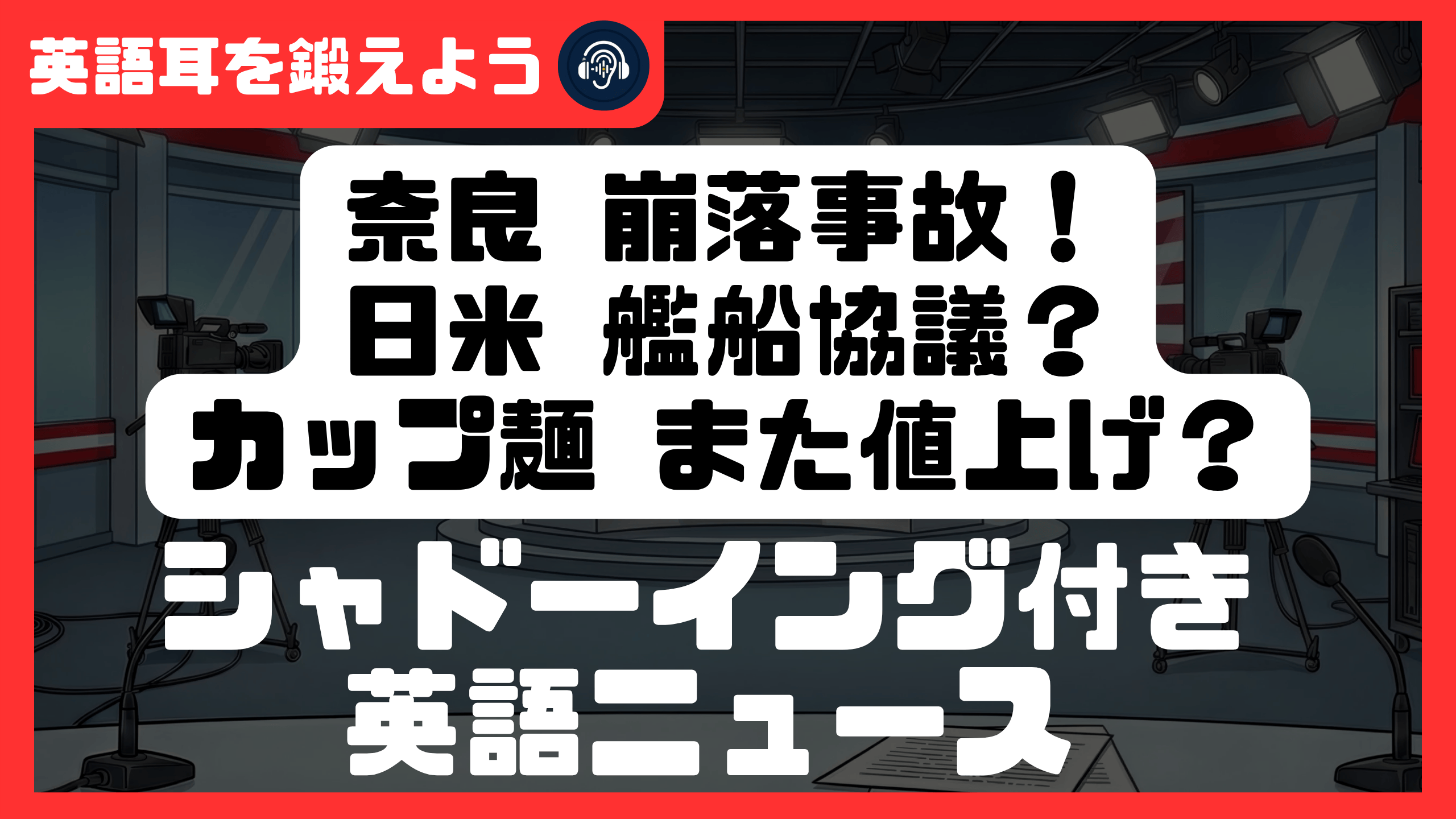
【シャドーイング付き英語ニュース】奈良 崩落事故!日米 艦船協議?カップ麺 また値上げ? | リスニング強化
【シャドーイング付き英語ニュース】奈良 崩落事故!日米 艦船協議?カップ麺 また値上げ? | リスニング強化
YouTube「スキマ時間で英語を学ぼう」の英語ニュース解説です。
動画と合わせてリスニング・シャドーイングにご利用ください。
スクリプト
Welcome to Sukima English News! I'm Sarah. (スキマ English Newsへようこそ!サラです。)
And I'm Marc. (マークです。)
Today we're covering a road collapse, the US-Japan summit, and ramen prices. (今日は、道路陥没、日米首脳会談、そしてラーメンの値段についてお伝えします。)
Our first story concerns a road collapse in Nara Prefecture, near Kintetsu Gakuenmae Station. (最初のニュースは、近鉄学園前駅近くの奈良県で起きた道路陥没についてです。)
A road collapse? What happened? (道路陥没ですか?何があったんですか?)
Change 'On March 20th' to 'On March 20th, 2026'. Residents reported a loud noise around 5 AM. (「3月20日」を「2026年3月20日」に変更してください。住民は午前5時頃に大きな音を聞いたと報告しています。)
Was anyone hurt? (けが人はいましたか?)
Fortunately, no injuries. About 1.3 meters of a 6-meter-wide road collapsed, about 8 meters down. The road is closed. (幸い、けが人はいません。幅6メートルの道路のうち、約1.3メートルが約8メートル下まで陥没しました。道路は閉鎖されています。)
Eight meters down? What caused it? (8メートル下ですか?原因は何ですか?)
Construction work below the road is mentioned, but the link is unclear. Residents reported cracks before the collapse. (道路下の工事が言及されていますが、関連性は不明です。住民は陥没前にひび割れを報告していました。)
There were warning signs. What about the area's geology? (兆候はあったんですね。この地域の地質はどうですか?)
Nara Basin is between mountain ranges, divided by faults. The area is part of the Ikoma Hills. The Osaka Group, mainly sand layers, is distributed here. (奈良盆地は山々に挟まれ、断層で分かれています。この地域は生駒山地の一部です。大阪層群、主に砂の層が分布しています。)
Sand layers… Does Nara have hazard maps? (砂の層ですか… 奈良にはハザードマップがありますか?)
Yes, Nara City publishes hazard maps for flood, landslide, and earthquake risks. (はい、奈良市は洪水、土砂災害、地震のリスクに関するハザードマップを公開しています。)
What about the overall state of Nara's roads? (奈良の道路全体の状況はどうですか?)
Nara Prefecture has the lowest road maintenance rate in Japan. About 20% of complaints are about pavement. (奈良県は、道路の維持管理率が日本で最も低い県です。苦情の約20%が舗装に関するものです。)
The lowest in Japan? What's being done? (日本で最も低いんですか?何か対策はされていますか?)
Nara Prefecture is implementing the "Nara Road Refresh Project" from 2024 to 2028. In 2013, Nara's road improvement rate was 46.8%, ranking 43rd. (奈良県は、2024年から2028年まで「奈良の道リフレッシュプロジェクト」を実施しています。2013年、奈良の道路改良率は46.8%で、43位でした。)
Are there systems for residents to report damage? (住民が被害を報告するシステムはありますか?)
Yes, Nara City uses a road emergency hotline, #9910, and a LINE reporting system. (はい、奈良市は道路緊急ダイヤル、#9910、そしてLINE通報システムを利用しています。)
What about long-term solutions? (長期的な解決策はどうですか?)
Nara City is using private companies for preventative maintenance. (奈良市は、民間企業を活用して予防保全を行っています。)
Does the report mention earthquakes or landslides? (報告書には地震や地滑りについて言及されていますか?)
No ground subsidence as of 2023. But an earthquake could cause a seismic intensity of 7, and liquefaction. (2023年現在、地盤沈下はありません。しかし、地震が発生すると震度7、そして液状化の可能性があります。)
This could be aging infrastructure and geological vulnerabilities? (これは老朽化したインフラと地質的な脆弱性によるものかもしれませんね?)
Exactly. It highlights neglecting road maintenance and geological risks. (その通りです。道路の維持管理の怠慢と地質的なリスクを浮き彫りにしています。)
What are the impacts on the community? (地域社会への影響は何ですか?)
The road closure disrupts traffic. Residents may face difficulties accessing necessities. (道路閉鎖は交通を混乱させます。住民は生活必需品へのアクセスが困難になる可能性があります。)
It can really affect lives. What about the economic impact? (人々の生活に大きな影響を与える可能性がありますね。経済的な影響はどうですか?)
Impacts on the construction project and recovery work. (建設プロジェクトと復旧作業への影響があります。)
What needs to be done to prevent similar incidents? (同様の事故を防ぐためには、何をする必要があるのでしょうか?)
Determine the cause, inspect similar roads, and implement preventative measures. (原因を究明し、類似の道路を点検し、予防策を実施します。)
How does this affect Japanese people more broadly? (これは、より広く日本の人々にどのような影響を与えますか?)
It's a reminder of infrastructure maintenance and disaster preparedness. Many regions face similar challenges. (インフラの維持管理と防災の重要性を改めて認識させられますね。多くの地域が同様の課題に直面しています。)
Let's discuss the meeting between Japanese and American leaders regarding the Strait of Hormuz. (ホルムズ海峡に関する日米首脳会談について話し合いましょう。)
The Strait of Hormuz? What's the issue? (ホルムズ海峡ですか?何が問題なのですか?)
The U.S. has asked Japan, among others, to send naval vessels to secure the Strait of Hormuz, a vital waterway for oil. The U.S. is concerned about Iranian actions. (アメリカは、日本を含む各国に、石油の重要な水路であるホルムズ海峡の安全確保のために海軍艦艇の派遣を要請しています。アメリカはイランの行動を懸念しています。)
So, the U.S. wants Japan to send warships. How has Japan responded? (つまり、アメリカは日本に軍艦の派遣を求めているのですね。日本はどのように対応していますか?)
Japan's Self-Defense Forces Law makes it difficult to dispatch ships to combat zones. Deployment would be challenging. (日本の自衛隊法では、戦闘地域への艦艇派遣は困難です。派遣は難しいでしょう。)
But Japan can't ignore the request, right? (しかし、日本は要請を無視できないですよね?)
Japan is hesitant to send ships into conflict but is considering options for protecting Japanese ships and gathering information. (日本は紛争地域への艦艇派遣には慎重ですが、日本の船舶の保護と情報収集のための選択肢を検討しています。)
A diplomatic compromise. What's the background? (外交的な妥協点ですね。背景は何ですか?)
The U.S., under its "America First" policy, wants allies to increase defense spending. Trump hoped Japan would contribute to securing the Strait of Hormuz. (アメリカは、「アメリカ・ファースト」政策の下、同盟国に防衛費の増額を求めています。トランプ大統領は、日本がホルムズ海峡の安全確保に貢献することを期待していました。)
So, it's about burden-sharing. How does this relate to the U.S.-Japan alliance? (つまり、負担の分担ということですね。これは日米同盟とどのように関係していますか?)
The U.S.-Japan alliance is based on the U.S.-Japan Security Treaty, the cornerstone of Japan's security policy. (日米同盟は、日本の安全保障政策の要である日米安全保障条約に基づいています。)
And Japan's defense spending? (日本の防衛費はどうですか?)
Japan's defense budget was capped at 1% of GDP, but the 2023 budget removed that cap. Japan aims to reach 2% of GDP by 2027. (日本の防衛予算はGDPの1%に制限されていましたが、2023年度予算でその上限が撤廃されました。日本は2027年までにGDPの2%に達することを目指しています。)
That's a significant increase. What about the U.S. defense budget? (それは大幅な増加ですね。アメリカの防衛予算はどうですか?)
The U.S. defense budget is the largest. In 2023, it reached 916 billion dollars. (アメリカの防衛予算は最大です。2023年には9160億ドルに達しました。)
The U.S. spends a larger percentage on defense. What are Japan's past maritime security contributions? (アメリカは防衛に大きな割合を費やしていますね。日本の過去の海上警備への貢献はどうですか?)
During WWI, Japan sent ships to the Mediterranean. After 9/11, Japan sent ships to the Indian Ocean for logistical support. (第一次世界大戦中、日本は地中海に艦艇を派遣しました。9.11以降、日本はインド洋に補給支援のために艦艇を派遣しました。)
There's precedent for Japan contributing. How important is the Strait of Hormuz? (日本が貢献した前例はあるのですね。ホルムズ海峡はどれほど重要ですか?)
The Strait of Hormuz is crucial for global oil transportation. Disruption could impact energy markets. (ホルムズ海峡は世界の石油輸送にとって非常に重要です。混乱はエネルギー市場に影響を与える可能性があります。)
What are the implications for Japan? (日本への影響は何ですか?)
Japan relies on oil imports through the Strait of Hormuz. Instability could impact Japan's economy. (日本はホルムズ海峡を通る石油輸入に依存しています。不安定化は日本経済に影響を与える可能性があります。)
Japan has a direct economic interest. What prevents Japan from sending ships? (日本は直接的な経済的利益を持っているのですね。日本が艦艇を派遣できない理由は何ですか?)
Japan's constitution and Self-Defense Forces Law limit SDF deployment for collective self-defense. (日本の憲法と自衛隊法は、集団的自衛のための自衛隊の展開を制限しています。)
The government must balance the alliance with legal limitations and pacifist principles. (政府は、同盟関係と法的制約、そして平和主義の原則とのバランスを取らなければなりません。)
Exactly. Public opinion also plays a role. (その通りです。世論も影響します。)
A delicate situation. How might this affect the average Japanese person? (難しい状況ですね。これは一般の日本人にどのような影響を与える可能性がありますか?)
Oil supply disruption could lead to higher energy prices, impacting gasoline, electricity, and businesses. (石油の供給が滞ると、エネルギー価格が上がり、ガソリン、電気、企業に影響が出る可能性がありますね。)
The Strait of Hormuz has real-world implications for Japanese citizens. (ホルムズ海峡は、日本の国民にとっても現実的な影響があります。)
Precisely. It highlights the complexities of Japan's security policy. (その通りです。日本の安全保障政策の複雑さを浮き彫りにしていますね。)
Thanks, Sarah. Insightful analysis. (サラさん、ありがとう。洞察に富んだ分析でした。)
You're welcome, Marc. (どういたしまして、マークさん。)
Okay, let's discuss rising prices, specifically with cup noodles. (さて、値上げについて話しましょう。特にカップ麺について。)
Not again! What's more expensive now? (またか!今度は何が高くなったんだ?)
Cup noodles, or "cup ramen," are facing price hikes in Japan. Several factors are combining to make them more expensive. (カップ麺、または「カップラーメン」が、日本で値上げに直面しています。いくつかの要因が重なって高くなっているんです。)
What's driving the increases? Just inflation? (何が値上げの原因ですか?ただのインフレですか?)
It’s more complex. Higher raw material costs, especially wheat, are a major driver. Wheat prices are volatile due to global demand, climate change, and geopolitical risks. (もっと複雑です。原材料費の高騰、特に小麦が大きな要因です。小麦の価格は、世界的な需要、気候変動、地政学的なリスクによって変動しやすいんです。)
So global events impact something as everyday as cup noodles. (つまり、世界的な出来事が、カップ麺のような身近なものに影響を与えるんですね。)
Exactly. Rising crude oil prices increase transportation and packaging costs. Add labor and logistics expenses, and you have a perfect storm. (その通りです。原油価格の上昇は、輸送費や包装費を増加させます。それに人件費や物流費が加わると、まさに最悪の状況です。)
That makes sense. Are companies announcing increases? (なるほど。企業は値上げを発表しているんですか?)
Yes, Acecook is raising prices on about 30 products starting July 1st, 2026. Sanyo Foods is also raising prices then. (はい、エースコックは2026年7月1日から約30品目の価格を引き上げます。サンヨー食品もその頃に値上げします。)
How much have prices already risen? (既にどれくらい価格は上がっているんですか?)
Cup Noodle originally sold for 100 yen in 1971. As of April 2026, the price will be 248 yen, excluding tax. (カップヌードルは1971年に100円で販売されました。2026年4月現在、税抜きで248円になります。)
That’s a significant increase. (かなり大幅な値上げですね。)
As of July 2025, a cup cost 236 yen before tax, a 31.1% increase in 10 years. (2025年7月現在、カップ1個236円(税抜き)で、10年間で31.1%の増加です。)
Is the market still growing? (市場はまだ成長しているんですか?)
Yes. The global market was valued at $61.08 billion in 2024 and is projected to reach $64.67 billion in 2025. It’s expected to reach $98.46 billion by 2032. (はい。世界の市場規模は2024年に610億8000万ドルと評価され、2025年には646億7000万ドルに達すると予測されています。2032年までに984億6000万ドルに達すると予想されています。)
What about Japan specifically? (日本だけではどうですか?)
The Japanese market was estimated at $6.39 billion in 2024 and is projected to reach $13.53 billion by 2033. (日本の市場規模は2024年に63億9000万ドルと推定され、2033年には135億3000万ドルに達すると予測されています。)
So, people are still buying instant ramen. How are consumers reacting? (つまり、人々はまだインスタントラーメンを買っているんですね。消費者はどのように反応しているんですか?)
Consumers are becoming more budget-conscious. There's increasing demand for cheaper bag noodles. (消費者はより予算を意識するようになっています。安い袋麺の需要が増加しています。)
People are looking for ways to save money. (人々は節約する方法を探しているんですね。)
Exactly. In 2024, total demand increased by 0.9%. Cup noodle demand decreased, but bag noodle demand increased by 3.1%. (その通りです。2024年には、総需要は0.9%増加しました。カップ麺の需要は減少しましたが、袋麺の需要は3.1%増加しました。)
So people are switching to bag noodles? (つまり、人々は袋麺に切り替えているんですね?)
Precisely. Lower-priced cup noodles are also gaining popularity. (その通りです。低価格のカップ麺も人気を集めています。)
Manufacturers are adapting by offering cheaper alternatives. (メーカーは、より安価な代替品を提供することで対応しているんですね。)
Yes, they are. But price increases impact more than household budgets. They can change eating habits. (ええ、そうです。しかし、価格の上昇は家計の予算以上に影響を与えます。食習慣を変える可能性があります。)
It could affect diet quality. (食生活の質に影響するかもしれないね。)
Exactly. It raises questions about food security, especially for lower-income households. (そうですね。特に低所得世帯にとっては、食料安全保障の問題が出てきますね。)
What's the overall outlook? Will prices continue to rise? (全体的な見通しはどうですか?価格は上がり続けるんでしょうか?)
It's hard to say. But as long as global factors remain elevated, we can expect continued pressure. (何とも言えませんね。ただ、世界的な要因が高止まりしている限り、プレッシャーは続くと考えられます。)
So, Japanese consumers will likely pay more. (ということは、日本の消費者はもっとお金を払うことになる可能性が高いですね。)
Unfortunately, that seems to be the case. It's an example of how global trends affect everyday life. (残念ながら、そうみたいですね。グローバルなトレンドが日常生活に影響を与える例ですね。)
Something to keep an eye on. (注意しておきたいところですね。)
今日のキーワード

Now let's look at some key vocabulary from today's stories. (では、今日のニュースに出てきた重要な語彙を見ていきましょう。)
First, we have "road collapse" . This refers to the sudden breaking and falling apart of a road surface. For example: "The heavy rainfall contributed to the road collapse on Highway 1." (まずは「道路陥没」です。これは、道路の表面が突然壊れて崩れ落ちることを指します。例えば、「大雨が国道1号線の道路陥没の原因となりました」のように使います。)
A very dangerous situation for drivers. (ドライバーにとっては非常に危険な状況ですね。)
Next is "hazard map" . This is a map that shows areas at risk from natural disasters like floods or earthquakes. For example: "The city provides a hazard map online so residents can see if they live in a flood zone." (次は「ハザードマップ」です。これは、洪水や地震などの自然災害のリスクがある地域を示した地図です。例えば、「市は、住民が自分の住んでいる場所が浸水区域かどうかを確認できるように、ハザードマップをオンラインで提供しています」のように使います。)
Important information for emergency preparedness. (緊急時の備えに重要な情報ですね。)
Our third term is "road maintenance" . This refers to the work of keeping roads in good condition, including repairs and resurfacing. For example: "The lack of road maintenance led to numerous potholes on the highway." (3つ目の用語は「道路維持」です。これは、道路を良好な状態に保つための作業のことで、修理や再舗装などが含まれます。例えば、「道路維持の不足が、高速道路の多数の穴ぼこの原因となりました」のように使います。)
Something we often take for granted. (当たり前だと思いがちですが。)
The phrase "implementing the project" means to start using a plan or system. For example: "The company is implementing the project to reduce carbon emissions." (「プロジェクトを実施する」というフレーズは、計画やシステムを使い始めるという意味です。例えば、「会社は、二酸化炭素排出量を削減するプロジェクトを実施しています」のように使います。)
Hopefully, it will be successful. (うまくいくといいですね。)
Then we have "dispatch ships" , which means to send ships, usually naval vessels, to a particular location. For example: "The navy decided to dispatch ships to the area affected by the hurricane." (次は「艦船を派遣する」です。これは、通常は海軍の艦船を特定の場所に送ることを意味します。例えば、「海軍は、ハリケーンの被害を受けた地域に艦船を派遣することを決定しました」のように使います。)
Often done for humanitarian aid or defense. (人道支援や防衛のために行われることが多いですね。)
Our next phrase is "vital waterway" . This refers to a sea route or river that is extremely important for transportation and trade. For example: "The Suez Canal is a vital waterway for global commerce." (次のフレーズは「重要な水路」です。これは、輸送や貿易にとって非常に重要な海路や河川を指します。例えば、「スエズ運河は、グローバルな商業にとって重要な水路です」のように使います。)
Keeping these routes open is crucial. (これらのルートを開放しておくことが重要ですね。)
Next, we have "burden-sharing" , which means the distribution of costs or responsibilities among different parties. For example: "The allies agreed on a new plan for burden-sharing in the defense of the region." (次は「負担分担」です。これは、費用や責任を異なる当事者間で分配することを意味します。例えば、「同盟国は、地域の防衛における負担分担のための新しい計画に合意しました」のように使います。)
A common topic in international relations. (国際関係における共通の話題ですね。)
Then we have "price hike" . This refers to a sudden or significant increase in the price of something. For example: "Consumers are worried about the recent price hike in gasoline." (次は「価格高騰」です。これは、何かの価格が突然、または大幅に上昇することを指します。例えば、「消費者は、最近のガソリン価格の高騰を心配しています」のように使います。)
Something we all feel in our wallets. (みんなが財布で感じるものですね。)
Our ninth phrase is "raw material costs" . This refers to the expense of the basic materials used in manufacturing a product. For example: "The company's profits were affected by the rising raw material costs." (9番目のフレーズは「原材料費」です。これは、製品の製造に使用される基本的な材料の費用のことです。例えば、「会社の利益は、原材料費の上昇によって影響を受けました」のように使います。)
A key factor in determining the final price. (最終価格を決定する上で重要な要素ですね。)
Finally, we have "perfect storm" , which describes a situation where several negative factors combine to create a particularly bad outcome. For example: "The combination of high unemployment and rising inflation created a perfect storm for the economy." (最後に「最悪の事態」です。これは、いくつかのマイナスの要因が組み合わさって、特に悪い結果を生み出す状況を表します。例えば、「高い失業率と上昇するインフレの組み合わせが、経済にとって最悪の事態を生み出しました」のように使います。)
A situation we definitely want to avoid. (絶対に避けたい状況ですね。)
シャドーイング用セクション
A: Time for our shadowing practice! Let's practice using the key vocabulary we just learned. (シャドーイングの練習の時間です!先ほど学んだ重要な語彙を使って練習しましょう。)
A: The road collapse was a major inconvenience for commuters. (道路陥没は、通勤者にとって大きな迷惑でした。)
B: Let's try that one more time at normal speed. (もう一回、普通のスピードでやってみましょう。)
A: The road collapse was a major inconvenience for commuters. (道路の陥没は、通勤者にとって大変な迷惑でした。)
A: After the heavy rains, the city updated its hazard map to include new flood zones. (大雨の後、市は新しい浸水想定区域を含むようにハザードマップを更新しました。)
B: Let's try that one more time at normal speed. (もう一回、普通のスピードでやってみましょう。)
A: After the heavy rains, the city updated its hazard map to include new flood zones. (大雨の後、市は新しい浸水想定区域を含むようにハザードマップを更新しました。)
A: Increased funding is needed for regular road maintenance to prevent further damage. (さらなる損傷を防ぐために、定期的な道路維持管理のための資金増額が必要です。)
B: Let's try that one more time at normal speed. (もう一回、普通のスピードでやってみましょう。)
A: Increased funding is needed for regular road maintenance to prevent further damage. (さらなる損傷を防ぐために、定期的な道路維持管理のための資金増額が必要です。)
A: The company is implementing the project in phases to ensure a smooth transition. (円滑な移行を確実にするため、会社は段階的にプロジェクトを実施しています。)
B: Let's try that one more time at normal speed. (もう一回、普通のスピードでやってみましょう。)
A: The company is implementing the project in phases to ensure a smooth transition. (円滑な移行を確実にするため、会社は段階的にプロジェクトを実施しています。)
A: Due to the increasing tensions, the government decided to dispatch ships to the region. (高まる緊張のため、政府はその地域に艦船を派遣することを決定しました。)
B: Let's try that one more time at normal speed. (もう一回、普通のスピードでやってみましょう。)
A: Due to the increasing tensions, the government decided to dispatch ships to the region. (高まる緊張のため、政府はその地域に艦船を派遣することを決定しました。)
A: The Strait of Malacca is a vital waterway for trade between Asia and Europe. (マラッカ海峡は、アジアとヨーロッパ間の貿易にとって不可欠な水路です。)
B: Let's try that one more time at normal speed. (もう一回、普通のスピードでやってみましょう。)
A: The Strait of Malacca is a vital waterway for trade between Asia and Europe. (マラッカ海峡は、アジアとヨーロッパ間の貿易にとって不可欠な水路です。)
A: Negotiations are ongoing to find a fair burden-sharing agreement among the nations. (各国間の公平な負担分担合意を見つけるために、交渉が続いています。)
B: Let's try that one more time at normal speed. (もう一回、普通のスピードでやってみましょう。)
A: Negotiations are ongoing to find a fair burden-sharing agreement among the nations. (各国間の公平な負担分担合意を見つけるために、交渉が続いています。)
A: Consumers are complaining about the significant price hike in electricity bills. (消費者は電気料金の大幅な値上げについて不満を述べています。)
B: Let's try that one more time at normal speed. (もう一回、普通のスピードでやってみましょう。)
A: Consumers are complaining about the significant price hike in electricity bills. (消費者は電気料金の大幅な値上げについて不満を述べています。)
A: The factory had to shut down due to soaring raw material costs. (工場は原材料費の高騰により閉鎖せざるを得ませんでした。)
B: Let's try that one more time at normal speed. (もう一回、普通のスピードでやってみましょう。)
A: The factory had to shut down due to soaring raw material costs. (工場は原材料費の高騰により閉鎖せざるを得ませんでした。)
A: The combination of high interest rates and low consumer confidence created a perfect storm for the economy. (高金利と低い消費者信頼感の組み合わせが、経済にとって最悪の状況を作り出しました。)
B: Let's try that one more time at normal speed. (もう一回、普通のスピードでやってみましょう。)
A: The combination of high interest rates and low consumer confidence created a perfect storm for the economy. (高金利と低い消費者信頼感の組み合わせが、経済にとって最悪の状況を作り出しました。)
And that's all the time we have for today's Sukima English News. (今日のスキマ英語ニュースは、これでお時間です。)
Thanks for listening, everyone. Keep practicing! (皆さん、聞いてくれてありがとう。練習頑張ってね!)
See you next time! Bye! (また次回!バイバイ!)

関連記事
【シャドーイング付き英語ニュース】人材重視企業は伸び悩み?危険運転に数値基準!埼玉地下鉄25周年 | リスニング強化
【シャドーイング付き英語ニュース】人材重視企業は伸び悩み?危険運転に数値基準!埼玉地下鉄25周年 | リスニング強化
【シャドーイング付き英語ニュース】生活制度変更!空港開業延期?高市首相のSNS発言! | リスニング強化
【シャドーイング付き英語ニュース】生活制度変更!空港開業延期?高市首相のSNS発言! | リスニング強化
【シャドーイング付き英語ニュース】広島城ガイド85歳!石炭火力増強へ?イージス艦トマホーク発射能力! | リスニング強化
【シャドーイング付き英語ニュース】広島城ガイド85歳!石炭火力増強へ?イージス艦トマホーク発射能力! | リスニング強化