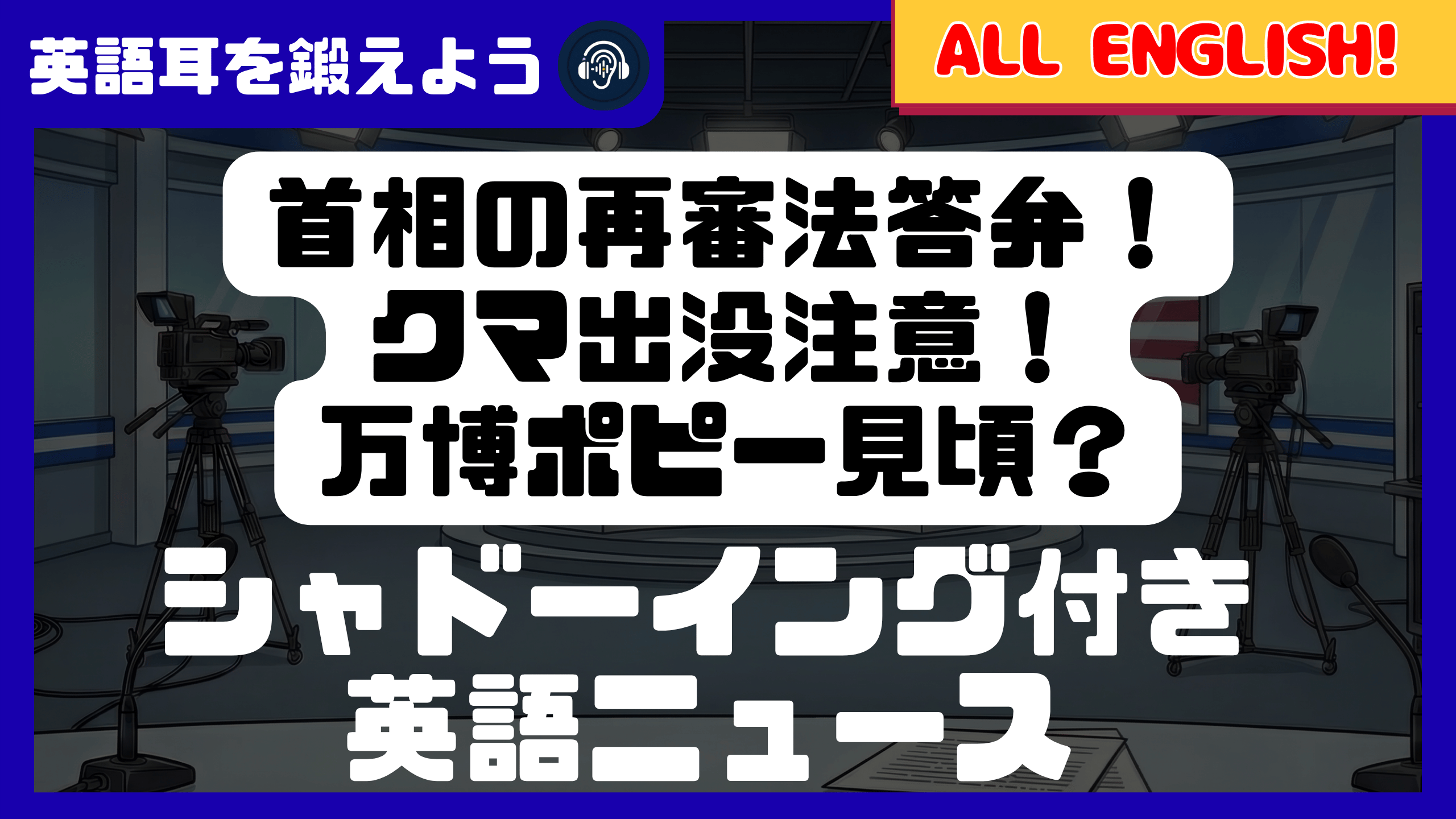
【シャドーイング付き英語ニュース】首相の再審法答弁!クマ出没注意!万博ポピー見頃? | リスニング強化
英語ニュース2026/4/29

【シャドーイング付き英語ニュース】首相の再審法答弁!クマ出没注意!万博ポピー見頃? | リスニング強化

【シャドーイング付き英語ニュース】首相の再審法答弁!クマ出没注意!万博ポピー見頃? | リスニング強化

シェア:

YouTube「スキマ時間で英語を学ぼう」の英語ニュース解説です。

動画と合わせてリスニング・シャドーイングにご利用ください。


スクリプト

Welcome to Sukima English News! I'm Sarah. (スキマ英字ニュースへようこそ!サラです。)

And I'm Marc. (そして、マークです。)

Today, we're looking at politics, wildlife, and beautiful flowers. (今日は、政治、野生動物、そして美しい花について見ていきます。)

First, a minister's comments on legal reviews. (まずは、法改正に関する大臣の発言です。)

Then, a bear sighting in Akita and a public warning. (次に、秋田でのクマの目撃情報と、それに関する注意喚起です。)

And finally, a stunning poppy display in Osaka. (そして最後に、大阪での見事なポピーの展示です。)

Our first story concerns Prime Minister Takaichi's comments on reviewing criminal retrial laws. (私たちの最初のニュースは、刑事再審法改正に関する高市大臣の発言についてです。)

He stated it's not for his political judgment alone, indicating internal party disagreements. (これは自分一人の政治的判断ではないと述べ、党内の意見の相違を示唆しました。)

So, what exactly is this retrial law, and why the LDP stir? (では、この再審法とは具体的に何で、なぜ自民党内で騒ぎになっているのでしょうか?)

The retrial system, "saishin seido," helps wrongly convicted people. (「再審制度」は、誤って有罪判決を受けた人々を救済するためのものです。)

It's meant to correct miscarriages of justice, but has structural problems. (これは司法の誤りを正すためのものですが、構造的な問題を抱えています。)

A major issue: when a court grants a retrial, prosecutors often appeal. (大きな問題は、裁判所が再審を認めた場合、検察官がしばしば控訴することです。)

This appeal process, "kokoku," delays or prevents relief for the wrongly accused. (この「抗告」という手続きが、誤って告発された人々の救済を遅らせたり、妨げたりします。)

So, prosecutors can block retrial decisions? That's a significant hurdle. (つまり、検察官は再審の決定を阻止できるということですか?それは大きな障害ですね。)

Exactly. The Ministry of Justice considers revising the law to largely prohibit these appeals. (その通りです。法務省は、これらの抗告を原則禁止するよう法律の改正を検討しています。)

But within the LDP, there's strong opposition to a complete ban, causing a stalemate. (しかし、自民党内では、全面禁止に強い反対があり、膠着状態となっています。)

And Takaichi's comment reflects this difficulty in reaching consensus? (そして、高市大臣の発言は、この合意形成の難しさを反映しているということですか?)

That's right. It highlights the challenge of passing the bill. (その通りです。法案成立の難しさを浮き彫りにしています。)

Let's look at data. In 2022, out of 252 retrial requests, zero resulted in a grant. (データを見てみましょう。2022年には、252件の再審請求のうち、認められたものはゼロでした。)

Data from 2020 onwards shows retrial grants are below one percent. (2020年以降のデータによると、再審の認容率は1パーセント未満です。)

Zero percent in 2022? That emphasizes why it's called the "door that never opens." (2022年はゼロパーセントですか?それは「開かない扉」と呼ばれる理由を強調していますね。)

It does. And when a retrial is granted, prosecutorial appeals are common. (そうです。そして、再審が認められた場合でも、検察官による抗告は一般的です。)

This slows down freeing wrongly convicted individuals. (これが、誤って有罪判決を受けた人々の解放を遅らせているのです。)

The data also mentions evidence disclosure issues, leading to "retrial disparities." What's that? (データには、証拠開示の問題にも触れられており、「再審格差」につながっているとのことですが、それは何ですか?)

It means rules for prosecutors to disclose evidence during retrials are unclear. (再審手続きにおいて、検察官が証拠を開示する際のルールが不明確であるということです。)

This lack of clarity creates unfairness, as access to crucial evidence varies greatly. (この不明確さが不公平を生み出しており、重要な証拠へのアクセスが大きく異なります。)

So, even if a retrial is granted, the process can be unfair due to unclear evidence rules. (つまり、再審が認められたとしても、証拠開示のルールが不明確なために、手続きが不公平になる可能性があるということですね。)

Precisely. Japan's conviction rate in first-instance trials is extremely high, around 99.9% in some years. (まさにその通りです。日本の第一審の有罪率は、年によっては約99.9%と非常に高いです。)

In 2023, it was 95.5%. While diligent prosecution, it raises concerns about wrongful convictions. (2023年は95.5%でした。これは検察の熱心さを示す一方で、誤判の懸念も生じさせます。)

A high conviction rate could contribute to the problem if correcting errors is so difficult. (有罪率の高さが、誤りを正すことがこれほど難しい場合、問題の一因となる可能性があります。)

It's a valid concern. Difficulty accessing retrials and frequent appeals directly impact those seeking exoneration. (再審請求へのアクセスが難しかったり、控訴が頻繁だったりすることは、無実を求める人々に直接影響します。)

If these issues aren't resolved, the path to justice for the wrongly convicted remains incredibly difficult. (これらの問題が解決されないと、冤罪を負わされた人たちが正義にたどり着く道は、非常に困難なままです。)

So, this isn't just a legal technicality; it has profound human consequences. (ですから、これは単なる法的な技術的な問題ではなく、深刻な人道的な結果をもたらすものです。)

Absolutely. It's about fundamental rights and ensuring the justice system can correct its mistakes. (まったくその通りです。これは基本的人権に関わることであり、司法制度がその過ちを正せるようにすることです。)

The LDP debate and Takaichi's cautious statement show the complexity of reforming this system. (自民党の議論や高市氏の慎重な発言は、この制度を改革することの複雑さを示しています。)

It makes you wonder how long these changes will take. (この改革にどれくらい時間がかかるのか、不思議に思えてきます。)

And how many more might suffer while discussions continue. (そして、議論が続く間に、どれだけ多くの人が苦しむことになるのか。)

The implications are significant for the fairness and trustworthiness of Japan's judicial process. (これは、日本の司法プロセスの公平性と信頼性にとって、重大な意味合いを持ちます。)

It's a critical issue affecting everyone's sense of security in the legal system. (これは、法制度に対する人々の安全意識に影響を与える、非常に重要な問題です。)

Indeed. We'll follow this story. (本当にそうですね。この件は追っていきましょう。)

Moving on. (次に移りましょう。)

Let's shift gears to a growing concern across Japan: bears. (では、日本全国で高まっている懸念、クマについて話を変えましょう。)

Oh? What's happening? (あら?どうしたんですか?)

A bear sighting in Odate City, Akita Prefecture, on April 27th. It was about one meter long. Police urge caution. (4月27日、秋田県大館市でクマが目撃されました。体長は約1メートルでした。警察は注意を呼びかけています。)

That sounds alarming. Is this isolated? (それは心配ですね。これは単独の事例ですか?)

It's part of a larger trend. Bear sightings have been increasing nationwide. (これはより大きな傾向の一部です。全国的にクマの目撃情報が増えています。)

What's causing this? (何が原因なんですか?)

Depopulation and aging in rural areas lead to abandoned farmland, bringing wild spaces closer to settlements. (農村部での人口減少と高齢化により、耕作放棄地が増え、野生の空間が人家に近づいています。)

So, more wild spaces near humans. (つまり、人間の近くに野生の空間が増えているんですね。)

Exactly. Also, changes in wildlife protection laws have reduced hunters. (その通りです。また、野生動物保護法の改正により、狩猟者が減っています。)

And environmental factors? (環境的な要因は?)

Yes, climate change and poor harvests of nuts and fruits are contributing factors. (はい、気候変動や、木の実や果物の不作も要因となっています。)

It's complex. You mentioned Akita. (複雑ですね。秋田について言及されましたね。)

Akita sees many sightings. In October 2025, over 6,200 sightings. (秋田では多くの目撃情報があります。2025年10月には、6,200件以上の目撃情報がありました。)

Wow. And this isn't the first in Odate recently? (すごい。そして、これは最近大館で初めてのことではないんですか?)

No, a day before, a cub was seen on a residential property. They're coming closer to homes. (いいえ、その前日には、住宅地で子グマが目撃されています。家にも近づいてきているんです。)

That's worrying. What about national statistics? (それは心配です。全国の統計はどうですか?)

In fiscal year 2023, a record 198 human injury cases from bears, involving 219 people. (2023年度は、クマによる人身被害が過去最多の198件で、219人が被害に遭いました。)

A record? And it's continuing. (過去最多?そして、それは続いてるんですね。)

By October 25th of fiscal year 2025, there had already been 10 bear-related deaths, surpassing the fiscal year 2023 record. (2025年度の10月25日までに、すでにクマによる死者が10人出ており、2023年度の記録を上回っています。)

Incredibly concerning. Specific regions hit harder? (すごく心配ですね。特定の地域がよりひどいんですか?)

Yes, the Tohoku region, including Akita and Iwate, sees a concentration of incidents. (はい、秋田や岩手を含む東北地方で、被害が集中しています。)

So, Akita has significant problems. (じゃあ、秋田は深刻な問題を抱えているんですね。)

In Akita alone, by April 26th, 2026, over 21,000 cumulative bear sightings. (秋田だけで、2026年4月26日までに、クマの目撃情報が累計で2万1000件を超えています。)

Twenty-one thousand? That's enormous. (2万1000件?それはすごい数ですね。)

And it's not just sightings. Agricultural damage is a major issue. (しかも、目撃情報だけじゃありません。農作物への被害も大きな問題です。)

How much damage? (どれくらいの被害なんですか?)

Nationally, agricultural damage in fiscal year 2023 was about 747 million yen, nearly double the previous year. (全国では、2023年度の農作物被害額は約7億4700万円で、前年度の倍近くになっています。)

A huge economic impact. (経済的な影響が大きいですね。)

Akita alone recorded over 166 million yen in agricultural damage in fiscal year 2023, a record high for them. (秋田だけでも、2023年度の農作物被害額は1億6600万円を超え、過去最高を記録しました。)

So, safety and economic issues. (ということは、安全面と経済面の問題ですね。)

Precisely. And the financial burden extends to local governments. (まさに。そして、その経済的な負担は地方自治体にも及んでいます。)

How so? (どういうことですか?)

Areas with frequent bear activity see impacts on property values and tourism. Plus, bear control costs are rising. (クマの出没が多い地域では、地価や観光業への影響があります。それに、クマ駆除の費用も増えています。)

That strains local budgets. (それは地方の財政を圧迫しますね。)

It does. Hokkaido allocated about 24 million yen for bear control in fiscal year 2025. (そうなんです。北海道は2025年度、クマ対策に約2400万円を計上しました。)

Other prefectures doing the same? (他の県も同じようなことをしているんですか?)

Yes, Miyagi's Kurihara City allocated over 70 million yen for measures like rewards and clearing fruit trees. (はい、宮城県栗原市は、報奨金や果樹の伐採などの対策に7000万円以上を計上しました。)

A nationwide challenge requiring significant investment. (全国的な課題で、多額の投資が必要なんですね。)

It is. The Odate sighting reflects this broader problem. (そうです。大館の目撃情報も、この広範な問題の表れです。)

So, what's being done? (では、具体的に何がされているんですか?)

Governments need to manage habitats, improve information sharing, educate the public, and enhance control systems. (政府は、生息地の管理、情報共有の改善、住民への啓発、そして駆除体制の強化が必要です。)

Technological solutions? (技術的な解決策は?)

Yes, AI-powered detection and ICT for sharing sighting information could help reduce damage. (はい、AIによる検知や、目撃情報の共有のためのICTを活用することで、被害を減らせる可能性があります。)

It impacts daily lives and safety across Japan. (日本全国の日常生活や安全に影響を与えているんですね。)

It certainly does. This trend underscores the need for vigilance and proactive measures. (まさにその通りです。この傾向は、警戒と予防策の必要性を浮き彫りにしています。)

Let's talk about Expo Commemoration Park in Suita City, Osaka. (大阪府吹田市の万博記念公園について話しましょう。)

The Tower of the Sun park? (太陽の塔の公園ですか?)

Yes. The "Hill of Flowers" has about 200,000 poppies blooming. (はい。「花の丘」には、約20万本のポピーが咲いています。)

Two hundred thousand poppies! That must be amazing. (20万本のポピー!それは素晴らしいでしょうね。)

The park was the site of the 1970 Japan World Exposition. (その公園は1970年の日本万国博覧会の会場でした。)

So, it has history and seasonal flower events. (だから、歴史もあって、季節ごとの花イベントもあるんですね。)

Exactly. Poppies are a springtime tradition. With the 2025 Osaka-Kansai Expo, interest is growing. (そうなんです。春にはポピーが定番で。2025年の大阪・関西万博もあって、注目度が高まっています。)

When is the peak bloom? (見頃はいつ頃ですか?)

As of April 22nd, Icelandic and California poppies are in full bloom, with other varieties starting to open. Peak is mid to late May. (4月22日現在、アイスランドポピーやカリフォルニアポピーが見頃で、他の品種も咲き始めています。見頃のピークは5月中旬から下旬です。)

Good to know. What are visitor numbers for the park? (なるほど。公園の来園者数はどれくらいなんですか?)

The Natural and Cultural Garden gets over 2 million visitors annually. (自然文化園には年間200万人以上が訪れます。)

Over two million! (200万人以上!)

Periods with seasonal flowers like poppies draw large crowds. (ポピーのような季節の花が見られる時期は、多くの人が集まります。)

I can imagine. In 2023, the Natural and Cultural Garden had 2.38 million visitors, up 3.9%. (そうでしょうね。2023年の自然文化園の来園者数は238万人で、3.9%増加しました。)

A steady increase. Now, the broader Japanese flower market. (着実に増えているんですね。では、日本の花市場全体についてですが。)

How is it doing? (どうなんでしょうか?)

Projected to reach 3.5 trillion yen by 2025. (2025年には3兆5000億円規模になると予測されています。)

Three point five trillion yen! (3兆5000億円!)

Expected to grow to 5.1 trillion yen by 2034, with 4.09% annual growth. (2034年には5兆1000億円に成長し、年平均成長率は4.09%と見込まれています。)

What's driving growth? (何が成長を牽引しているんですか?)

Cultural traditions, festivals, smart agriculture tech, and home demand. (伝統文化、祭り、スマート農業技術、そして家庭での需要です。)

Interesting how flowers are valued. (花が大切にされているんですね。)

Indeed. While planting area is decreasing, key areas are Aichi, Chiba, and Fukuoka. (ええ。栽培面積は減少していますが、主要な産地は愛知、千葉、福岡です。)

What about Osaka? (大阪はどうですか?)

Osaka cut flower production has declined significantly between 2007 and 2022, with a 35 percent decrease in planting area. (大阪の切り花生産は2007年から2022年にかけて大幅に減少し、栽培面積は35%減少しました。)

That's a steep decline. (かなり減ったんですね。)

However, Osaka has a 10% share in the Kinki region's flower production, after Wakayama, Nara, and Hyogo. (ただ、大阪は近畿地方の花き生産において、和歌山、奈良、兵庫に次いで10%のシェアを占めています。)

So, still important. (それでも重要なんですね。)

Right. Now, parks and green spaces. (そうです。では、公園や緑地についてですが。)

The situation? (状況は?)

As of fiscal year 2024, per capita urban park area is about 11.0 square meters. (2024年度の都市公園の人口一人当たりの面積は約11.0平方メートルです。)

Seems low. (少ないですね。)

It is. Park development is crucial for disaster prevention, revitalization, and biodiversity. (そうなんです。公園整備は防災、地域活性化、生物多様性のために不可欠です。)

Expo Commemoration Park, at 264 hectares, is a significant urban park. (万博記念公園は264ヘクタールあり、重要な都市公園です。)

Absolutely. And for Osaka tourism, it's a major contributor. (もちろんです。大阪の観光にとっても、大きな貢献をしています。)

Osaka is a popular tourist destination. (大阪は人気の観光地です。)

In 2018, foreign tourists hit a record 12.6 million. (2018年には、外国人観光客が過去最高の1260万人に達しました。)

Recovering well after COVID-19. (コロナ禍からの回復も順調です。)

Yes, estimated foreign visitors to Osaka in 2024 are 14.639 million. (はい、2024年の大阪への外国人訪問者数は1463万9000人と推定されています。)

Wow, a significant recovery. (わあ、すごい回復ですね。)

Estimated spending is 1.393 trillion yen. Expo Commemoration Park is a key tourism resource. (消費額は1兆3930億円と推定されています。万博記念公園は主要な観光資源です。)

So, the poppies are part of cultural value, economic activity, and visitor attraction. (つまり、ポピーは文化的な価値、経済活動、そして観光客誘致の一部なんですね。)

Precisely. Natural attractions, well-maintained, have tangible economic and social impact. (まさに。自然の魅力は、きちんと整備されていれば、はっきりとした経済的・社会的な影響を与えます。)

Makes you appreciate these spaces more. (こういう場所をより大切に思えてきますね。)

True. Beautiful scenery connects with tourism and local economies. (本当ですね。美しい景色は観光や地域経済と結びつきます。)

Wonderful to see nature contributing to Osaka's appeal. (自然が大阪の魅力に貢献しているのを見るのは素晴らしいことです。)

It really is. For Japanese people, seasonal flower events hold a special place, evoking memories and the changing seasons. (本当にそうですね。日本人にとって、季節の花のイベントは特別な意味を持ち、思い出や季節の移ろいを呼び起こします。)

That connection to nature is beautiful. (自然とのつながりって素敵ですね。)

It is. Many look forward to it each year. (ええ。毎年楽しみにしている人も多いです。)

A reminder of nature's simple joys. (自然のささやかな喜びを思い出させてくれます。)

Definitely. These poppy fields are a perfect illustration. (まさに。このポピー畑は完璧な例です。)

今日のキーワード

PR

シャドーイング用セクション

B: Now let's try some shadowing practice. We'll go over sentences using the key vocabulary. (さあ、シャドーイングの練習をしましょう。キーとなる単語を使った文をやっていきます。)

B: It was a clear miscarriage of justice when the wrong person was convicted. (間違った人が有罪判決を受けたのは、明らかな冤罪でした。)

A: Let's try that one more time at normal speed. (では、もう一度普通のスピードでやってみましょう。)

B: It was a clear miscarriage of justice when the wrong person was convicted. (間違った人が有罪判決を受けたのは、明らかな冤罪でした。)

B: The rise in remote work is part of a larger trend towards flexible employment. (リモートワークの増加は、より大きな柔軟な雇用という流れの一部です。)

A: Let's try that one more time at normal speed. (では、もう一度普通のスピードでやってみましょう。)

B: The rise in remote work is part of a larger trend towards flexible employment. (リモートワークの増加は、より大きな柔軟な雇用という流れの一部です。)

B: Discussions about the new policy have reached a stalemate, with no agreement in sight. (新しい政策に関する議論は、合意の見通しもなく、行き詰まっています。)

A: Let's try that one more time at normal speed. (では、もう一度普通のスピードでやってみましょう。)

B: Discussions about the new policy have reached a stalemate, with no agreement in sight. (新しい政策に関する議論は、合意の見通しもなく、行き詰まっています。)

B: Lack of exercise and poor diet are contributing factors to the growing obesity rates. (運動不足と食生活の乱れが、肥満率の上昇に寄与しています。)

A: Let's try that one more time at normal speed. (では、もう一度普通のスピードでやってみましょう。)

B: Lack of exercise and poor diet are contributing factors to the growing obesity rates. (運動不足と食生活の乱れが、肥満率の上昇に寄与しています。)

B: The cherry blossoms reached their peak bloom last week, attracting many visitors to the park. (先週、桜が満開になり、公園には多くの人が訪れました。)

A: Let's try that one more time at normal speed. (では、もう一度普通のスピードでやってみましょう。)

B: The cherry blossoms reached their peak bloom last week, attracting many visitors to the park. (先週、桜が満開になり、公園には多くの人が訪れました。)

B: The park reported a significant increase in human injury cases due to encounters with wildlife this year. (今年は、野生動物との遭遇による人的負傷事例が大幅に増加したと公園は報告しました。)

A: Let's try that one more time at normal speed. (では、もう一度普通のスピードでやってみましょう。)

B: The park reported a significant increase in human injury cases due to encounters with wildlife this year. (今年は、野生動物との遭遇による人的負傷事例が大幅に増加したと公園は報告しました。)

B: Great job, everyone! Keep practicing these phrases. (皆さん、よくできました!これらのフレーズの練習を続けてください。)

That's all the time we have for today's Sukima English News. (今週のスキマ英語ニュースはここまでです。)

Remember to subscribe and practice English every day. (チャンネル登録と、毎日英語の練習をすることを忘れないでください。)

See you next time! (また次回お会いしましょう!)

Goodbye! (さようなら!)

PR
シェア:

関連記事