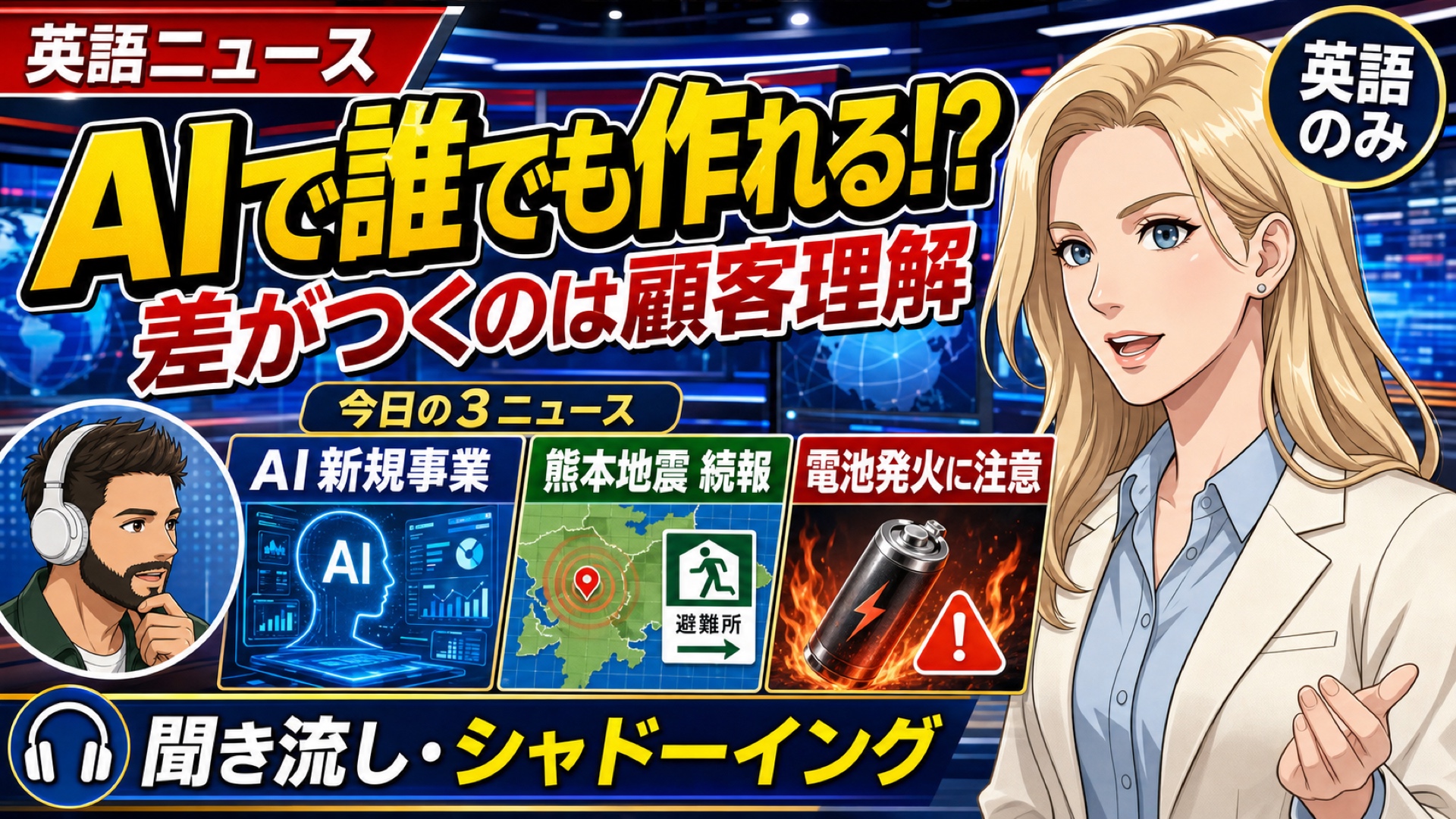
【シャドーイング付き英語ニュース】AI新時代!熊本豪雨!電池発火注意? | リスニング強化
【シャドーイング付き英語ニュース】AI新時代!熊本豪雨!電池発火注意? | リスニング強化
YouTube「スキマ時間で英語を学ぼう」の英語ニュース解説です。
動画と合わせてリスニング・シャドーイングにご利用ください。
スクリプト
Welcome to Sukima English News! I'm Sarah. (スキマ英語ニュースへようこそ!サラです。)
And I'm Marc. (マークです。)
Today, three stories from Japan — a big shift in how new business gets built with AI, the latest from the Kumamoto earthquake, and a summer warning about the batteries in your bag. (今日は日本から3つのニュースです。AIで新しいビジネスが生まれる仕組みの大きな変化、熊本地震の最新情報、そしてバッグの中のバッテリーに関する夏の注意報です。)
Business, disaster, and everyday safety. Let's get into it. (ビジネス、災害、そして日々の安全。早速見ていきましょう。)
Our first story comes from Toyo Keizai — a piece by Yoichi Aso, who runs AlphaDrive and wrote a book on new business. (最初のニュースは東洋経済からです。新規事業に関する著書があり、アルファドライブを率いる麻生要一さんの記事です。)
What's his main point? (どんな主張なんですか?)
The old idea was that salarymen inside big companies just can't launch new businesses. (かつての考えは、大企業に勤めるサラリーマンは新しい事業を立ち上げられない、というものでした。)
Right, that "you need a startup mindset, not a company mindset" narrative. (そう、「会社人間ではなく、スタートアップ的なマインドセットが必要だ」という話ですね。)
Aso says that idea is collapsing — because generative AI has changed what a small team can actually build. (麻生さんによると、その考えは崩れつつあります。生成AIによって、小さなチームが実際に作れるものが変わったからです。)
What's the change? Faster prototyping? (どんな変化ですか?プロトタイピングが速くなったとか?)
More than that. In the old model, you'd build an MVP — a minimum viable product — and get feedback. (それ以上です。古いモデルでは、MVP、つまり実用最小限の製品を作ってフィードバックを得ていました。)
Then iterate for months. (そこから何カ月もかけて改善していくわけですね。)
Right. But with generative AI, you can now push something much closer to a finished product straight into the market. (ええ。しかし、生成AIを使えば、完成品に近いものをそのまま市場に投入できるようになりました。)
So the launch bar moves up. What's the new challenge for teams? (つまり、発売時点で求められる水準が上がるわけですね。では、チームにとっての新しい課題は何ですか?)
Aso says the new challenge is reading the customer. (麻生さんによると、新しい課題は「顧客を読むこと」です。)
Reading the customer — meaning? (顧客を読む、というと?)
If anyone can build anything quickly, the difference is who really understands what the customer wants — and what they'd actually pay for. (誰でも何でもすぐに作れるなら、差がつくのは、顧客が本当に求めているもの、そして実際にお金を払ってくれるものを、誰が本当に分かっているかです。)
So the bottleneck moves from "can we build it" to "do we actually get the customer." (つまり、ボトルネックが「作れるかどうか」から「顧客を本当に分かっているかどうか」に移ったわけですね。)
Exactly. Ideas and prototypes get cheap. Real customer understanding gets expensive. (その通りです。アイデアやプロトタイプは安くなり、本物の顧客理解こそが高くつくようになります。)
That sounds like a lesson for any team, not just Japanese ones. (それは日本のチームだけでなく、どんなチームにとっても教訓になりそうですね。)
It really is. AI raises the floor for everyone — so the ceiling moves too. (本当にそうです。AIが全員の底上げをするので、上限も上がっていくわけです。)
Our next story comes from NHK — an update on the Kumamoto earthquake. (次のニュースはNHKからです。熊本地震の最新情報です。)
Right — the one they're now calling the Reiwa 8 Kumamoto Earthquake. What's the latest? (そう、今「令和8年熊本地震」と呼ばれている地震ですね。最新の状況はどうですか?)
As of 2 PM on August 5th, Kumamoto Prefecture reported 133 evacuation centers open, with 7,155 people staying in them. (8月5日午後2時現在、熊本県は133箇所の避難所を開設し、7,155人がそこに滞在していると報告しています。)
That's a lot of people still not home. (まだ家に帰れていない人がたくさんいるのですね。)
It is. And the death toll now stands at 38. (ええ。そして死者数は現在38人です。)
38 — is that all from the earthquake itself? (38人。それは全員、地震そのものによる死者ですか?)
That's the total count from the prefecture. One's suspected to be a disaster-related death, and one more's still under investigation. (それは県が発表した合計数です。1人は災害関連死の疑いがあり、もう1人はまだ調査中です。)
So there's still one case being sorted — direct death, or disaster-related. (つまり、直接死か災害関連死か、まだ判断中のケースが1件あるわけですね。)
Exactly. And that's a heavy line to draw, but an important one. (その通りです。重い線引きですが、大切なことです。)
What's the difference, for listeners hearing this term for the first time? (この言葉を初めて聞く方のために、違いを教えてもらえますか?)
A "direct death" is caused by the disaster itself — like a building collapse. A "disaster-related death" happens later, from things like illness or stress connected to the disaster. (「直接死」は、建物の倒壊のように、災害そのものによって亡くなることです。「災害関連死」は、その後、災害に関連する病気やストレスなどによって亡くなるケースです。)
So counting them separately actually matters — that's how you see what a quake really costs. (だから、別々に数えることが実際に大事なんですね。そうすることで、地震が本当にもたらした被害が見えてくるわけですね。)
It does. And it also matters for who gets support and how. (ええ。そして、誰がどのように支援を受けるかという点でも重要です。)
The situation is still moving day by day, isn't it? (状況は今も日々変わっているんですよね?)
It is. NHK is updating the numbers roughly twice a day, so today's shelter count won't match tomorrow's. (ええ。NHKはほぼ1日2回数字を更新しているので、今日の避難所の数字も、明日には変わっているでしょう。)
The one thing that doesn't change is how disrupted daily life still is for people there. (ただ一つ変わらないのは、現地の人たちの日常生活が今も大きく乱れたままだということです。)
That's the part to keep in mind — behind every one of these numbers is a family sleeping somewhere that isn't home. (そこを忘れてはいけませんね。これらの数字の一つ一つの裏に、自宅ではない場所で眠る家族がいるんです。)
Our last story is a summer safety warning, from the Asahi Shimbun. (最後にお伝えするのは、朝日新聞からの夏の安全に関する注意喚起です。)
What's the warning? (どんな注意喚起ですか?)
The article uses a pun — "natsu-bate" normally means "summer fatigue" for people, but here it's for your batteries. (記事ではダジャレが使われています。「夏バテ」は普通、人が夏の暑さで疲れることを言いますが、ここではバッテリーの話です。)
So — "summer fatigue" of your batteries. (つまり、「バッテリーの夏バテ」ですね。)
Exactly. Lithium-ion batteries in mobile chargers, phones, e-bikes — they get weak and dangerous in the heat. (その通りです。モバイルバッテリーや携帯電話、電動自転車などに使われるリチウムイオン電池は、暑さで劣化し、危険な状態になります。)
Who's warning us? (誰が注意を呼びかけているんですか?)
NITE — the National Institute of Technology and Evaluation. They're a public agency that tracks product accidents. (NITE、製品評価技術基盤機構です。製品事故を調べている公的機関です。)
What kind of accidents are they seeing? (どんな事故が起きているんですか?)
Two real cases, both from July 2024. First one — a teenage boy in Osaka was biking with a mobile battery in his bag, and heard a strange sound. (2024年7月の実際の事例が2件あります。最初の事例は、大阪の10代の少年が、カバンの中にモバイルバッテリーを入れて自転車に乗っていて、変な音を聞いたというものです。)
When he checked, it turned out the mobile battery inside had actually burned. (調べてみると、中のモバイルバッテリーが燃えていたことが分かりました。)
In his bag while he was riding? (乗っている最中に、カバンの中でですか?)
Yes. Something outside — maybe another item in the bag — pressed on the battery, and it overheated and caught fire. (はい。バッテリーの外から、おそらくカバンの中の別の物が押しつけられ、過熱して発火したとみられます。)
So just carrying it wrong is a real risk. (つまり、持ち運び方を誤るだけでも、実際に危険があるということですね。)
The other case was in Shiga. Someone left a mobile battery inside a parked car in the summer heat. (もう一つの事例は滋賀県です。夏の暑さの中、駐車中の車内にモバイルバッテリーを置きっぱなしにしていたケースです。)
In a hot car — I can picture that. (暑い車内ですか。目に浮かびますね。)
The pressure inside the battery rose until it burst. The flammable gas that came out caught fire, and the battery and everything around it burned too. (バッテリー内部の圧力が上昇し、破裂しました。そこから漏れ出た可燃性ガスに引火し、バッテリーとその周辺も燃えてしまいました。)
So heat, and impact — those are the two things to worry about. (つまり、気をつけるべきは熱と衝撃、この2つなんですね。)
Right. NITE has a few concrete things they want you to check. (ええ。NITEは、皆さんに確認してほしい具体的なことをいくつか挙げています。)
Let's hear them. (聞かせてください。)
First — check the recall list. Manufacturers, the Consumer Affairs Agency, and NITE all post them. (まず、リコール情報を確認してください。メーカー、消費者庁、NITEがそれぞれ公表しています。)
If your model's on the list, don't use it. (お使いの機種がリストにあれば、使用しないでください。)
Second — look for the "PSE mark" and the maker's name on the battery. (次に、バッテリーに「PSEマーク」とメーカー名があるか確認してください。)
PSE mark? (PSEマーク、ですか?)
It's a Japanese safety mark. If a lithium-ion battery is sold in Japan, with a few exceptions, it has to carry that mark. (日本の安全マークです。日本でリチウムイオン電池を売る場合、一部の例外を除いて、このマークを付けなければなりません。)
Good to know. (それは知っておくと便利ですね。)
And third — watch for warning signs. Won't charge, cuts out suddenly, drains fast, gets unusually hot while charging, or the shell is starting to swell. (そして3つ目は、異常のサインに気をつけることです。充電できない、急に電源が切れる、すぐに電池が減る、充電中に異常に熱くなる、本体が膨らみ始めている、といったサインです。)
Swelling is the one that always scares me. (膨らむのは、いつ見ても怖いんですよね。)
Same. If you see any of that, stop using it — don't wait for the smell of something burning. (私もです。どれか一つでも当てはまったら、使うのをやめてください。焦げ臭いにおいがするまで待ってはいけません。)
Got it. Heat, impact, warning signs — three things to keep in mind this summer. (分かりました。熱、衝撃、異常のサイン。この夏、覚えておきたい3つのポイントですね。)
今日のキーワード

Now let's look at some key vocabulary from today's stories. (では、今日のニュースに出てきた重要な単語を見ていきましょう。)
First, from the AI story, we have "read the customer" — really understanding what a customer wants and how they'll actually behave. (まずはAIのニュースから、「顧客を読む」。顧客が何を求め、実際にどう行動するかを本当に理解することです。)
Not just running a survey — actually getting inside their head. (アンケートを取るだけではなく、相手の頭の中にまで入り込むことですね。)
Right. For example: "AI can build the product. The hard part now is reading the customer." (そうです。例文:「AIは製品を作れる。今難しいのは、顧客を読むことだ」。)
Next, also from the AI story, "market-ready" — finished enough to be launched to real users, not just a rough prototype. (次もAIのニュースから、「市場投入できる」。ラフなプロトタイプではなく、実際のユーザーにリリースできるくらい完成している状態です。)
Something you could sell tomorrow, not just show in a demo. (デモで見せるだけでなく、明日にでも売れるもの、ということですね。)
Exactly. For example: "With generative AI, small teams can push out a market-ready product in weeks." (その通りです。例文:「生成AIを使えば、小さなチームでも数週間で市場投入できる製品を出せる」。)
From the Kumamoto story, "evacuation center" — a temporary place where people go when their home isn't safe to live in. (熊本のニュースから、「避難所」。家が安全に住める状態でないときに、人々が身を寄せる一時的な場所です。)
Schools and community halls often get used. (学校や公民館がよく使われますね。)
Right. For example: "As of 2 PM on August 5th, over 7,000 people were staying in evacuation centers." (そうです。例文:「8月5日午後2時時点で、7000人以上が避難所に身を寄せていた」。)
Also from Kumamoto, "disaster-related death" — a death that happens later because of the stress, illness, or conditions caused by the disaster, not the disaster itself. (同じく熊本のニュースから、「災害関連死」。災害そのものではなく、災害によるストレスや病気、生活環境が原因で、後になって亡くなることです。)
An important distinction — it changes how support gets counted, and who gets it. (大切な区別です。支援の数え方や、誰が支援を受けられるかが変わってきます。)
Exactly. For example: "One of the deaths in Kumamoto is being investigated as a possible disaster-related death." (その通りです。例文:「熊本の死者のうち1人は、災害関連死の可能性があるとして調査されている」。)
From the battery story, we have "overheat" — to get much hotter than it should, in a dangerous way. (バッテリーのニュースからは、「過熱する」。本来よりもずっと熱くなり、危険な状態になることです。)
Not just warm — hot enough to be a problem. (ただ温かいのではなく、問題になるほど熱い、ということですね。)
Right. For example: "A mobile battery left in a hot car can overheat and burst without warning." (そうです。例文:「暑い車内に置きっぱなしにしたモバイルバッテリーは、前触れなく過熱して破裂することがある」。)
And our last one, also from the battery story: "PSE mark" — the Japanese safety mark that lithium-ion batteries and other electrical products need to carry to be sold here. (最後もバッテリーのニュースから、「PSEマーク」。リチウムイオン電池などの電気製品を日本で販売するために、表示が必要な日本の安全マークです。)
A quick way to check that the battery was legally sold here. (そのバッテリーが日本で正規に販売されたものか、手軽に確かめられる目印ですね。)
For example: "Before you buy a portable battery, check that it carries the PSE mark." (例文:「モバイルバッテリーを買う前に、PSEマークが付いているか確認しよう」。)
シャドーイング用セクション
B: Time for shadowing practice. Let's use today's key vocabulary in real sentences from the news. (シャドーイング練習の時間です。今日の重要な語彙を、ニュースの実際の文で使ってみましょう。)
B: AI can build the product. The hard part now is reading the customer. (AIは製品を作れる。今難しいのは、顧客を読むことだ。)
A: Let's try that one more time at normal speed. (もう一度、普通のスピードでやってみましょう。)
B: AI can build the product. The hard part now is reading the customer. (AIは製品を作れる。今難しいのは、顧客を読むことだ。)
B: With generative AI, small teams can push out a market-ready product in weeks. (生成AIを使えば、小さなチームでも数週間で市場投入できる製品を出せる。)
A: Let's try that one more time at normal speed. (もう一度、普通のスピードでやってみましょう。)
B: With generative AI, small teams can push out a market-ready product in weeks. (生成AIを使えば、小さなチームでも数週間で市場投入できる製品を出せる。)
B: As of 2 PM on August 5th, over 7,000 people were staying in evacuation centers. (8月5日午後2時時点で、7000人以上が避難所に身を寄せていた。)
A: Let's try that one more time at normal speed. (もう一度、普通のスピードでやってみましょう。)
B: As of 2 PM on August 5th, over 7,000 people were staying in evacuation centers. (8月5日午後2時時点で、7000人以上が避難所に身を寄せていた。)
B: One of the deaths in Kumamoto is being investigated as a possible disaster-related death. (熊本の死者のうち1人は、災害関連死の可能性があるとして調査されている。)
A: Let's try that one more time at normal speed. (もう一度、普通のスピードでやってみましょう。)
B: One of the deaths in Kumamoto is being investigated as a possible disaster-related death. (熊本の死者のうち1人は、災害関連死の可能性があるとして調査されている。)
B: A mobile battery left in a hot car can overheat and burst without warning. (暑い車内に置きっぱなしにしたモバイルバッテリーは、前触れなく過熱して破裂することがある。)
A: Let's try that one more time at normal speed. (もう一度、普通のスピードでやってみましょう。)
B: A mobile battery left in a hot car can overheat and burst without warning. (暑い車内に置きっぱなしにしたモバイルバッテリーは、前触れなく過熱して破裂することがある。)
B: Before you buy a portable battery, check that it carries the PSE mark. (モバイルバッテリーを買う前に、PSEマークが付いているか確認しよう。)
A: Let's try that one more time at normal speed. (もう一度、普通のスピードでやってみましょう。)
B: Before you buy a portable battery, check that it carries the PSE mark. (モバイルバッテリーを買う前に、PSEマークが付いているか確認しよう。)
That's it for today's Sukima English News — how AI is quietly rewriting who can build a new business, the Kumamoto earthquake still shaping daily life for thousands, and a summer reminder to treat the batteries in your bag with care. (以上、今日のスキマ英語ニュースでした。新しいビジネスを誰が生み出せるのかをAIが静かに塗り替えていること、熊本地震が今も何千人もの日常生活に影を落としていること、そしてバッグの中のバッテリーを丁寧に扱うよう促す夏の注意喚起をお伝えしました。)
Three different stories, one thread — the small details behind the big picture. (話題は3つとも違いますが、共通点が1つあります。大きな出来事の裏にある、小さなディテールです。)
Keep practicing your English every day. See you next time. (毎日英語の練習を続けてください。また次回お会いしましょう。)
Bye for now! (では、また!)

関連記事
【シャドーイング付き英語ニュース】詐欺増加!漫画で注意喚起?ちいかわ大ヒット! | リスニング強化
【シャドーイング付き英語ニュース】詐欺増加!漫画で注意喚起?ちいかわ大ヒット! | リスニング強化
【シャドーイング付き英語ニュース】幻のモグラ発見!韓国映画で唐田えりか?羽田 小型機新規則! | リスニング強化
【シャドーイング付き英語ニュース】幻のモグラ発見!韓国映画で唐田えりか?羽田 小型機新規則! | リスニング強化
【シャドーイング付き英語ニュース】お菓子値上げ!冷しカプヌ秒殺?不発弾騒動解決! | リスニング強化
【シャドーイング付き英語ニュース】お菓子値上げ!冷しカプヌ秒殺?不発弾騒動解決! | リスニング強化
【シャドーイング付き英語ニュース】サムスン新Galaxy!山陽新幹線新デザイン?新世界夏祭り! | リスニング強化
【シャドーイング付き英語ニュース】サムスン新Galaxy!山陽新幹線新デザイン?新世界夏祭り! | リスニング強化
【シャドーイング付き英語ニュース】教科書用語減!減税反対!副首都構想にNO? | リスニング強化
【シャドーイング付き英語ニュース】教科書用語減!減税反対!副首都構想にNO? | リスニング強化
【シャドーイング付き英語ニュース】高市首相インドへ!ムーンライトながら復活?ダガー賞翻訳は? | リスニング強化
【シャドーイング付き英語ニュース】高市首相インドへ!ムーンライトながら復活?ダガー賞翻訳は? | リスニング強化