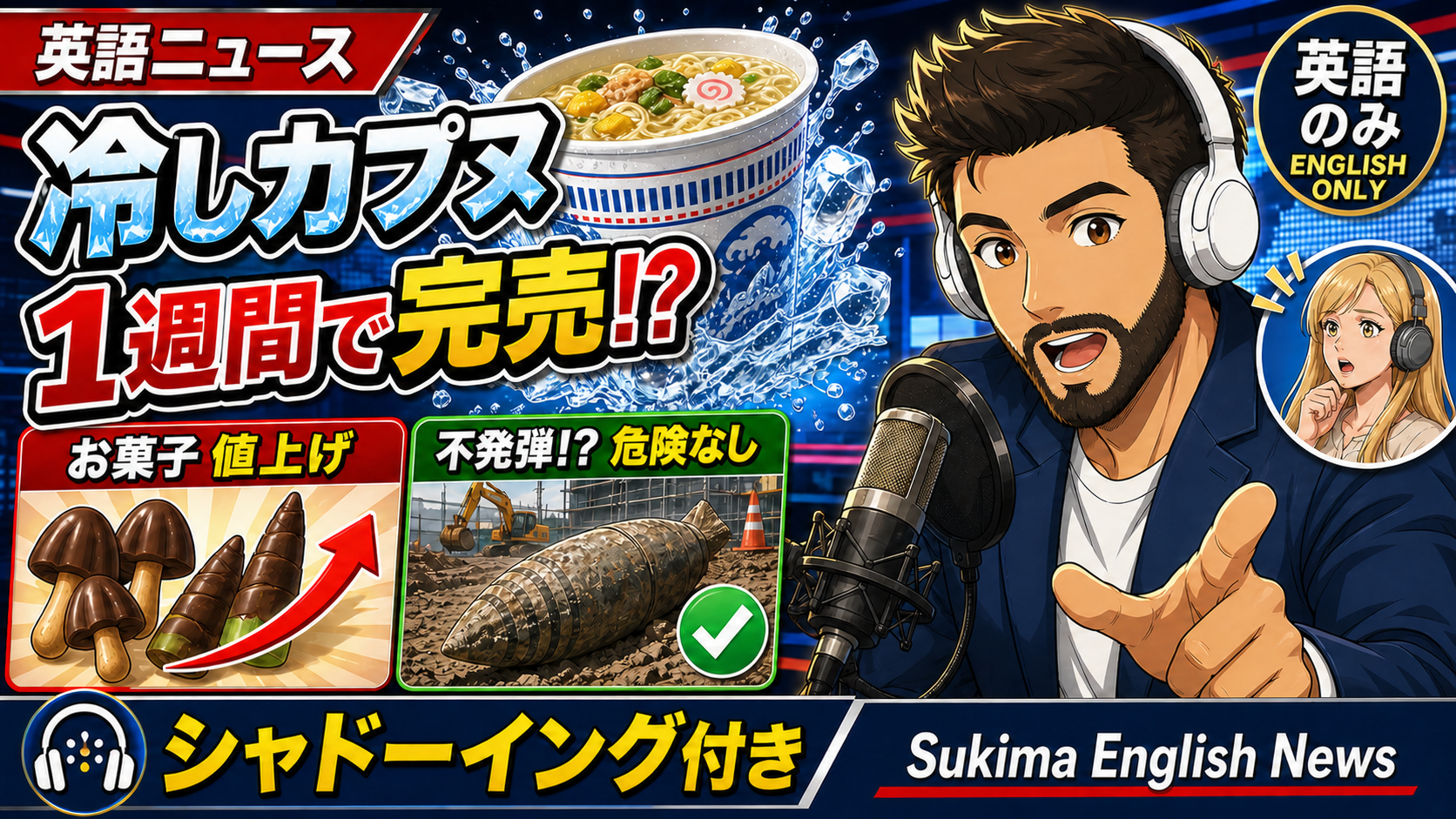
【シャドーイング付き英語ニュース】お菓子値上げ!冷しカプヌ秒殺?不発弾騒動解決! | リスニング強化
【シャドーイング付き英語ニュース】お菓子値上げ!冷しカプヌ秒殺?不発弾騒動解決! | リスニング強化
YouTube「スキマ時間で英語を学ぼう」の英語ニュース解説です。
動画と合わせてリスニング・シャドーイングにご利用ください。
スクリプト
Welcome to Sukima English News! I'm Sarah. (スキマ英語ニュースへようこそ!サラです。)
And I'm Marc. (そしてマークです。)
Today, three stories from Japan — a big snack maker raising prices, a cup noodle that only needs cold water, and an old wartime object turning up in Akita. (今日は日本から3つのニュースです。大手お菓子メーカーの値上げ、冷水だけで作れるカップ麺、そして秋田で見つかった戦時中の古い物体です。)
Prices, a hot summer product, and a piece of history. Let's get into it. (値上げ、夏の人気商品、そして歴史の一片。早速見ていきましょう。)
Our first story comes from NHK — Meiji has announced price hikes for some of its most iconic snacks. (まず最初のニュースはNHKからです。明治が、定番のお菓子のいくつかで値上げを発表しました。)
Which ones? (どんなお菓子ですか?)
Chocolate favorites like "Kinoko no Yama" and "Takenoko no Sato" — eleven items in total, across their chocolate and snack lineup. (「きのこの山」や「たけのこの里」といったチョコレート菓子です。チョコレートやスナック菓子全般で、合計11品目です。)
Kinoko no Yama and Takenoko no Sato — those are huge names in Japan. (きのこの山、たけのこの里。日本でとても有名な名前ですね。)
They are. If you grew up in Japan, you probably ate one or the other. Or you argued with a friend over which was better. (そうなんです。日本で育った人なら、どちらか一方を食べたことがあるでしょう。あるいは、どちらが美味しいか友達と議論したことがあるかもしれません。)
So why the price increase? (では、なぜ値上げになったんでしょうか?)
The main reason Meiji gives is that raw material costs have stayed high for a long time now. (明治が挙げる主な理由は、原材料費が長い間高いままだったことです。)
When you say "raw material costs," what does that cover for a chocolate snack? (「原材料費」と言うと、チョコレート菓子では何が含まれるのですか?)
Cocoa, sugar, dairy — the basics. All of them have been running expensive. (カカオ、砂糖、乳製品など、基本的なものです。どれも高値が続いています。)
And those costs stay with the product from the factory all the way to the store shelf. (そして、そのコストは工場から店頭に並ぶまで、製品にずっとかかってきます。)
Meiji says they've been trying to absorb the increases on their side. (明治は、自社でコスト上昇を吸収しようとしてきたと言っています。)
Meaning they've been eating the difference. (つまり、差額を自分たちでかぶってきたわけですね。)
Right. But at some point, that stops working, and the price on the shelf has to move up. (ええ。でも、ある時点になると、それは通用しなくなり、店頭価格を上げざるを得なくなります。)
That's the story of a lot of snack brands in Japan right now. (今、日本の多くのお菓子ブランドがそういった状況です。)
It really is. Food prices in general have been climbing, and families have been feeling it in their monthly budgets for a while. (本当にそうですね。食品全般の価格が上がっていて、家庭ではしばらく前から、毎月の家計でそれを実感しています。)
The tricky part is, these are small treats. A 30 or 50 yen bump doesn't sound huge on its own — (難しいのは、これらはちょっとしたおやつだということです。30円や50円の値上げは、それ単体ではそれほど大きく聞こえないかもしれませんが…)
— but if you buy them for the kids every week, or you're a convenience store owner ordering by the box, it stacks up fast. (…毎週子どものために買ったり、コンビニのオーナーが箱で注文したりすると、あっという間に積み重なります。)
A steady kind of pain, not a shock. (衝撃ではなく、じわじわくる痛みですね。)
Exactly. And people watch snack prices closely — probably closer than they realize. (そうなんです。そして人々は、お菓子の値段をよく見ています。おそらく、自分で思っている以上に注意深く。)
It'll be interesting to see if other confectionery makers follow. (他の菓子メーカーも追随するかどうか、興味深いですね。)
My guess is yes. Once one big player raises prices, the others usually can't stay behind for long. (私は、追随すると思います。大手が1社値上げすると、ほかも長くは据え置けないものです。)
Our next story is from Bloomberg — a cup noodle that broke the "just add hot water" rule. (次のニュースはブルームバーグからです。「お湯を注ぐだけ」というルールを破ったカップ麺です。)
Oh, this sounds like a fun one. (ああ、これは面白そうな話ですね。)
It's from Nissin Foods Holdings. This summer, they released a limited-edition product called "Cold Cup Noodle" — a cup noodle you prepare with cold water instead of hot. (日清食品ホールディングスの製品です。この夏、彼らは「冷やしカップヌードル」という限定商品を発売しました。熱湯ではなく冷水で作るカップ麺です。)
Cold water only? (冷水だけですか?)
Cold water only. And here's the surprise — Nissin expected the launch supply to last one to two months. (冷水だけです。そして驚くべきは、日清は発売当初の供給量が1~2ヶ月もつと予想していたことです。)
How long did it actually last? (実際には、どれくらいもったんですか?)
One week. The whole launch batch sold out in about a week. (1週間です。最初に出荷した分は、約1週間で完売しました。)
A week? For something people usually eat hot? (1週間ですか?普通は熱々で食べるものなのに?)
Yeah, it caught even Nissin off-guard. The actual sales numbers weren't made public, but "sold out in a week" tells you enough. (そうなんです。日清にとっても予想外だったようです。実際の販売数は公表されていませんが、「1週間で完売」と聞けば十分でしょう。)
So what's driving that kind of demand? (では、何がそんな需要を生んでいるんでしょう?)
Two things line up nicely. One, Japanese summers have been brutally hot recently — you don't really want to stand over a kettle in a hot apartment. (ちょうど2つの条件が重なりました。1つは、最近の日本の夏がとにかく暑いこと。暑い部屋で、やかんの前に立ちたくはないですよね。)
Right, hot water plus hot weather is a bad combination. (確かに、お湯と暑さは最悪の組み合わせですね。)
And two, novelty. "Cup noodles you make with cold water" is exactly the kind of thing that spreads on social media. (そして2つ目は、目新しさです。「冷たい水で作れるカップ麺」というのは、まさにSNSで広がりやすい話題なんです。)
I can picture influencers lining up to try it. (インフルエンサーたちがこぞって試す様子が目に浮かびますね。)
They did. And once something takes off online, keeping stock on shelves gets really hard. (実際にそうなりました。そして、ネットで火がつくと、店頭の在庫を保つのがすごく難しくなるんです。)
So Nissin has a supply problem to solve now. (つまり、日清は今、供給の問題を解決しなければならないんですね。)
They do. But it's a good problem to have — proof that people wanted something like this. (そうなんです。でも、それはうれしい悲鳴です。人々がこういうものを求めていた証拠ですからね。)
What do you take away from it as a food industry story? (食品業界のニュースとしては、ここから何が読み取れますか?)
The lesson for me is that even a very established product — cup noodles have been around for more than fifty years — still has room to break its own rules. (私が思うのは、カップ麺のように50年以上の歴史がある、すっかり定着した商品でも、自らのルールを破る余地がまだある、ということです。)
Change one basic assumption, and suddenly it's a new product. (基本的な前提を一つ変えるだけで、突然、新しい商品になるんですね。)
Exactly. And in a hot summer, "no hot water needed" isn't a gimmick. It's a real feature. (そのとおりです。暑い夏には、「お湯いらず」は単なる話題作りではありません。本当に役立つ特長なんです。)
Our last story is from ABS News — something that turned up at a construction site in Akita City. (最後のニュースはABSニュースからです。秋田市内の工事現場で見つかったものについてです。)
What was found? (何が見つかったんですか?)
On the afternoon of August 20th, workers spotted what looked like unexploded ordnance — a UXO — sticking out of the ground. (8月20日の午後、作業員が、地面から突き出ている不発弾のようなものを見つけました。)
That's the kind of find that stops everything on a site. (工事現場の作業が、すべて止まってしまうような発見ですね。)
It does. Police were called, and the Ground Self-Defense Force — the JGSDF — came out to check it. (そうなんです。警察が呼ばれ、陸上自衛隊が確認に来ました。)
And what did they find? (それで、結果はどうだったんですか?)
This is the good part. After they took a look, they said it wasn't a shell or a bomb at all. (ここからがいい話なんです。確認の結果、砲弾でも爆弾でもまったくないと判断されました。)
Oh — so it just looked like one. (なるほど、見た目が似ていただけなんですね。)
Right. It had the shape, but it turned out not to be dangerous. (そうです。形は似ていましたが、危険なものではないとわかりました。)
What a relief for the site — and for the neighborhood. (現場にとっても、近所の人たちにとっても、ひと安心ですね。)
Exactly. The restrictions around the area were lifted right after. (そのとおりです。周辺の規制も、すぐに解除されました。)
Why is Akita a place where this kind of thing keeps coming up? (どうして秋田では、こういうものがたびたび見つかるんですか?)
Akita, like a lot of Japanese cities, was affected by air raids in the final days of World War II. (秋田は、日本の多くの都市と同じように、第二次世界大戦の末期に空襲を受けたんです。)
So decades later, things can still turn up during construction. (だから何十年も経った今でも、工事中に見つかることがあるんですね。)
Right. When developers dig into old ground, sometimes the past comes back up with the soil. (そうですね。開発業者が古い土地を掘るとき、時々、過去のものが土と一緒に掘り起こされることがあります。)
Do we know of other recent cases in Akita? (秋田で最近あったほかの例はありますか?)
Yes — earlier this year, on May 8th, near JR Akita Station. (はい、今年の5月8日に、JR秋田駅の近くでありました。)
JR Akita Station — that's right in the city center. (JR秋田駅、それはまさに市の中心部ですね。)
A model-room demolition site there. Workers found what looked like a shell in the ground, and the area was cordoned off for a little over two hours until the JGSDF came and collected it. (そこにあったモデルルームの解体現場です。作業員が地面で砲弾のようなものを見つけ、陸上自衛隊が来て回収するまでの2時間あまり、その地域は封鎖されました。)
A short restriction, but still a real disruption for shops and commuters nearby. (短い規制ですが、近くの店や通勤客にとってはやはり大きな混乱でした。)
It is. And that's part of the pattern with these finds — even the ones that turn out to be harmless still stop nearby life for a while. (そうなんです。そして、それがこうした発見のパターンの一部なんです。無害だと判明したものさえ、しばらくは周辺の生活を止めてしまうんです。)
Traffic, foot traffic, the school run — everything shifts around it. (交通、人の流れ、送り迎え、すべてがそれに合わせて変わります。)
Which is why, when construction crews spot anything that looks like a shell, they call it in right away. (だからこそ、建設作業員は砲弾のようなものを見つけたら、すぐに通報するんです。)
Better to stop for two hours than to guess wrong. (間違った判断をするより、2時間止まる方がいいですから。)
Exactly. And this time, the story ended cleanly — not a shell, no danger, back to work. (まさにそのとおりです。そして今回は、すっきりと決着しました。砲弾ではなく、危険もなく、作業も再開されました。)
Still — a reminder of how the past sits just under the surface, even now. (それでも、今でも過去が地表のすぐ下にあるということを思い出させますね。)
今日のキーワード

Now let's look at some key vocabulary from today's stories. (さて、今日のニュースからいくつか重要な語彙を見ていきましょう。)
Our first phrase is "price increase" — when something becomes more expensive. (最初のフレーズは「値上げ」です。何かがより高価になることです。)
For example: "Meiji announced a price increase for their most popular snacks." (例えば、「明治は、一番人気のお菓子の値上げを発表した」。)
Simple, but you hear it every day in the news. (シンプルですが、ニュースで毎日耳にします。)
Next, from the second story: "sold out" — all of something has been bought, and there's none left. (次に、2つ目のニュースから「売り切れ」です。何かがすべて買われてしまい、もう残っていない状態です。)
For example: "The new cold cup noodles sold out in about a week." (例えば、「新しい冷たいカップ麺は、約1週間で売り切れた」。)
A short phrase that carries a lot of meaning. (短いフレーズですが、多くの意味を含んでいます。)
Also from the first story: "raw material" — the basic things you need to make a product, like cocoa or sugar for chocolate. (最初のニュースからも、「原材料」です。チョコレートのココアや砂糖のように、製品を作るために必要な基本的なものです。)
For example: "Meiji says raw material costs have stayed high for a long time." (例えば、「明治は、原材料費が長く高止まりしていると言っている」。)
You'll hear this one a lot in business news. (ビジネスニュースでよく聞く言葉です。)
From the third story: "unexploded ordnance" — bombs or shells that were dropped or fired but never went off, and can still be dangerous. (3つ目のニュースから、「不発弾」です。投下されたり発射されたりしたものの、爆発しなかった爆弾や砲弾で、まだ危険な場合があります。)
For example: "Workers spotted what looked like unexploded ordnance at the site." (例えば、「作業員が、現場で不発弾らしきものを見つけた」。)
A very specific term — worth knowing if you follow the news in Japan. (非常に専門的な言葉です。日本のニュースをフォローするなら知っておくと良いでしょう。)
Also from the third story: "cordon off" — to close off an area so people can't go in. (3つ目のニュースからも、「封鎖する」です。人が入れないように地域を閉鎖することです。)
For example: "The area near the station was cordoned off for about two hours." (例えば、「駅の近くのエリアは、約2時間封鎖された」。)
You hear this one for accidents, protests, all kinds of situations. (事故や抗議活動など、あらゆる状況でこの言葉を聞きます。)
And our last one, also from the third story: "turn out to be" — to end up being something, especially something different from what you first thought. (そして最後の言葉も3つ目のニュースから、「~だと判明する」です。結局~になること、特に最初に思ったものとは違うものになることです。)
For example: "The object turned out to be harmless." (例えば、「その物体は無害だと判明した」。)
A really useful phrase for telling a story in English. (物語を話すときにすごく役立つフレーズです。)
シャドーイング用セクション
B: Meiji announced a price increase for their most popular snacks. (明治は、一番人気のお菓子の値上げを発表した。)
A: Let's try that one more time at normal speed. (もう一度、普通のスピードでやってみましょう。)
B: Meiji announced a price increase for their most popular snacks. (明治は、一番人気のお菓子の値上げを発表した。)
B: The new cold cup noodles sold out in about a week. (新しい冷たいカップ麺は、約1週間で売り切れた。)
A: Let's try that one more time at normal speed. (もう一度、普通のスピードでやってみましょう。)
B: The new cold cup noodles sold out in about a week. (新しい冷たいカップ麺は、約1週間で売り切れた。)
B: Meiji says raw material costs have stayed high for a long time. (明治は、原材料費が長く高止まりしていると言っている。)
A: Let's try that one more time at normal speed. (もう一度、普通のスピードでやってみましょう。)
B: Meiji says raw material costs have stayed high for a long time. (明治は、原材料費が長く高止まりしていると言っている。)
B: Workers spotted what looked like unexploded ordnance at the site. (作業員たちが、現場で不発弾らしきものを見つけた。)
A: Let's try that one more time at normal speed. (もう一度、普通のスピードでやってみましょう。)
B: Workers spotted what looked like unexploded ordnance at the site. (作業員たちが、現場で不発弾らしきものを見つけた。)
B: The area near the station was cordoned off for about two hours. (駅の近くのエリアは、約2時間封鎖された。)
A: Let's try that one more time at normal speed. (もう一度、普通のスピードでやってみましょう。)
B: The area near the station was cordoned off for about two hours. (駅の近くのエリアは、約2時間封鎖された。)
B: The object turned out to be harmless. (その物体は無害だと判明した。)
A: Let's try that one more time at normal speed. (もう一度、普通のスピードでやってみましょう。)
B: The object turned out to be harmless. (その物体は無害だと判明した。)
That's it for today's Sukima English News — a big-name snack maker raising prices, a cup noodle rewriting its own rulebook, and a reminder from the ground in Akita. (今日のスキマ英語ニュースはここまでです。有名お菓子メーカーの値上げ、自らのルールを書き換えたカップ麺、そして秋田の地中から届いた、過去を思い出させる出来事でした。)
Three very different stories, one thread — everyday life in Japan, right now. (まったく違う3つの話ですが、共通点が一つあります。今の日本の日常、です。)
Keep practicing your English every day. See you next time. (毎日英語の練習を続けてください。また次回お会いしましょう。)
Bye for now! (それではまた!)

関連記事
【シャドーイング付き英語ニュース】詐欺増加!漫画で注意喚起?ちいかわ大ヒット! | リスニング強化
【シャドーイング付き英語ニュース】詐欺増加!漫画で注意喚起?ちいかわ大ヒット! | リスニング強化
【シャドーイング付き英語ニュース】幻のモグラ発見!韓国映画で唐田えりか?羽田 小型機新規則! | リスニング強化
【シャドーイング付き英語ニュース】幻のモグラ発見!韓国映画で唐田えりか?羽田 小型機新規則! | リスニング強化
【シャドーイング付き英語ニュース】AI新時代!熊本豪雨!電池発火注意? | リスニング強化
【シャドーイング付き英語ニュース】AI新時代!熊本豪雨!電池発火注意? | リスニング強化
【シャドーイング付き英語ニュース】サムスン新Galaxy!山陽新幹線新デザイン?新世界夏祭り! | リスニング強化
【シャドーイング付き英語ニュース】サムスン新Galaxy!山陽新幹線新デザイン?新世界夏祭り! | リスニング強化
【シャドーイング付き英語ニュース】教科書用語減!減税反対!副首都構想にNO? | リスニング強化
【シャドーイング付き英語ニュース】教科書用語減!減税反対!副首都構想にNO? | リスニング強化
【シャドーイング付き英語ニュース】高市首相インドへ!ムーンライトながら復活?ダガー賞翻訳は? | リスニング強化
【シャドーイング付き英語ニュース】高市首相インドへ!ムーンライトながら復活?ダガー賞翻訳は? | リスニング強化