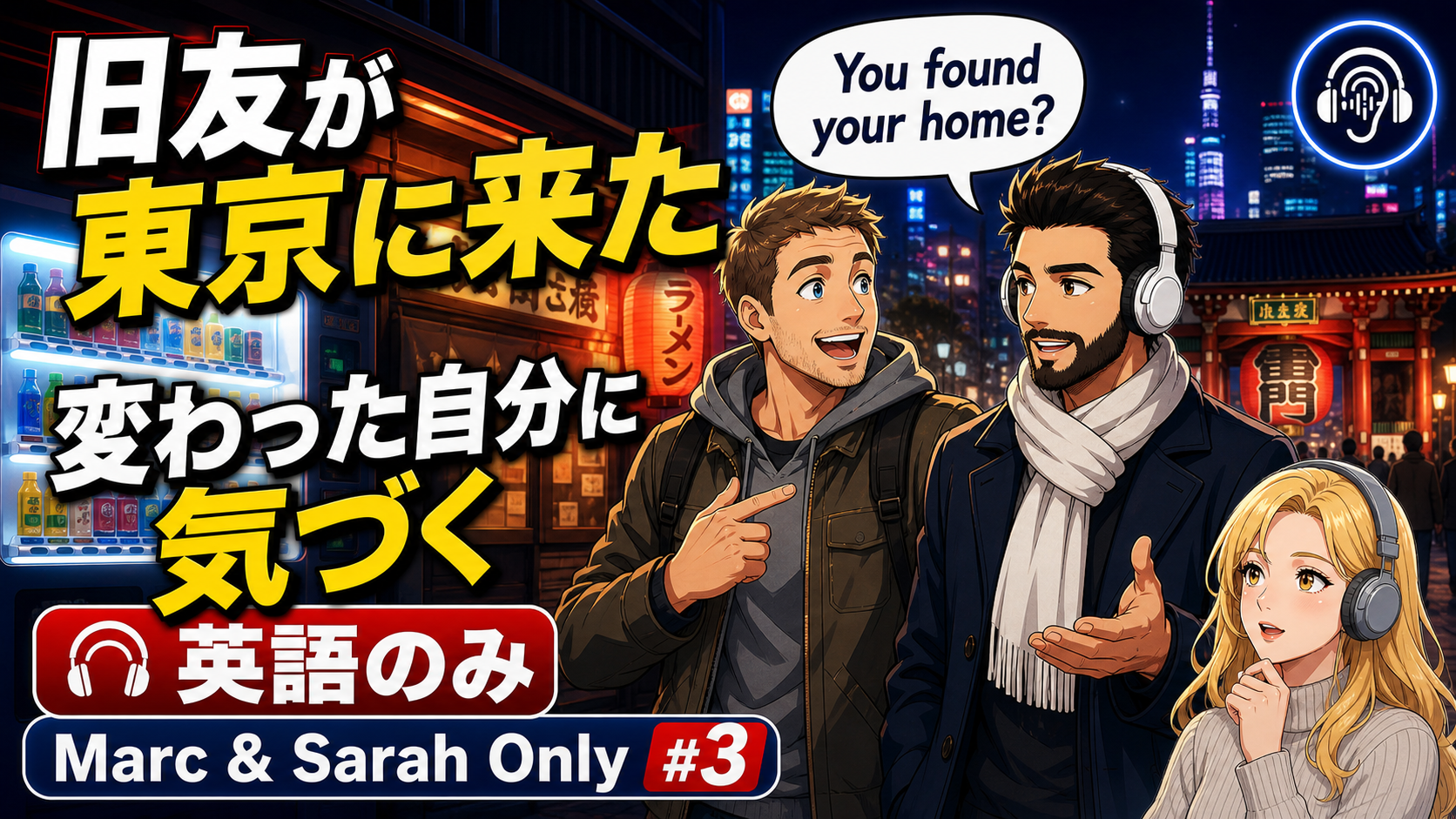
シカゴの親友 Ryan が3年ぶりに東京に来た一週間|ネイティブ2人の英語イマージョン会話
ポッドキャスト「すきまイングリッシュ」のスクリプト。「シカゴの親友 Ryan が3年ぶりに東京に来た一週間|ネイティブ2人の英語イマージョン会話」の会話全文です。

Marc: Sarah, can I tell you about the most disorienting week of my year? (日本語訳: サラ、今年一番戸惑った一週間について話してもいい?)
サラ: Always. (日本語訳: もちろん。)
Marc: Last week, my best friend from Chicago — Ryan — came to visit. First time he's been back to Tokyo in three years. (日本語訳: 先週、シカゴにいる親友のライアンが遊びに来たんだ。東京に来るのは3年ぶり。)
サラ: Wait. The Ryan? The Ryan who got you to come to Japan in the first place? (日本語訳: え、あのライアン? 君がそもそも日本に来るきっかけになった、あのライアン?)
Marc: That Ryan. (日本語訳: そう、あのライアン。)
サラ: I have been waiting to hear about this Ryan for years. (日本語訳: そのライアンの話、何年も聞きたかったんだ。)
Marc: Today's episode is — what happens when your best friend from your old life comes to visit your new life. It is, weirdly, both wonderful and exposing. (日本語訳: 今日のテーマは、昔の人生の親友が、今の人生を訪ねてきたらどうなるか。不思議なことに、最高でもあり、自分がさらけ出される感じもするんだ。)
サラ: Exposing how? (日本語訳: さらけ出されるって、どういうこと?)
Marc: I will get to it. Let me set it up properly. This was a strange week. (日本語訳: そこは後で話すよ。まず、ちゃんと順を追って説明させて。本当に不思議な一週間だったんだ。)
Marc: So Ryan flies in from Chicago. Solo trip. He used to live here. He moved back three years ago. Got married, has a kid now, the whole grown-up thing. (日本語訳: それでライアンがシカゴから飛んできた。一人旅。彼は昔ここに住んでて、3年前にシカゴへ戻ったんだ。結婚して、今は子どももいて、すっかり大人の暮らし。)
サラ: Solo trip though. (日本語訳: でも一人旅なんだ。)
Marc: Solo. Wife and son stayed home. He had a week, and he wanted to come to Tokyo and "remember what it felt like." That's exactly how he put it. (日本語訳: 一人でね。奥さんと息子さんは留守番。一週間あったから、東京に来て「あの頃の感覚を思い出したい」って。まさにそう言ってたんだ。)
サラ: I love that as a reason for travel. (日本語訳: 旅行の理由として最高だね。)
Marc: It is the best reason for travel. Better than vacation. He wanted to remember. (日本語訳: 最高の理由だよ。ただの休暇よりいい。彼は思い出したかったんだ。)
サラ: Where did you meet him? (日本語訳: どこで落ち合ったの?)
Marc: I went to pick him up at Narita. I waited at the Skyliner platform. I'm standing there, and the train pulls in, and Ryan steps off, and he just stood there for a second. Looking around. Like he was taking it in. (日本語訳: 成田まで迎えに行ったんだ。スカイライナーのホームで待ってた。立ってたら電車が入ってきて、ライアンが降りてきて、そのまま少し立ち止まってた。周りを見回して。全部を目に焼きつけるみたいに。)
サラ: Wide-eyed. (日本語訳: 目を丸くして?)
Marc: Completely wide-eyed. Like a tourist. And this is a guy who lived here for two years. (日本語訳: 完全に目を丸くして。まるで観光客みたいに。なのに、ここに2年住んでた男だよ。)
サラ: Three years away can do that. (日本語訳: 3年も離れてると、そうなるよね。)
Marc: It can do that. He hugged me. He said, "Marc, this place still smells the same." And I'm standing there thinking, what does Tokyo smell like? I have no idea anymore. (日本語訳: そうなるんだよ。彼は僕をハグして、「マーク、ここ、匂いが昔のままだな」って言ったんだ。僕はそこに立ったまま、東京ってどんな匂いだっけって考えてた。もう全然わからないんだ。)
サラ: That's the part that gets to you. You stop noticing your own city. (日本語訳: そこがグッとくるところだよね。自分の街に気づかなくなるんだ。)
Marc: Exactly. You stop seeing it. You stop smelling it. You stop hearing it. It just becomes the background of your life. (日本語訳: まさに。見えなくなる。匂いもわからなくなる。音も聞こえなくなる。ただの人生の背景になっちゃうんだ。)
サラ: Where did you take him first? (日本語訳: 最初にどこに連れて行ったの?)
Marc: Asakusa. Senso-ji. The classic. He'd been a hundred times when he lived here, but he wanted to see it again. He said it was non-negotiable. (日本語訳: 浅草。浅草寺。定番だね。ここに住んでた頃に100回は行ってたのに、もう一度見たいって。絶対に外せないって言ってた。)
サラ: A non-negotiable Senso-ji visit. (日本語訳: 浅草寺は絶対に外せない、か。)
Marc: A non-negotiable Senso-ji visit. And, Sarah, watching him at Senso-ji — the way he was looking at everything — I realized I had completely stopped seeing it. I walk through Asakusa once a month. I had forgotten how it looks. (日本語訳: 浅草寺は絶対に外せない。それでね、サラ、浅草寺であらゆるものを見つめる彼を見てたら、僕はもう全然見てなかったんだって気づいたんだ。浅草なんて月に一度は歩いてるのに、どんな景色か忘れてた。)
サラ: I'd forgotten how this looks. (日本語訳: こんな景色だったこと、忘れてた。)
Marc: I'd forgotten how this looks. He took out his phone for the smoke at the incense burner. The smoke. He stood in front of it for ten minutes. He said, "Look at this, Marc. We do not have anything like this." And I had to admit — yeah. We don't. (日本語訳: こんな景色だったこと、忘れてた。彼は香炉の煙をスマホで撮ってた。煙をだよ。その前に10分も立ってた。「見ろよ、マーク。こんなもの、うちの国にはないぞ」って。僕も認めるしかなかった。そう、ないんだよね。)
サラ: It's a familiar place that becomes new again. (日本語訳: 見慣れた場所が、また新鮮に見えるんだね。)
Marc: That is the strange double vision. Same temple, same smoke, same vendors selling those round senbei. But seen through the eyes of someone who used to live here and now visits — transformed. (日本語訳: それが不思議な二重写しなんだ。同じお寺、同じ煙、同じ丸いせんべいを売る店。でも、昔ここに住んでいて、今は訪ねてくる人の目を通すと、まるで別物になるんだ。)
サラ: Did he do the omikuji? (日本語訳: おみくじは引いたの?)
Marc: He did the omikuji. He shook the box. He pulled out a stick. He got — and I'm not making this up — kichi. Mid-grade luck. (日本語訳: おみくじも引いたよ。箱を振って、棒を1本出した。で、出たのが、嘘じゃないよ、「吉」。真ん中くらいの運。)
サラ: Mid-grade. Classic Ryan luck. (日本語訳: 真ん中くらい。いかにもライアンらしい運だね。)
Marc: Classic Ryan luck. He folded the paper and tied it to the rack. He said, "I'll take it. Mid-grade is honest." (日本語訳: いかにもライアンらしい運だよ。紙を折りたたんで、結び所に結んだ。「これでいいよ。真ん中くらいが正直だ」って言ってた。)
Marc: So I went into tour-guide mode. (日本語訳: それで僕はツアーガイドモードに入ったよ。)
サラ: Tour-guide mode is real. (日本語訳: ツアーガイドモード、本当にあるよね。)
Marc: Tour-guide mode is real and exhausting. And I had to explain things I haven't thought about in five years. Like, why everyone uses IC cards. Like, the difference between Yamanote and Marunouchi. Like, why convenience store food is good. (日本語訳: 本当にあるし、すごく疲れるんだ。5年間考えもしなかったことを説明しなきゃいけなくて。なんでみんなICカードを使うのかとか、山手線と丸ノ内線の違いとか、なんでコンビニのご飯がおいしいのかとか。)
サラ: He had questions. (日本語訳: 質問攻めだったんだ。)
Marc: He had so many questions. And every question forced me to look at my own life in Tokyo and say — wait. Why is that? (日本語訳: 質問だらけだったよ。しかも質問されるたびに、東京での自分の生活を見直して、「あれ、なんでだっけ?」って考えさせられたんだ。)
サラ: Like what? (日本語訳: 例えばどんな?)
Marc: Like, he asked me why people don't talk on the train. And I started to answer, and I realized — I don't know anymore. I just don't talk on the train. It became automatic. It is no longer a rule I'm following. It is a habit I have absorbed. (日本語訳: 例えば、電車でなんでみんな喋らないの?って聞かれたんだ。で、答えようとしたんだけど、あれ?もうわかんないなって思った。ただ電車で喋らないだけなんだ。それはもうルールを守ってるんじゃなくて、体に染み付いた習慣なんだ。)
サラ: I caught myself the same way last year. Someone asked me why I bow on phone calls. I said, "Wait, do I do that?" (日本語訳: 私も去年、同じようにハッとしたことがある。電話しながらなんでお辞儀するのって聞かれて、「え、私そんなことしてる?」って。)
Marc: You do that. (日本語訳: してるよ。)
サラ: I do that. And the explanation I gave was — I have no idea, but it's important. (日本語訳: してるんだよね。で、そのとき私がした説明が、「全然わからないけど、大事なこと」。)
Marc: The "I have no idea but it's important" answer. The classic ex-pat-who-stayed-too-long answer. (日本語訳: 「わからないけど大事」っていう答えね。長く住みすぎた外国人の典型的な答えだよ。)
サラ: Where else did you take him? (日本語訳: 他にどこに連れて行ったの?)
Marc: We took a day for Shinjuku at night. The Kabukicho area. The neon, the noise, the people. And Ryan said something I keep thinking about. He said, "Marc, this used to feel overwhelming to me. Now it feels familiar to you. And that is the difference." (日本語訳: 夜の新宿に丸一日使ったんだ。歌舞伎町のあたり。ネオン、騒音、人混み。そこでライアンが、今も考えちゃうことを言ったんだ。「マーク、昔の僕にはこれが圧倒される感じだった。今の君には見慣れた景色なんだよな。そこが違うんだ」って。)
サラ: That's a heavy line. (日本語訳: 重たいセリフだね。)
Marc: That is a very heavy line. I had to sit with that one for an hour. He's right. Shinjuku at night was overwhelming to me too, in my first year. Now I take meetings there. (日本語訳: 本当に重いセリフだよ。1時間くらい、その言葉をかみしめてた。彼の言う通りなんだ。夜の新宿は、僕も最初の年は圧倒されてた。今はそこで打ち合わせしてるんだから。)
サラ: Now you take meetings in places that used to feel like a movie set. (日本語訳: 昔は映画のセットみたいだった場所で、今は打ち合わせしてるんだね。)
Marc: Exactly. Now my office is two stops from Kabukicho and I do not even register it. (日本語訳: そうそう。今はオフィスが歌舞伎町から2駅なのに、意識すらしてないんだ。)
サラ: Where else? (日本語訳: 他は?)
Marc: Tsukiji outer market for breakfast. The classic — sushi, tamagoyaki, fresh tuna. He almost cried at the tamago. (日本語訳: 朝ごはんに築地場外市場。定番の、お寿司、卵焼き、新鮮なマグロ。彼、卵焼きで泣きそうになってたよ。)
サラ: He cried at egg. (日本語訳: 卵で泣いたの?)
Marc: He cried at egg. He said, "We do not have egg like this." And I had to agree. We don't. We have egg, but not like this. (日本語訳: 卵で泣いたんだ。「こんな卵、うちの国にはない」って。僕も同意するしかなかった。ないんだよ。卵はあるけど、こういうのじゃない。)
サラ: This is the second time he made you re-evaluate egg. (日本語訳: 彼に卵を見直させられたの、これで2回目だよね。)
Marc: This is the only time he made me re-evaluate egg. The first time he made me re-evaluate it was eight years ago when he convinced me to come for a two-week trip. (日本語訳: 彼に卵を見直させられたのは、これだけだよ。最初に見直させられたのは8年前、2週間の旅行に来いって説得された時だった。)
サラ: Right. Egg started this whole thing. (日本語訳: なるほど。卵がこの全部の始まりなんだ。)
Marc: Egg started this whole life. (日本語訳: 卵がこの人生の始まりなんだ。)
サラ: Where else? (日本語訳: 他は?)
Marc: Old ramen shop in Nishi-Shinjuku. Harajuku for nostalgia. The cat street. The crepe stands. (日本語訳: 西新宿のなじみのラーメン屋。懐かしさで原宿にも。キャットストリートとか、クレープ屋とか。)
サラ: How was the crepe stand? (日本語訳: クレープ屋さんはどうだった?)
Marc: He stood in front of one for five minutes, looking at the menu. He couldn't decide. He said, "Marc, every flavor is something I want to live with for the rest of my life." It was a serious sentence. (日本語訳: 一軒の前で5分くらい立ってメニューを見てた。決められなかったんだ。で、「マーク、どの味も一生付き合っていきたいものばかりだ」って言った。真剣な口ぶりだったよ。)
サラ: That is a Ryan-level review. (日本語訳: それはライアンらしいレビューだね。)
Marc: That is a Ryan-level review. He picked banana chocolate. He ate it walking down Cat Street. He said, "I miss this kind of joy." (日本語訳: そう、ライアンらしいレビューだ。彼はバナナチョコレートを選んで、キャットストリートを歩きながら食べた。彼は「こういう楽しさが懐かしい」って言ったんだ。)
サラ: That gets to me. (日本語訳: それはグッとくるね。)
Marc: It got to me. And — this is the part I'm proud of — I took him to my apartment. (日本語訳: グッときたよ。で、ここは自慢したいところなんだけど、彼を僕の家にも連れていったんだ。)
サラ: For the kotatsu. (日本語訳: こたつを体験させるために?)
Marc: For the kotatsu. I needed him to experience the kotatsu. He had not had the kotatsu life in his three years away. (日本語訳: こたつのため。こたつを体験してもらう必要があったんだ。離れてた3年間、こたつのある生活はしてなかったから。)
サラ: How did he take it? (日本語訳: どうだった?)
Marc: He sat down. He pulled the blanket up. And within forty seconds, he said, "Oh no. I get it now. This is dangerous." And he did not move for two hours. (日本語訳: 座ったんだ。毛布をかけた。そしたら40秒もしないうちに、「あー、わかった。これはヤバいな」って。そのまま2時間も動かなかった。)
サラ: The kotatsu wins again. (日本語訳: また、こたつの勝ちだね。)
Marc: The kotatsu always wins. I told him to make himself at home and he did. Aggressively. He fell asleep there. I had to step around him to get to the bathroom. (日本語訳: こたつはいつも勝つんだよ。くつろいでって言ったら、本当にくつろいでた。しかも全力で。そこで寝ちゃって、トイレに行くのに彼をよけて通らなきゃいけなかった。)
サラ: That is full at-home. (日本語訳: 完全にくつろいでるね。)
Marc: That is full at-home. (日本語訳: 完全にくつろいでたよ。)
Marc: But here is the thing. Across that whole week, Ryan kept making little observations. (日本語訳: でもね、その1週間ずっと、ライアンはちょっとした指摘をし続けてたんだ。)
サラ: About you. (日本語訳: 君のことについて。)
Marc: About me. Some of them I knew. Some of them I did not. (日本語訳: 僕のことだよ。知ってることもあったけど、知らないこともあった。)
サラ: Tell me. (日本語訳: 聞かせて。)
Marc: Day three, we are at a restaurant. The waiter brings something. I bow. Just a small bow, the kind you do without thinking. Ryan looks at me and says, "You bow now." (日本語訳: 3日目、レストランにいたんだ。ウェイターが何か持ってきた。僕はちょっとお辞儀をした。無意識にやるような、ちっちゃいお辞儀だよ。そしたらライアンが僕を見て、「今、お辞儀したな」って言ったんだ。)
サラ: That's a Ryan moment. (日本語訳: いかにもライアンだね。)
Marc: That is a Ryan moment. Day five, we are at a cafe. The barista calls my name. I bow. Ryan says, "You did it again." (日本語訳: いかにもライアンだよ。5日目、カフェにいた。バリスタが僕の名前を呼んだ。僕はお辞儀をした。そしたらライアンが、「またやったな」って。)
サラ: He's keeping count. (日本語訳: 数えてるんだ。)
Marc: He is absolutely keeping count. By the end of the week, the official tally was — I had bowed forty-seven times. (日本語訳: 間違いなく数えてたよ。1週間が終わる頃には、公式記録で、僕のお辞儀は47回。)
サラ: Forty-seven. (日本語訳: 47回も?)
Marc: He had a tally on his phone. He kept it as a souvenir. He showed me on the last night. Just a little note in his phone with tick marks. (日本語訳: スマホに記録してたんだ。記念に取っておいたんだよ。最後の夜に見せてくれた。スマホにちょこっとメモがあって、チェックマークがついてた。)
サラ: That is a horror movie level of friendship. (日本語訳: それはホラー映画レベルの友情だね。)
Marc: It is brutal but loving. And then, Day six, we are in the kitchen and I made Japanese-style coffee. Pour-over. The whole thing. Slow, careful, with a kitchen scale. (日本語訳: 容赦ないけど、愛があるんだ。それで6日目、キッチンで僕が日本式のコーヒーを淹れたんだ。ハンドドリップで、本格的に。ゆっくり、丁寧に、キッチンスケールまで使って。)
サラ: A kitchen scale. (日本語訳: キッチンスケール。)
Marc: A kitchen scale. I weigh my coffee now. Ryan looked at me and said, "The Marc I knew would have laughed at this." (日本語訳: キッチンスケール。今、コーヒーを量ってるんだ。ライアンが僕を見て、「昔のマークなら、こんなの笑ってたはずだ」って言ったんだ。)
サラ: Damn. (日本語訳: うわー。)
Marc: I did not have a comeback. He was right. The Marc he knew would have used a giant Chicago Bears mug and four scoops from a Folger's tub. The Marc now uses a thirty-second blooming pour and beans from a roaster in Shibuya. (日本語訳: 言い返せなかった。彼の言う通りなんだ。彼が知ってるマークなら、シカゴ・ベアーズの巨大なマグカップに、フォルジャーズの缶からコーヒーを4杯すくってたはず。今のマークは30秒蒸らしてから注いで、渋谷の焙煎所の豆を使ってる。)
サラ: It is like seeing a photo of your past self. (日本語訳: 自分の過去の写真を見てるみたいだね。)
Marc: It is exactly that. It is seeing yourself through someone else's eyes. The kind of self-awareness you cannot get on your own. (日本語訳: まさにそうだよ。他人の目を通して自分を見るってこと。自分だけじゃ得られない自己認識だよ。)
サラ: I had this with Mia. The first time she came back to New York after I had moved here. She kept saying, "You take longer to answer questions now." (日本語訳: 私もミアとそんな感じになった。私がこっちに引っ越してきてから、彼女が初めてニューヨークに戻ってきた時。彼女がずっと「あなた、質問に答えるのに前より時間かかるようになったね」って言ってたの。)
Marc: Yes. That same kind of observation. (日本語訳: うん、そういう観察だね。)
サラ: It hurts a little but it is also useful. (日本語訳: ちょっと傷つくけど、同時に役に立つんだ。)
Marc: It is useful. Ryan also pointed out that I take off my shoes the second I step inside any door. Like, I do not even check if shoes are required. I just take them off. (日本語訳: 役に立つんだよ。ライアンには、僕がどこでも中に入った瞬間に靴を脱ぐことも指摘された。脱ぐ必要があるかどうか確かめもしないで、とにかく脱ぐんだって。)
サラ: I do that too. (日本語訳: 私もそうするよ。)
Marc: He noticed I always carry a hand towel in my bag. (日本語訳: 僕がいつもバッグにハンドタオルを持ち歩いてることも気づいてた。)
サラ: We all do that. (日本語訳: みんなそうだよ。)
Marc: He said, "Marc, you have a hand towel. The Marc I knew would not have known what a hand towel was for." And I had to defend it. I had to say, "Look, the bathrooms here, they don't have paper towels, you have to —" (日本語訳: 彼は「マーク、ハンドタオル持ってるね。昔のマークならハンドタオルの使い方も知らなかっただろうに」って言ったんだ。で、僕も反論しないといけなかった。「ほら、ここのトイレ、ペーパータオルないし、自分で―」って。)
サラ: You went into a defensive monologue. (日本語訳: 必死に言い訳を始めちゃったんだね。)
Marc: I went into a full defensive monologue about hand towels in the middle of a coffee shop. Ryan let me finish. Then he said, "Marc. I am not attacking you. I am observing you." (日本語訳: コーヒーショップのど真ん中で、ハンドタオルについて延々と言い訳したよ。ライアンは最後まで聞いてから、「マーク。責めてるんじゃない。観察してるんだ」って言った。)
サラ: Brutal kindness. (日本語訳: 容赦ない優しさだね。)
Marc: Brutal kindness. The kind only an old friend can deliver. (日本語訳: 容赦ない優しさ。昔からの友達にしかできないやつだよ。)
Marc: The last night, we went back to that ramen shop in Nishi-Shinjuku. The one I'm a regular at. (日本語訳: 最後の夜は、西新宿のあのラーメン屋にまた行ったんだ。僕がいつも行く店。)
サラ: Your spot. (日本語訳: 君の指定席。)
Marc: My spot. The owner saw us, did the small nod, did not say anything. We sat at the counter, ate the same bowl of tonkotsu, drank the same beer. (日本語訳: 僕の指定席。店主は僕らに気づいて、小さく頷いただけで、何も言わなかった。カウンターに座って、同じ豚骨ラーメンを食べて、同じビールを飲んだ。)
サラ: A quiet meal. (日本語訳: 静かな食事。)
Marc: A pretty quiet meal. We had been talking for a week. I think we had run out of things to fill the air with. So we just ate. (日本語訳: かなり静かな食事だった。一週間ずっと喋ってたから、間を埋める話題が尽きてたんだと思う。だから、ただ食べた。)
サラ: That is the best kind of meal with an old friend. (日本語訳: それが昔からの友達との一番いい食事だよ。)
Marc: That is the best kind. And as we were walking back to the station, Ryan suddenly stopped on the street. Under one of those vending machine lights. And he said, "Marc." (日本語訳: 一番いいやつだよ。で、駅に向かって歩いてたら、ライアンが急に道で立ち止まったんだ。自販機の明かりの下で。そして言ったんだ。「マーク」って。)
サラ: Oh no, here we go. (日本語訳: あーあ、始まった。)
Marc: Here we go. He said, "Marc. You found your home, didn't you?" (日本語訳: 始まった。彼はこう言ったんだ。「マーク、自分の居場所を見つけたんだな?」)
サラ: Damn it. (日本語訳: ああ、もう。)
Marc: Damn it. And I just stood there. I did not have an answer for like ten seconds. Just stood there under this vending machine light, looking at this guy who knew the version of me that did not exist anymore. (日本語訳: ああ、もう、だよ。僕はそこに立ち尽くした。10秒くらい何も言えなかった。自販機の明かりの下で、もういない頃の僕を知ってる男を見ながら、ただ立ってた。)
サラ: What did you say? (日本語訳: なんて答えたの?)
Marc: I said, "Yeah. I think I did." (日本語訳: 「うん。そう思うよ」って言った。)
サラ: That is a moment. (日本語訳: 胸にくる瞬間だね。)
Marc: It was a moment. And then he said, "Don't tell your dad." Because that was Ryan. He always knew how to break a heavy moment. (日本語訳: 胸にくる瞬間だった。そしたら彼、「親父さんには言うなよ」だって。それがライアンなんだ。重い空気の崩し方をいつもわかってる。)
サラ: Don't tell your dad. (日本語訳: 親父さんには言うなよ、か。)
Marc: Don't tell your dad. Even Ryan knows my Chicago dad does not want to hear that I have a second home now. (日本語訳: 親父さんには言うなよ。ライアンでさえ、シカゴにいる僕の父が、僕にもう一つの故郷ができたなんて聞きたくないって、わかってるんだ。)
サラ: How do you feel about it now? (日本語訳: 今、どう感じてる?)
Marc: Lighter. I think I needed to hear someone from my old life confirm what I have been kind of avoiding admitting to myself. That this is the place. This is where I am, and where I want to be, for now. (日本語訳: 軽くなったよ。自分でも認めるのを避けてたことを、昔の人生の誰かに確かめてもらう必要があったんだと思う。ここが自分の場所なんだって。今のところは、ここにいるし、ここにいたいんだって。)
サラ: That is a big admission. (日本語訳: それは大きな告白だね。)
Marc: It is a big admission. I will have to deliver it carefully, in stages, to my actual dad. But Ryan got the first version of it. (日本語訳: 大きな告白だよ。本物の父には、段階を踏んで慎重に伝えないといけない。でも、最初のバージョンはライアンが受け取ったんだ。)
サラ: He got the alpha release. (日本語訳: アルファ版を受け取ったわけだね。)
Marc: He got the alpha release. The bug-fix-version goes to my dad next year, slowly, with paper documentation. (日本語訳: アルファ版を受け取った。バグを直した版は、来年、ゆっくり、書面付きで父に渡すよ。)
サラ: And how did Ryan leave? (日本語訳: で、ライアンはどうやって帰ったの?)
Marc: He left at five in the morning. I walked him to the train. He had a small backpack and a wrinkled face from kotatsu sleep. He hugged me and said, "Marc, you good?" (日本語訳: 朝5時に帰った。駅まで送った。小さなバックパックと、こたつで寝てできたシワくちゃな顔をしてた。ハグして、「マーク、大丈夫か?」って言った。)
サラ: A two-word check-in. (日本語訳: たった2語の確認だね。)
Marc: A two-word check-in. The way only old friends do it. I said, "Yeah. I'm good." He nodded and got on the train. And then he was gone. (日本語訳: たった2語の確認。昔からの友達同士だけのやり方だよ。「うん、大丈夫」って答えた。彼は頷いて電車に乗った。そして、行ってしまった。)
サラ: That is the cleanest goodbye possible. (日本語訳: これ以上ないくらい、すっきりした別れ方だね。)
Marc: That is the cleanest goodbye possible. No drama. Just an acknowledgment that things were okay. (日本語訳: これ以上ないくらい、すっきりした別れ方だよ。大げさなことは何もなし。ただ、大丈夫だって確かめ合っただけ。)
サラ: Okay. Quick recap. What did we learn today? (日本語訳: じゃあ、簡単にまとめよう。今日は何を学んだ?)
Marc: We learned that Ryan is the kind of friend who comes back and makes you see your own life clearly. (日本語訳: ライアンは、戻ってきて自分の人生をはっきり見せてくれる、そんな友達だってこと。)
サラ: We learned that you bow forty-seven times in a week, on average. (日本語訳: マークは1週間に平均47回お辞儀するってこと。)
Marc: I have not been able to verify that number, but I am not denying it. (日本語訳: その数字は確認できてないけど、否定はしないよ。)
サラ: We learned that "wide-eyed" is what tourism feels like, even for ex-residents. (日本語訳: 「wide-eyed」、目を丸くするっていうのは、元住民にとっても観光しているときの感覚なんだってこと。)
Marc: We learned that "tour-guide mode" is real, exhausting, and rewarding. (日本語訳: 「tour-guide mode」、ツアーガイドモードは本当にあって、疲れるけど、やりがいもあるってこと。)
サラ: We learned the line "I'd forgotten how this looks" — what you say when someone shows you your own backyard. (日本語訳: 「I'd forgotten how this looks」、「こんな景色だったこと、忘れてた」っていうセリフ。自分の地元を誰かに見せてもらったときに言うやつだね。)
Marc: We learned that "show him around" is the simple verb for the giant gift of being someone's home guide. (日本語訳: 「show him around」は、誰かの地元案内役になるっていう大きな贈り物を表す、シンプルな言い方だってこと。)
サラ: We learned that "see it through his eyes" — what makes a foreign-resident notice their adopted home again. (日本語訳: 「see it through his eyes」、彼の目を通して見ること。それが、外国に住む人に、住みついた街に改めて気づかせてくれるんだ。)
Marc: And we learned the line "make yourself at home" — and the related line, "the kotatsu has won." (日本語訳: それから、「make yourself at home」っていうセリフと、それに関連して「the kotatsu has won」、こたつの勝ち、っていうセリフもね。)
サラ: One slipped in. (日本語訳: 一つ紛れ込んだね。)
Marc: One always slips in. The kotatsu always wins. (日本語訳: いつも一つ紛れ込むんだよ。こたつはいつも勝つ。)
サラ: I think the most important thing is — old friends are mirrors. (日本語訳: 一番大事なのは、昔の友達は鏡だってことだと思う。)
Marc: Old friends are mirrors. They show you the version of yourself that you don't see anymore. (日本語訳: 昔の友達は鏡。自分ではもう見えなくなった自分を見せてくれる。)
サラ: Sometimes the mirror shows you a hand towel. (日本語訳: 鏡がハンドタオルを見せてくることもあるけどね。)
Marc: Sometimes the mirror shows you forty-seven bows. (日本語訳: 47回のお辞儀を見せてくることもある。)
サラ: Whichever it is, you should listen to the mirror. (日本語訳: どっちにしても、鏡の言うことは聞いたほうがいいよ。)
Marc: That is the episode. If you have ever had a friend visit your new life and felt that strange double vision — drop a comment. I want to hear how it landed for you. (日本語訳: というわけで、今回のエピソードはここまでです。昔の友達があなたの新しい生活を訪ねてきて、あの不思議な二重写しの感覚を味わったことがあるなら、コメントをください。その体験がどう響いたか、聞きたいです。)
サラ: Especially if your friend gave you a little nudge of "you've changed." Tell us how it felt. (日本語訳: 特に、友達から「変わったね」ってちょっとした一言をもらったなら。どう感じたか教えてください。)
Marc: I would love to hear it. The good versions, the awkward versions, the ones that made you cry under a vending machine light. (日本語訳: ぜひ聞きたいです。良いバージョンも、気まずいバージョンも、自販機の明かりの下で泣いちゃったバージョンも。)
サラ: Vending machine light moments. (日本語訳: 自販機の明かりの下での瞬間。)
Marc: Vending machine light moments. They are real and they are powerful. (日本語訳: 自販機の明かりの下の瞬間。本当にあるし、心を揺さぶるんです。)
サラ: See you next time on Sukima English. (日本語訳: それでは、次回の「すきまイングリッシュ」でお会いしましょう。)
Marc: Take care, and call your friends from your old life. They miss you. Even if they do not say it. (日本語訳: 気をつけて、そして昔の友達に電話してみてください。彼らはあなたに会いたがっています。たとえそう言わなくても。)

関連記事
【日常英会話】「感謝していることを一つずつ」アメリカの感謝祭とネイティブの本音 #英語学習 #ネイティブ英語会話 #リスニング強化 #英語耳
ポッドキャスト「すきまイングリッシュ」のスクリプト。「【日常英会話】「感謝していることを一つずつ」アメリカの感謝祭とネイティブの本音 #英語学習 #ネイティブ英語会話 #リスニング強化 #英語耳」の会話全文です。

【日常英会話】英語のみ | ニューヨークと東京のハロウィンを英語で語ると? #英語学習 #ネイティブ英語会話 #リスニング強化
ポッドキャスト「すきまイングリッシュ」のスクリプト。「【日常英会話】英語のみ | ニューヨークと東京のハロウィンを英語で語ると? #英語学習 #ネイティブ英語会話 #リスニング強化」の会話全文です。

【日常の英語】元気のない同僚にかける英語フレーズ12選|声かけから励ましまで #英語学習 #英語フレーズ #英会話 #英語耳
ポッドキャスト「すきまイングリッシュ」のスクリプト。「【日常の英語】元気のない同僚にかける英語フレーズ12選|声かけから励ましまで #英語学習 #英語フレーズ #英会話 #英語耳」の会話全文です。

【日常英会話】住所と道案内を英語で話すと?日本の住所には通りの名前がない #英語学習 #ネイティブ英語会話 #リスニング強化 #英語耳
ポッドキャスト「すきまイングリッシュ」のスクリプト。「【日常英会話】住所と道案内を英語で話すと?日本の住所には通りの名前がない #英語学習 #ネイティブ英語会話 #リスニング強化 #英語耳」の会話全文です。

【日常の英語】日本語解説あり | 席を譲ろうとして、断られた |申し出る英語と、断られたときの英語6つ #英語学習 #英語フレーズ #英会話 #英語耳
ポッドキャスト「すきまイングリッシュ」のスクリプト。「【日常の英語】日本語解説あり | 席を譲ろうとして、断られた |申し出る英語と、断られたときの英語6つ #英語学習 #英語フレーズ #英会話 #英語耳」の会話全文です。

【日常英会話】カウンターには、向かいの椅子がない、「お一人ですか」と聞かれる国 #英語学習 #ネイティブ英語会話 #リスニング強化 #英語耳
ポッドキャスト「すきまイングリッシュ」のスクリプト。「【日常英会話】カウンターには、向かいの椅子がない、「お一人ですか」と聞かれる国 #英語学習 #ネイティブ英語会話 #リスニング強化 #英語耳」の会話全文です。