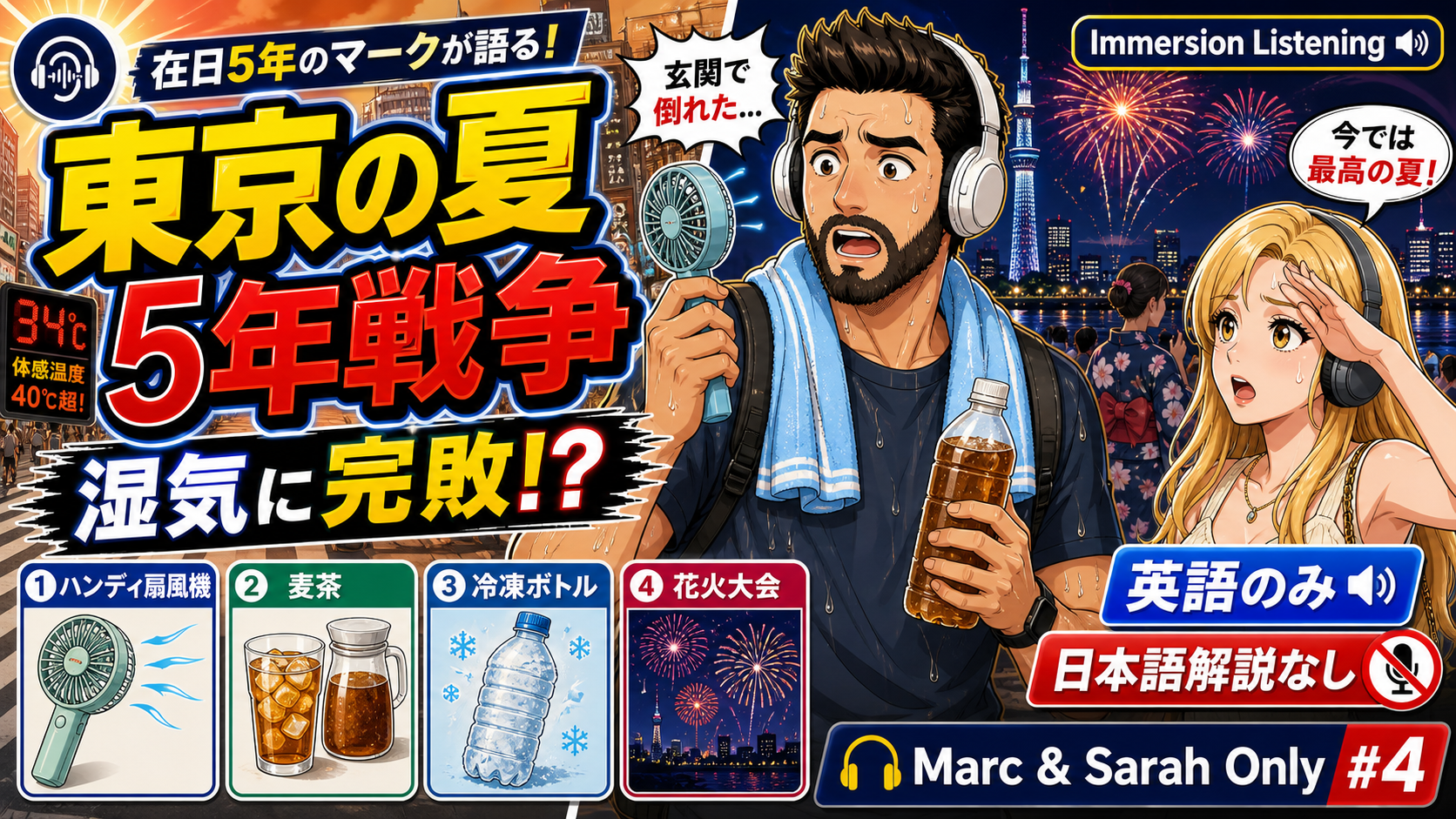
東京の夏をネイティブが英語だけで語ったら|湿気・コンビニ・花火大会、イマージョンリスニング【英語学習】
ポッドキャスト「すきまイングリッシュ」のスクリプト。「東京の夏をネイティブが英語だけで語ったら|湿気・コンビニ・花火大会、イマージョンリスニング【英語学習】」の会話全文です。

Marc: Sarah, before we even start, I want you to know — this episode took five years to earn the right to record. (日本語訳: サラ、始める前に言っておくけど、このエピソードを収録する資格を得るのに5年かかったんだ。)
サラ: That's a dramatic opener for a podcast. (日本語訳: ポッドキャストのオープニングとしてはドラマチックだね。)
Marc: It's not dramatic. It's accurate. Today we're talking about Tokyo summer. (日本語訳: ドラマチックじゃないよ、正確なんだ。今日は東京の夏について話すんだ。)
サラ: Oh boy, here we go. (日本語訳: うわー、始まった。)
Marc: Five years. Five Tokyo summers. And I am finally, finally, in a place where I can talk about it without flinching. (日本語訳: 5年間。5回の東京の夏。そしてようやく、ようやく、顔をしかめずに話せるようになったんだ。)
サラ: I've actually been waiting for this one. Because you complain about Tokyo summer more than you complain about anything else, including Tokyo winter, which is saying something. (日本語訳: これ、実は待ってたんだよ。だって君、東京の夏については、他の何よりも文句を言ってるからね。東京の冬よりもだよ。これはよっぽどのことだよ。)
Marc: Tokyo winter is honest. It's cold. It tells you it's cold. Tokyo summer is a psychological attack. (日本語訳: 東京の冬は正直なんだ。寒い。寒いってちゃんと伝えてくる。東京の夏は心理攻撃だよ。)
サラ: Walk us through it. Three stops. Start at year one. (日本語訳: 順番に聞かせて。3つの場面で。1年目から。)
Marc: Okay. Year one. July. I had been in Tokyo for, I don't know, six months at that point. So I'd gone through winter. I'd gone through that weird February-March stretch. I felt like a guy who was handling Tokyo. And then July arrived. (日本語訳: わかった。1年目の7月。東京に来て、たしか半年くらい経ってた。だから冬も経験したし、あの妙な2月から3月も乗り越えた。東京をうまくやれてるつもりだったんだ。そこへ7月が来た。)
サラ: Late July or early July ? (日本語訳: 7月下旬?それとも7月上旬?)
Marc: It was the back half of July. The part where the rainy season ends and the country just... gives up trying to be subtle about the heat. One day it's drizzly and grey, and the next day you walk outside and the air has weight. (日本語訳: 7月の後半だった。梅雨が明けて、この国が暑さを隠そうとするのをやめる頃。前の日は小雨で曇ってたのに、次の日外に出ると、空気に重さがあるんだ。)
サラ: I know exactly the day you're talking about. It's like the city flips a switch. (日本語訳: その日のこと、よくわかる。街のスイッチが切り替わるみたいなんだよね。)
Marc: It hits you like a wall. That was my first thought. Literally, "it hits you like a wall." I'd grown up in Chicago. We had hot summers. We had ninety-degree days. But that's a dry heat. The Tokyo heat doesn't sit on top of you. It moves into you. (日本語訳: 壁にぶつかるみたいだった。それが最初の感想。文字通り、「壁にぶつかるみたい」。シカゴ育ちで、暑い夏もあった。30度超えの日もあった。でもそれは乾燥した暑さだ。東京の暑さは上に乗っかるんじゃなくて、中に染み込んでくるんだ。)
サラ: It's sticky in a way I can't describe to someone who hasn't lived through it. (日本語訳: 経験したことない人には説明できないくらい、ベタベタするんだ。)
Marc: That's the phrase. Sticky in a way I can't describe. Anyway. The specific day. I'd been at the office, AC was working fine. I walked twelve minutes from the station to my apartment. I unlocked my door, stepped inside, kicked off my shoes, and I just... I sat down in the genkan. (日本語訳: まさにその言い方。「説明できないくらいベタベタ」。で、その日のこと。オフィスにいる間はエアコンがちゃんと効いてた。駅から12分歩いて家に着いて、鍵を開けて中に入って、靴を脱ぎ捨てて、そのまま…玄関に座り込んだんだ。)
サラ: Like, sat down sat down? On the step? (日本語訳: え、本当に座り込んだの? 段差に?)
Marc: On the step. My back against the door. I could not stand up. My legs were not legs. They were these wet, heavy things that were attached to me but had stopped being on my team. (日本語訳: 段差に。ドアに背中をあずけて。立てなかった。脚が脚じゃなかったんだ。体にくっついてはいるけど、もう味方じゃなくなった、濡れて重たい何かになってた。)
サラ: Marc. That sounds like the early stage of heat stroke. (日本語訳: マーク。それ、熱中症の初期症状みたいだよ。)
Marc: That's exactly what it was. I just didn't have the vocabulary for it yet. And here's the part of the story that still embarrasses me. I'd left the AC on before I went to work that morning. So I assumed the apartment would be cool when I got home. (日本語訳: まさにそれだった。ただ、その頃はまだその言葉を知らなかったんだ。で、今でも恥ずかしいのがここから。その朝、仕事に行く前にエアコンをつけっぱなしにしてたんだ。だから、帰ったら部屋は涼しいだろうって思ってた。)
サラ: Oh no, please don't tell me. (日本語訳: うわ、お願い、言わないで。)
Marc: Oh yes. I look up from the floor. I look at the AC remote sitting on the entryway shelf. And I realize, in slow motion, that I had set it to heat mode. Not cool. Heat. For nine hours. (日本語訳: それがそうなんだ。床から見上げて、玄関の棚に置いてあるエアコンのリモコンを見た。そして、スローモーションみたいに気づいたんだ。暖房にしてたって。冷房じゃない。暖房。9時間も。)
サラ: You boiled your own apartment, Marc. (日本語訳: 自分で部屋を蒸し風呂にしちゃったんだね、マーク。)
Marc: I boiled my own apartment. The thermometer said thirty-four degrees Celsius. Inside. I'd been running a sauna for myself all day. (日本語訳: 自分で部屋を蒸し風呂にしたんだ。温度計は摂氏34度。室内でだよ。一日中、自分用のサウナを動かしてたんだ。)
サラ: How did you not catch it? (日本語訳: どうして気づかなかったの?)
Marc: The icons on the remote. Same shape. Different colors. I'd grabbed it in the morning, hit the button I thought I'd hit the day before, and walked out the door. I'm not built for this. That's what I said out loud, on the floor of my genkan. "I'm not built for this country." (日本語訳: リモコンのアイコンだよ。形は同じで、色が違うだけ。朝それを手に取って、前の日に押したつもりのボタンを押して、そのまま出かけたんだ。僕はこういうのに向いてない。玄関の床で、声に出してそう言ったよ。「僕はこの国に向いてない」って。)
サラ: That is rough. Did you get up eventually? (日本語訳: それはきついね。結局、立ち上がれたの?)
Marc: I crawled — and I mean crawled — to the AC remote. I switched it to cool. I lay on the floor in front of the unit until the air coming out of it became, I don't know, breathable. It took an hour. And then I texted my coworker, who was also American, and I said, "I think I made a mistake moving here." (日本語訳: リモコンまで這っていった。本当に這ってだよ。冷房に切り替えて、吹き出す空気が、なんていうか、吸える空気になるまで、エアコンの前の床に寝転がってた。1時間かかった。それから、同じくアメリカ人の同僚にメッセージを送ったんだ。「ここに引っ越してきたのは間違いだったかも」って。)
サラ: That's a moment. (日本語訳: それは大きな出来事だね。)
Marc: That was a moment. And I want to be honest, I was twenty-four hours away from booking a flight back. (日本語訳: 大きな出来事だった。正直に言うと、あと24時間で帰りの飛行機を予約するところだったんだ。)
サラ: But you didn't. (日本語訳: でも、予約しなかった。)
Marc: I didn't. Because the next morning I woke up in a cool apartment, and I went outside, and the morning air was actually beautiful. There's something about Tokyo at seven a.m. in July that almost makes you forget what happened at six p.m. the day before. (日本語訳: しなかった。次の朝、涼しい部屋で目が覚めて外に出たら、朝の空気が本当に気持ちよかったんだ。7月の東京の朝7時には、前の日の夕方6時に起きたことを、ほぼ忘れさせてくれる何かがあるんだよ。)
サラ: Almost, but not quite. (日本語訳: ほぼ、ね。完全にじゃない。)
Marc: Almost is doing some heavy lifting there. (日本語訳: その「ほぼ」が、かなり重い役目を背負ってるんだよ。)
サラ: Okay so you survived the genkan incident. What happens between then and now? (日本語訳: じゃあ、玄関の件は乗り越えたと。そこから今までどうだったの?)
Marc: Slow accumulation. Five years of slowly buying gear that twenty-five-year-old me would have mocked. (日本語訳: 少しずつ増えていったんだ。25歳の僕ならバカにしてたような道具を、5年かけて少しずつ買い揃えていった。)
サラ: Walk me through the kit. (日本語訳: その装備、順番に教えて。)
Marc: Okay. Item one. The handy fan. The little battery-powered one you hold up to your face. I saw these for the first time in year two. I was on the train. A woman next to me had one pointed at her neck. And I thought, "what a ridiculous device. Who would carry that around." (日本語訳: わかった。1つ目。ハンディファン。顔に向けて持つ、小さな電池式のやつ。初めて見たのは2年目で、電車の中だった。隣の女の人がそれを首に向けてて、「なんてバカげた道具だ。あんなの誰が持ち歩くんだ」って思ったんだ。)
サラ: And how about now, year five? (日本語訳: で、5年目の今は?)
Marc: I have three. One in my work bag. One charging at home. One in my apartment for emergencies. The model I use has a USB-C port and a neck strap and a setting called "turbo" that sounds like a small leaf blower. (日本語訳: 3つ持ってる。仕事用のバッグに1つ、家で充電中のが1つ、非常用に家にもう1つ。僕が使ってるモデルは、USB-Cの端子とネックストラップがついてて、「ターボ」っていうモードもあるんだけど、それが小型のリーフブロワーみたいな音なんだ。)
サラ: You went down the rabbit hole. (日本語訳: 完全にハマったんだね。)
Marc: I went all the way down the rabbit hole. I read Japanese reviews of handy fans. With Google Translate. At one in the morning. (日本語訳: どっぷりハマったよ。ハンディファンの日本語のレビューまで読んだんだ。Google翻訳で。夜中の1時に。)
サラ: That's commitment. (日本語訳: 本気だね。)
Marc: That's surrender. Item two. Mugicha. (日本語訳: 降参したんだよ。2つ目。麦茶。)
サラ: Barley tea. (日本語訳: 大麦のお茶だね。)
Marc: Barley tea. Cold barley tea. My coworker in year one, this woman on my team, she looked at me one day in August and she said, "Marc-san, you don't drink mugicha?" Like it was a moral failing. (日本語訳: 大麦のお茶。冷たい麦茶。1年目、同じチームの同僚の女性が、8月のある日、僕を見て「マークさん、麦茶飲まないの?」って言ったんだ。まるで人としてどうかしてるみたいに。)
サラ: It kind of is, when it's that hot. (日本語訳: あれだけ暑いと、実際そうかもね。)
Marc: At the time I didn't get it. I was like, why would you brew tea just to chill it. Where I'm from, iced tea is sweetened and lemony. Mugicha is... it's not even tea, really. It's roasted barley water. It tastes like the inside of a kitchen. (日本語訳: 当時はピンとこなかった。わざわざお茶を煮出して冷やすなんて、なんで?って。僕の地元では、アイスティーといえば甘くてレモン味なんだ。麦茶は…正直お茶ですらない。炒った大麦のお湯だよ。台所の中みたいな味がする。)
サラ: That's not selling it. (日本語訳: 全然おいしそうに聞こえないよ。)
Marc: I'm telling you the year-one version. The year-five version is — I keep a pitcher of it in the fridge at all times. It's the only thing that actually hydrates me in August. Water feels heavy. Sports drinks feel like syrup. Mugicha goes down clean. (日本語訳: それは1年目の話。5年目の僕は、いつも冷蔵庫にピッチャーで冷やしてる。8月にちゃんと水分補給できるのは、麦茶だけなんだ。水は重く感じるし、スポーツドリンクはシロップみたい。麦茶はすっと入ってくる。)
サラ: That's a real conversion arc. (日本語訳: 見事な転向ぶりだね。)
Marc: It is. Item three. The ice cream education. (日本語訳: そうなんだ。3つ目。アイスの勉強。)
サラ: I want to hear this. (日本語訳: それ聞きたい。)
Marc: So in America, growing up, if you bought a soda-flavored popsicle, it was either red or it was kind of orange. Sweet. Fake-fruit. In Japan, year one, I bought a popsicle called Gari Gari Kun. Soda flavor. It was blue. Bright blue. And in my American brain, blue popsicle equals chewing gum. (日本語訳: アメリカで子どもの頃、ソーダ味のアイスキャンディーを買うと、赤か、オレンジっぽい色だった。甘くて、作りもののフルーツ味。日本での1年目に、ガリガリ君っていうアイスを買ったんだ。ソーダ味。それが青かった。鮮やかな青。アメリカ育ちの僕の頭の中では、青いアイスはガム味なんだよ。)
サラ: Oh that's a wiring problem. (日本語訳: 頭の回路がずれてるね。)
Marc: It's a wiring problem. I bit into it expecting bubble gum. I got, like, cream soda. My face must have been incredible because the convenience store clerk asked me if I was okay. (日本語訳: 回路がずれてるんだよ。風船ガムの味を想像してかじったら、クリームソーダみたいな味がした。よっぽどすごい顔をしてたんだろうね、コンビニの店員さんに大丈夫ですかって聞かれたよ。)
サラ: You broke a clerk. (日本語訳: 店員さんを困らせちゃったんだ。)
Marc: I broke a clerk. Then I tried Imuraya azuki bar. The red bean one. (日本語訳: 困らせちゃった。それから、井村屋のあずきバーも試した。小豆のやつ。)
サラ: I love azuki bar. (日本語訳: あずきバー、大好き。)
Marc: I love it now. Year one me did not know it was frozen solid. I bit into it and my front tooth gave me a warning. I almost broke a tooth on a popsicle. (日本語訳: 今は僕も大好き。1年目の僕は、あれがカチカチに凍ってるって知らなかったんだ。かじったら前歯が悲鳴を上げた。アイスで歯が折れるところだったよ。)
サラ: Marc. There's a technique. (日本語訳: マーク。コツがあるんだよ。)
Marc: There is a technique. You let it sit for thirty seconds. You start at the corner. You don't go in like an animal. (日本語訳: コツがあるんだよね。30秒くらい置いておく。角からかじる。獣みたいにかぶりつかない。)
サラ: I'd cave by noon if it was up to me to remember any of this. How are you keeping all of it straight now? (日本語訳: 私だったら、こんなの全部覚えておくなんて、お昼までに投げ出しちゃう。今はどうやって全部こなしてるの?)
Marc: I caved a long time ago. That's what year five is. It's the version of you that just gave in. I have a neck cooler. I have the handy fan. I have the mugicha in the fridge. I have a frozen water bottle that I carry in my work bag on the way in, and it's a hot water bottle by the time I get home. I have a small towel that I never leave the house without. (日本語訳: 僕はとっくに投げ出したよ。それが5年目ってこと。あきらめて受け入れた自分なんだ。ネッククーラーもある。ハンディファンもある。冷蔵庫には麦茶。行きは仕事用のバッグに凍らせたペットボトルを入れていくんだけど、家に着く頃にはお湯のボトルになってる。それに、家を出るときは絶対に小さいタオルを持っていく。)
サラ: You sound like a person who got assimilated. (日本語訳: 完全に染まった人みたいだね。)
Marc: I am a person who got assimilated. And the funny thing is, I don't even notice it anymore. I packed for a business trip back to the States last summer, and my wife — yeah, partner, I'll say partner — she looked at my carry-on and she said, "are you bringing the fan and the neck thing." And I said, "of course." And she said, "Marc, you're going to Chicago. It's dry there. You don't need this." And I just stood there staring at her, because for one full second, my brain had forgotten that. (日本語訳: 完全に染まった人間だよ。しかも面白いことに、もう自分では気づきもしない。去年の夏、アメリカに出張する荷造りをしてたら、妻が、いや、パートナーって言っておこうかな、そのパートナーが僕の機内持ち込みバッグを見て、「ファンと首に巻くやつも持っていくの?」って聞いたんだ。「もちろん」って言ったら、「マーク、行き先はシカゴだよ。向こうは乾燥してるんだから、いらないでしょ」って。僕はただ立ったまま彼女を見つめてた。まるまる1秒、僕の頭はそのことを忘れてたんだ。)
サラ: You'd forgotten dry heat existed. (日本語訳: 乾燥した暑さがあるってことを忘れてたんだ。)
Marc: I'd forgotten dry heat was a thing. (日本語訳: 乾燥した暑さっていうものがあるのを忘れてた。)
サラ: That's the moment. Right there. You became a Tokyoite. (日本語訳: それだよ。まさにその瞬間。東京の人になったんだね。)
Marc: I think it might be. And honestly, packing the fan anyway felt right. (日本語訳: そうかもしれない。それに正直、それでもファンを荷物に入れたのは、正解だった気がする。)
サラ: Okay. So you've survived the genkan. You've got your gear. But you've also told me — off-mic — that something changed in year four. That the summer started feeling different. (日本語訳: なるほど。玄関の一件は乗り越えて、装備も揃った。でも、マイクの外で言ってたよね。4年目に何かが変わって、夏が違って感じられるようになったって。)
Marc: Yeah. Year four. Late August. Aiko, my coworker, she'd been trying to get me to come to a hanabi taikai for years, and I'd always said no. (日本語訳: うん。4年目。8月下旬。同僚のアイコが、何年も花火大会に誘ってくれてたんだけど、いつも断ってたんだ。)
サラ: Why no, though? (日本語訳: でも、なんで断ってたの?)
Marc: Because in my head, fireworks plus crowds plus humidity sounded like a punishment. I'd seen the photos online. The packed riverbanks. The sweat-through-shirts. I was like, that's a hard pass. (日本語訳: だって僕の頭の中では、花火と人混みと湿気の組み合わせなんて、罰ゲームだったから。ネットで写真も見てた。ぎゅうぎゅうの河川敷。汗びっしょりのシャツ。これは絶対パスだなって。)
サラ: But year four you said yes. (日本語訳: でも、4年目には「いいよ」って言ったんだね。)
Marc: Year four I said yes. And she said, "great, I have an extra yukata, my brother's. You're wearing it." And I said no. And she said yes. And that was the end of that conversation. (日本語訳: 4年目は「いいよ」って言った。そしたら彼女が「よかった、浴衣が一枚余ってるの。弟のやつ。それ着てね」って。僕が嫌だって言ったら、彼女は着るのって言って、それで話は終わり。)
サラ: I love that about Aiko. She doesn't take no. (日本語訳: アイコのそういうところ、好き。断らせてくれないんだよね。)
Marc: She does not take no. So that Saturday, late August, she came over to my apartment with the yukata, and she tied the obi for me. I had no idea what to do. I stood there with my arms slightly out, like an awkward scarecrow, while she folded the fabric and tied this knot at my back that I could not, even now, replicate with both hands and a YouTube tutorial. (日本語訳: 断らせてくれないんだ。それでその土曜日、8月の終わりに、彼女が浴衣を持ってうちに来て、帯を結んでくれた。僕はどうしていいか全然わからなくて、腕をちょっと広げて、ぎこちないかかしみたいに突っ立ってた。その間に彼女が布を折って、背中で結び目を作ってくれたんだけど、今でも、両手とYouTubeの解説動画があっても再現できない。)
サラ: I want a photo of this. (日本語訳: それ、写真が見たいな。)
Marc: There are photos. I'll send them. Anyway. We took the train. The cars were packed with people in yukata. Couples. Families. Groups of friends. Everybody dressed the same way and yet everybody dressed completely differently. (日本語訳: 写真はあるよ。送るね。それで、電車に乗ったんだ。車内は浴衣姿の人でいっぱいだった。カップルとか、家族連れとか、友達グループとか。みんな同じような格好なのに、一人ひとり全然違うんだ。)
サラ: That's a real Tokyo evening. (日本語訳: まさに東京の夜だね。)
Marc: It's the most Tokyo evening I have ever had. We got to the riverbank. We staked out a small spot on a tarp. Aiko had brought snacks and chuhai and a hand fan for me, which I needed because of course it was still hot. And then the first firework went off. (日本語訳: 今までで一番東京らしい夜だった。河川敷に着いて、ブルーシートを敷いて小さな場所を確保した。アイコはおつまみとチューハイ、それに僕用のうちわまで持ってきてくれてた。もちろんまだ暑かったから、それが必要だったんだ。そして、最初の花火が上がった。)
サラ: How was the firework? (日本語訳: 花火はどうだった?)
Marc: I'm going to sound dumb. But honestly, it was a different kind of firework. American fireworks are loud and round and they hit you in the chest. These fireworks were... patient. They opened slowly. Some of them changed shape mid-bloom. One of them dropped these little willow-branch trails that hung in the sky for, I don't know, four seconds before fading. Four seconds is forever in firework time. (日本語訳: バカみたいに聞こえるだろうけど、正直、別物の花火だった。アメリカの花火は、うるさくて、まん丸で、胸にドンとくる。でもこっちの花火は…辛抱強いんだ。ゆっくり開く。開く途中で形が変わるのもある。柳の枝みたいな細い光の筋を垂らして、たぶん4秒くらい空に残ってから消えるのもあった。花火の世界で4秒なんて永遠だよ。)
サラ: I get it. I've seen them. (日本語訳: わかる。見たことあるよ。)
Marc: And the crowd. Sarah. The crowd. Tens of thousands of people. And almost no one is yelling. It's a quiet "ooh" that ripples through the crowd when something pretty happens. And then it gets quiet again. (日本語訳: それに観客だよ、サラ。観客。何万人もいるのに、叫んでる人がほとんどいない。きれいなのが上がると、「おお」っていう静かな声が波みたいに広がって、また静かになるんだ。)
サラ: It's a whole vibe. That's the phrase. (日本語訳: あれはもう「a whole vibe」だよね。まさにその言葉。)
Marc: It is a whole vibe. And at some point during the show, the wind shifted. It was that little breeze that comes off the river at the end of the day. And I sat there in this borrowed yukata, with my coworker, and I realized I had been wrong for three full summers about what this season was. (日本語訳: まさに「a whole vibe」だよ。それで花火の途中で、風向きが変わったんだ。一日の終わりに川から吹いてくる、あのそよ風。借りた浴衣を着て、同僚と並んで座ってたら、気づいたんだ。まる3回の夏のあいだ、僕はこの季節を誤解してたって。)
サラ: You'd been fighting it. (日本語訳: それに抵抗してたんだね。)
Marc: I'd been fighting it. And the fight was never going to win. The only thing to do was learn to embrace it. To find the moments when the heat actually means something. (日本語訳: 抵抗してた。でも、その戦いに勝ち目なんてなかった。できるのは、受け入れることだけ。暑さがちゃんと意味を持つ瞬間を見つけることなんだ。)
サラ: What did you say to Aiko after? (日本語訳: そのあと、アイコに何て言ったの?)
Marc: I didn't say anything for a long time. We walked to the station, slowly because the streets were packed. I just kept looking up. And eventually I said, "I think I get it now." And she just smiled. And she said, "Took you long enough." (日本語訳: しばらく何も言わなかった。道が混んでたから、駅までゆっくり歩いた。僕はずっと空を見上げてた。そしてやっと「わかった気がする」って言ったんだ。そしたら彼女はにっこりして、「ずいぶん時間がかかったね」って。)
サラ: I love her. (日本語訳: 彼女、大好き。)
Marc: I love her too. I think about that night every August. I've gone back to that same hanabi every year since. Three years in a row now. Always in yukata. Always with mugicha in a thermos. Always with my dumb little handy fan. (日本語訳: 僕も大好き。毎年8月になると、あの夜のことを思い出す。それ以来、毎年同じ花火大会に行ってるんだ。もう3年連続。いつも浴衣で。いつも水筒に麦茶を入れて。いつも僕のちっちゃなハンディファンと一緒に。)
サラ: Marc. That's a beautiful place to land for this episode. (日本語訳: マーク。このエピソードの締めくくりにぴったりの話だね。)
Marc: I'll tell you one more thing. The walk home that night. We got off the train and we were walking back to my apartment through this quiet residential street. And I heard cicadas — not the daytime drilling kind, the evening ones, the slower ones — and a wind chime hanging from somebody's veranda. And it was warm but not hot anymore. And I thought, "this is going to be the part of summer I miss when I leave Tokyo someday." If I ever leave. (日本語訳: もう一つだけ。あの夜の帰り道。電車を降りて、静かな住宅街を家まで歩いてたら、セミの声が聞こえたんだ。昼間のドリルみたいなのじゃなくて、夕方の、もっとゆっくり鳴くほう。それと、どこかのベランダに吊るされた風鈴の音。暖かいけど、もう暑くはなかった。それで思ったんだ。「いつか東京を離れるとき、夏で一番恋しくなるのはここだろうな」って。離れることがあれば、だけど。)
サラ: Are you planning to leave? (日本語訳: 出る予定なの?)
Marc: I don't know. But that night I knew I'd remember it. That counts for something. (日本語訳: わからない。でもあの夜、この夜はずっと覚えてるだろうなってわかったんだ。それだけでも意味があるよ。)
サラ: Marc. We've now done your Tokyo winter episode, and your Tokyo summer episode. I feel like we've completed a set. (日本語訳: マーク。東京の冬のエピソードと、東京の夏のエピソードを、これでやったね。セットが完成した気分だよ。)
Marc: It's a four-season tour. Spring and fall, we'll get to. But I think the seasons that broke me and remade me were these two. Winter taught me to layer. Summer taught me to surrender. (日本語訳: 四季をめぐるツアーだよ。春と秋もそのうちやる。でも、僕を打ちのめして作り直したのは、この2つの季節だと思う。冬は重ね着を教えてくれて、夏は降参することを教えてくれた。)
サラ: That's a tagline. (日本語訳: それはキャッチコピーだね。)
Marc: That's a tagline. And honestly, the running theme across both is the same. Year one, I thought the city was attacking me. Year five, I realized the city was just being itself, and I was the one who had to adjust. (日本語訳: キャッチコピーだね。それに正直、どっちにも共通するテーマは同じなんだ。1年目は、街に攻撃されてると思ってた。5年目になって、街はただありのままでいるだけで、合わせるべきなのは僕の方だって気づいたんだ。)
サラ: Five years for an adjustment is honest. (日本語訳: 適応に5年かかるって、正直でいいね。)
Marc: It's honest. There's no shortcut. Anyone listening to this who's in year one of their Tokyo summer — I see you. You're going to be okay. Buy the fan. Drink the mugicha. Don't bite the azuki bar. (日本語訳: 正直だよ。近道はない。これを聞いてる人で、東京の夏1年目の人がいたら、その気持ち、わかるよ。大丈夫だから。ハンディファンを買って。麦茶を飲んで。あずきバーにはかぶりつかないで。)
サラ: And maybe say yes to the hanabi. (日本語訳: そして、花火大会にも「いいよ」って言ってみて。)
Marc: And maybe say yes to the hanabi. Even if it's hot. Even if it's crowded. Especially then. (日本語訳: それと、花火大会にも「いいよ」って言ってみて。暑くても。混んでても。むしろそういう時こそ。)
サラ: Alright everyone. That's our Tokyo summer episode. If you survived your own first humid summer somewhere, drop a comment and tell us about it. I want to hear the moment you sat down on a floor and gave up. (日本語訳: はい、皆さん。東京の夏エピソードはここまでです。もし皆さんが初めてのじめじめした夏を乗り切った経験があったら、コメントで教えてください。床に座り込んで諦めた瞬間とか、聞きたいな。)
Marc: Or the moment you got back up. (日本語訳: それか、また立ち上がった瞬間を。)
サラ: Or that one. (日本語訳: うん、それもね。)
Marc: See you in the next episode. Stay cool out there. And drink the mugicha. (日本語訳: 次のエピソードでお会いしましょう。外では涼しく過ごしてくださいね。そして麦茶を飲んで。)
サラ: Drink the mugicha. (日本語訳: 麦茶を飲んで。)

関連記事
【日常英会話】「感謝していることを一つずつ」アメリカの感謝祭とネイティブの本音 #英語学習 #ネイティブ英語会話 #リスニング強化 #英語耳
ポッドキャスト「すきまイングリッシュ」のスクリプト。「【日常英会話】「感謝していることを一つずつ」アメリカの感謝祭とネイティブの本音 #英語学習 #ネイティブ英語会話 #リスニング強化 #英語耳」の会話全文です。
【日常英会話】英語のみ | ニューヨークと東京のハロウィンを英語で語ると? #英語学習 #ネイティブ英語会話 #リスニング強化
ポッドキャスト「すきまイングリッシュ」のスクリプト。「【日常英会話】英語のみ | ニューヨークと東京のハロウィンを英語で語ると? #英語学習 #ネイティブ英語会話 #リスニング強化」の会話全文です。
【日常の英語】元気のない同僚にかける英語フレーズ12選|声かけから励ましまで #英語学習 #英語フレーズ #英会話 #英語耳
ポッドキャスト「すきまイングリッシュ」のスクリプト。「【日常の英語】元気のない同僚にかける英語フレーズ12選|声かけから励ましまで #英語学習 #英語フレーズ #英会話 #英語耳」の会話全文です。
【日常英会話】住所と道案内を英語で話すと?日本の住所には通りの名前がない #英語学習 #ネイティブ英語会話 #リスニング強化 #英語耳
ポッドキャスト「すきまイングリッシュ」のスクリプト。「【日常英会話】住所と道案内を英語で話すと?日本の住所には通りの名前がない #英語学習 #ネイティブ英語会話 #リスニング強化 #英語耳」の会話全文です。
【日常の英語】日本語解説あり | 席を譲ろうとして、断られた |申し出る英語と、断られたときの英語6つ #英語学習 #英語フレーズ #英会話 #英語耳
ポッドキャスト「すきまイングリッシュ」のスクリプト。「【日常の英語】日本語解説あり | 席を譲ろうとして、断られた |申し出る英語と、断られたときの英語6つ #英語学習 #英語フレーズ #英会話 #英語耳」の会話全文です。

【日常英会話】カウンターには、向かいの椅子がない、「お一人ですか」と聞かれる国 #英語学習 #ネイティブ英語会話 #リスニング強化 #英語耳
ポッドキャスト「すきまイングリッシュ」のスクリプト。「【日常英会話】カウンターには、向かいの椅子がない、「お一人ですか」と聞かれる国 #英語学習 #ネイティブ英語会話 #リスニング強化 #英語耳」の会話全文です。