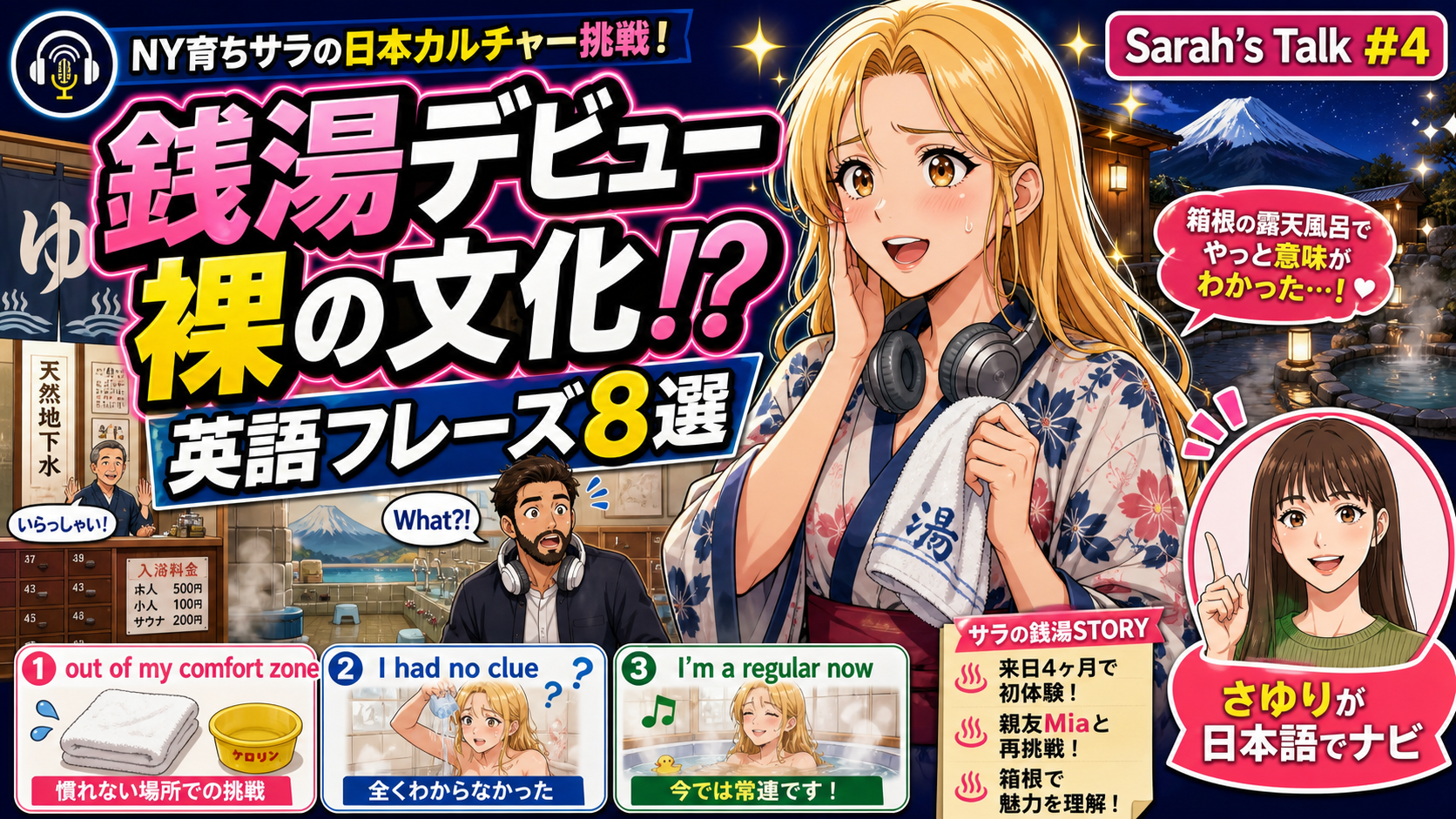
【日常英会話】日本語解説あり | 銭湯・温泉を英語で話す|文化の違いで学ぶ自然な英語表現 #英語学習 #英語フレーズ #英会話 #英語耳
ポッドキャスト「すきまイングリッシュ」のスクリプト。「【日常英会話】日本語解説あり | 銭湯・温泉を英語で話す|文化の違いで学ぶ自然な英語表現 #英語学習 #英語フレーズ #英会話 #英語耳」の会話全文です。

さゆり: 「Sukima English」へようこそ。 今日は Pattern3、サラの日常トークの回です。 テーマは「銭湯デビュー」。サラが来日して数ヶ月の頃、近所の銭湯にひとりで挑戦した話、半年後に Mia と再挑戦した話、そして1年半後の箱根の旅館で「やっと意味がわかった」 瞬間まで、 3つのトピック でお届けします。
さゆり: 銭湯という、日本人にとっては当たり前の場所が、ニューヨーク育ちのサラにとってはどれくらいの挑戦だったのか。タオルの位置、かけ湯のルール、お婆さんとの会話、そして タトゥー問題。 サラが「I had no clue」 から「I'm a regular now」 になるまでの全部を聞いてみましょう。
さゆり: それでは、サラとマーク、お願いします。
Marc: So Sarah. Today's topic — the sento. The Japanese public bathhouse. I have been here five years and I will be honest, I am still kind of working on this one. But I know you have a whole journey. (日本語訳: サラ、今日のテーマは銭湯。日本の公衆浴場だね。僕は日本に来て5年だけど、正直、まだちょっと慣れきれてないんだ。でもサラには、ひとつの長い物語があるんだよね。)
サラ: Marc. This episode might be the most exposed I have ever been in front of strangers. Literally and figuratively. We are going to talk about being naked in front of seventy-year-old Japanese women. And how that turned out to be one of the best things that happened to me here. (日本語訳: マーク、このエピソードは、私がこれまで見知らぬ人の前で一番さらけ出す回になるかも。文字どおりの意味でも、比喩的な意味でもね。70代の日本人女性たちの前で裸になる話をするんだから。しかもそれが、ここに来てから起きた最高の出来事の一つになったっていう話。)
Marc: Okay. I am ready. Three topics, right? (日本語訳: よし、準備はできてるよ。トピックは3つだよね?)
サラ: Three topics. First time, total disaster. Second time, with Mia, where it actually clicked. And third time, the moment in Hakone where I finally got it. The whole thing. Should we dive in? (日本語訳: トピックは3つ。1回目は、大失敗。2回目は、ミアと一緒で、ちゃんとしっくりきたとき。そして3回目は、箱根でついに腑に落ちた瞬間。全部がね。じゃあ、飛び込もうか?)
Marc: Dive in. Pun very much intended. (日本語訳: 飛び込もう。もちろんダジャレのつもりだよ。)
サラ: Okay. Month four in Tokyo. I had just moved into my place in Nakano. There was a small sento about three blocks from my apartment. I had walked past it like a hundred times. The little smoke stack, the noren curtain, the soft yellow light at night. I kept thinking, I should try that. And then immediately, no, I really should not try that. (日本語訳: よし。東京に来て4か月目。中野に引っ越したばかりだった。アパートから3ブロックくらいのところに小さな銭湯があって。前を100回くらいは通ってたかな。小さな煙突、暖簾、夜のやわらかい黄色い明かり。いつも「行ってみなきゃ」って思ってた。でもすぐに「いや、やっぱり無理」って。)
Marc: Why not though? (日本語訳: でも、なんで?)
サラ: Because I am from New York. The most contact you have with strangers in public bathrooms in New York is making sure no one steals your bag while you wash your hands. The idea of taking off everything I am wearing and walking into a room of women I have never met — that was not in my New York operating system. (日本語訳: だって、私はニューヨーク出身だから。ニューヨークの公衆トイレで見知らぬ人と関わるといえば、手を洗ってる間にバッグを盗まれないよう気をつけるくらい。着てるものを全部脱いで、会ったこともない女性たちでいっぱいの部屋に入るなんて、私のニューヨーク仕様のOSには入ってなかったんだ。)
Marc: Yeah. That is a real adjustment. (日本語訳: ああ。それは確かに、慣れるのが大変だね。)
サラ: And then Mia, of course, my friend Mia who I have talked about before, she is the one who made it happen. She said to me — Sarah, you live three blocks from a sento and you have not been. That is criminal. Go. This week. Stop overthinking it. (日本語訳: そこで、もちろんミア。前にも話した友達のミアが、背中を押してくれたの。こう言われたんだ。「サラ、銭湯まで3ブロックなのに、まだ行ってないなんて。それはもう犯罪だよ。行きなさい。今週中に。考えすぎるのはやめて」って。)
Marc: Mia does not let you off the hook. (日本語訳: ミアは、サラを逃がしてくれないね。)
サラ: She does not. So one Tuesday night I just decided. I grabbed a towel, I grabbed my soap, I walked over. I stood outside for probably four minutes. Just staring at the noren. And then I told myself, you are going in. You went to NYU. You moved to Tokyo. You can take off your clothes for fifteen minutes. (日本語訳: 逃がしてくれない。それで、ある火曜の夜に決めたの。タオルをつかんで、石鹸をつかんで、歩いて行った。暖簾の前で、たぶん4分くらい立ち尽くしてた。ただ暖簾を見つめてね。それで自分に言い聞かせたの。「入るよ。ニューヨーク大学に行ったでしょ。東京に引っ越してきたでしょ。15分くらい服を脱ぐことぐらいできる」って。)
Marc: That is a real pep talk. (日本語訳: それは立派な自分への激励だね。)
サラ: It was the worst pep talk. So I went in. There is the shoe locker right at the entrance — I stood there for five minutes trying to figure out which slot was empty. The lady at the counter, the bandai, she said something to me in Japanese and I just bowed and held out my money. She was very patient. (日本語訳: 最悪の激励だったよ。それで、入ったの。入り口のすぐのところに靴箱があって、どこが空いてるのか分からなくて5分くらい立ってた。カウンターの番台の女性が日本語で何か言ったんだけど、私はただお辞儀してお金を差し出したの。すごく辛抱強く付き合ってくれたよ。)
Marc: Bandai is the person sitting at the front desk? (日本語訳: 番台さんっていうのは、フロントに座ってる人のこと?)
サラ: Yeah. Sort of like the host or hostess of the bathhouse. They run the place. So I paid, I bowed, I walked through the curtain to the women's side. And I just — froze. Because the locker room was full of women just casually changing. Like it was nothing. Like it was a Tuesday. Which it was. (日本語訳: うん。銭湯の主人とか、女将さんみたいな感じ。その場を切り盛りしてる人。それで、お金を払って、お辞儀して、暖簾をくぐって女湯に入ったの。そしたら、固まっちゃった。脱衣所では、女性たちがごく普通に着替えてたから。何でもないことみたいに。ただの火曜日みたいに。実際、火曜日だったんだけど。)
Marc: Because it was. (日本語訳: だって、火曜日だったからね。)
サラ: I was completely out of my comfort zone. I had no clue what I was doing. The towel they had given me was tiny. Like the size of a dish towel. And I was thinking, what is this for? Am I supposed to wrap it around me? Wear it as a hat? Use it as a flag of surrender? (日本語訳: 完全に居心地のいい範囲の外にいた。何をしてるのか全然分からなかった。渡されたタオルがすごく小さくて。ふきんくらいの大きさ。それで、「これ何に使うの?体に巻くの?帽子みたいにかぶるの?降参の白旗にするの?」って考えてた。)
Marc: All valid options. (日本語訳: どれも、あり得る使い方だね。)
サラ: I undressed slower than anyone has ever undressed in human history. I was trying to keep the tiny towel in front of me at all times. And I have a small tattoo on my left shoulder. A little design I got at twenty-two. I was completely convinced someone was going to see it and make me leave. So I am hunched over, holding this dish towel, trying to hide a tattoo the size of a stamp. (日本語訳: 人類史上いちばんゆっくり服を脱いだと思う。あの小さなタオルを、ずっと体の前に当てようとしてた。それに、左肩に小さなタトゥーがあるの。22歳のときに入れた小さな図柄。誰かに見られて追い出されるって、完全に思い込んでた。だから、背中を丸めて、あのふきんを握って、切手サイズのタトゥーを隠そうとしてたんだ。)
Marc: That is a lot of mental load for one moment. (日本語訳: 一瞬のことにしては、ずいぶん気を張ってたね。)
サラ: It was so much. So I walked into the bathing area. And I just stopped. Because every woman in there was doing her own thing. One was washing her hair. One was sitting on a stool scrubbing her arms. Two older women were chatting in the big bath. And nobody — and I mean nobody — looked at me. (日本語訳: 本当にそう。それで洗い場のほうに入っていったんだけど、そこで立ち止まっちゃった。そこにいた女性はみんな、それぞれ自分のことをしてたから。一人は髪を洗ってて、一人は椅子に座って腕をこすってた。年配の女性が二人、大きな湯船でおしゃべりしてた。そして誰も、本当に誰も、私を見てなかった。)
Marc: That is the part people do not warn you about. (日本語訳: それが、みんな教えてくれない部分だよね。)
サラ: It is wild. I had spent four months bracing for judgment and there was no judgment. Just steam and the sound of water and someone gently humming. (日本語訳: すごいでしょ。4か月も、じろじろ見られるって身構えてたのに、誰も気にしてなかった。ただ湯気と水の音と、誰かのやさしい鼻歌があるだけ。)
さゆり: 今、サラが言った「out of my comfort zone」 は、「自分の快適ゾーンの外」、つまり「居心地のいい範囲を超えた、慣れない場所」 という意味です。 新しい挑戦をする時、初めての文化に触れる時にぴったりの表現です。
サラ: But here is the thing. I was so wound up, I did not actually do anything correctly. I sat on a stool. I did not wash properly. I splashed myself with one tiny scoop of water from the bucket and then walked straight to the bath. (日本語訳: でもね、ここからなんだけど。緊張しすぎて、実は何ひとつちゃんとできてなかったの。椅子には座ったけど、ちゃんと洗わなかった。桶でほんの少しお湯をすくって体にかけて、そのまま湯船に向かっちゃった。)
Marc: Oh no, that is the wrong order. (日本語訳: あー、それは順番が違うね。)
サラ: I dipped in for about sixty seconds. I felt like everyone could tell I had not washed. I got out, dried off, dressed faster than I had ever dressed, and left. The bandai smiled at me on the way out and said something kind. I bowed and basically fled. (日本語訳: 60秒くらい浸かったかな。洗ってないのがみんなにバレてる気がして。上がって、体を拭いて、人生最速で服を着て、出てきた。出るとき番台の人が微笑んで、何かやさしい言葉をかけてくれたんだけど、私はお辞儀して、ほとんど逃げるように帰った。)
Marc: How long were you in there total? (日本語訳: 全部でどれくらい入ってたの?)
サラ: Maybe twelve minutes. From walking in to walking out. (日本語訳: たぶん12分くらい。入ってから出てくるまで。)
Marc: That is a fast exit. (日本語訳: ずいぶん早く出ちゃったね。)
サラ: I came home, called Mia, and said — I just went for it but I bailed at the five-minute mark. She laughed for a long time. And then she said, okay. Next week. With me. We are doing it right. (日本語訳: 家に帰ってミアに電話して、「思い切って行ってみたけど、5分で逃げてきた」って言ったの。彼女はしばらく笑って、それから言ったんだ。「よし。来週、私と一緒に行こう。ちゃんとやるよ」って。)
さゆり: 「I just went for it」 は「思い切ってやってみた」 という意味。 準備が足りなくても、とりあえず飛び込んだ時のフレーズです。 サラはまさに「飛び込んだけど五分で逃げた」 と笑い話にしています。
Marc: Okay. So Mia's intervention. What happened on round two? (日本語訳: なるほど。ミアの出番だね。2回目はどうだった?)
サラ: Round two was a week later. Mia came over after work. She brought her own towel — a slightly bigger one — and she said, okay, we are going to walk through this step by step. I want you to actually enjoy this. So we walked back to the same sento. (日本語訳: 2回目は1週間後。ミアが仕事帰りに来てくれた。自分のタオル、ちょっと大きめのやつを持ってきて、「よし、一つずつ順番にやっていこう。本当に楽しんでほしいから」って。それで、同じ銭湯に歩いて行ったんだ。)
Marc: The same one as before? (日本語訳: 前と同じところ?)
サラ: The same one. The bandai recognized me. She gave me a tiny nod. I almost cried. (日本語訳: 同じところ。番台の人が私を覚えててくれた。小さく頷いてくれたんだ。泣きそうになっちゃった。)
Marc: That is sweet. (日本語訳: それはいいね。)
サラ: And inside the locker room, Mia just narrated everything. Take off your watch. Yes, everything. Yes, including that. The little towel — you carry it with you into the bathing area. You can put it on your head, you can drape it over the side of the tub, but it does not go in the water. (日本語訳: それで脱衣所では、ミアが全部実況してくれたの。「時計を外して。そう、全部。そう、それも。小さいタオルは、洗い場に持っていくの。頭に乗せてもいいし、湯船の縁にかけてもいいけど、お湯には入れないで」って。)
Marc: That was my first sento mistake too. I sat down with the towel in the water like a tourist. (日本語訳: それ、僕の銭湯での最初の失敗でもあるよ。観光客みたいに、タオルをお湯につけたまま座っちゃった。)
サラ: Of course you did. I love that for you. Then she taught me the kakeyu — the rinse before the bath. You sit on the stool. You take the bucket. You pour warm water over yourself, slowly. You wash with soap. You rinse completely. Only then, you walk over to the big bath. (日本語訳: やっぱりね。いかにもマークらしくていいと思う。それから、ミアがかけ湯を教えてくれたの。湯船に入る前に体を流すこと。椅子に座って、桶を取って、ゆっくりお湯をかける。石鹸で洗って、しっかり流す。それが済んでから、やっと大きな湯船に向かうんだ。)
Marc: It is a whole ritual. (日本語訳: ちゃんとした儀式なんだね。)
サラ: It is. And once she explained it, it was not intimidating anymore. It made sense. The bath is for soaking and relaxing. You do the cleaning at the stool. The bath stays clean for everyone. The logic was beautiful. (日本語訳: そうなの。説明してもらったら、もう怖くなくなった。筋が通ってたから。湯船は浸かってくつろぐ場所。体は洗い場で洗う。そうすれば、湯船はみんなのためにきれいなまま。その理屈が美しかった。)
さゆり: 「when in Rome」 は「郷に入っては郷に従え」 という意味です。 英語のことわざ「When in Rome, do as the Romans do」 の前半だけを使う、口語的な言い方。 新しい場所のルールに合わせる時に使えます。
Marc: When in Rome. (日本語訳: 郷に入っては郷に従え、だね。)
サラ: Exactly. So I went through the whole thing properly. Stool, bucket, soap, rinse, walk to the bath. And then, this is my favorite part — I lowered myself into the big bath, finally relaxed, and a woman, maybe seventy years old, very small, very kind face, she looked over at me and said something in Japanese. I caught two words. Atsui. Hot. And mizu. Water. (日本語訳: そうそう。それで、全部ちゃんと手順どおりにやったよ。椅子、桶、石鹸、流して、湯船へ。それで、ここが一番好きなところなんだけど、大きな湯船にゆっくり浸かって、やっとくつろいだとき、70歳くらいの、小柄で、すごくやさしい顔をした女性がこっちを見て、日本語で何か言ったの。聞き取れたのは二つの単語だけ。「あつい」、熱い。それと「みず」、水。)
Marc: She was telling you the water was too hot? (日本語訳: お湯が熱すぎるって言ってたの?)
サラ: She was telling me to grab the little cold water hose on the side of the tub and adjust it. Because the bath was hotter than usual that night. I had no idea you could do that. (日本語訳: 浴槽の横にある冷水のホースを取って、調整するようにって言ってたの。その夜はお湯がいつもより熱かったから。そんなことできるなんて知らなかった。)
Marc: I did not know either, to be fair. (日本語訳: 僕も知らなかったよ、正直に言うと。)
サラ: I bowed and said, arigatou gozaimasu. Probably with terrible pronunciation. And she smiled at me. And then — and this is the moment, Marc, this is the real moment — she pointed at my shoulder, at my little tattoo. And she said, in English, wow. Pretty. (日本語訳: お辞儀して「ありがとうございます」って言った。たぶん、ひどい発音でね。そしたら彼女が微笑んでくれて。それから、ここなの、マーク、ここが本当の瞬間。彼女が私の肩の、小さなタトゥーを指さして、英語でこう言ったの。「ワオ。プリティ」って。)
Marc: She said it in English? (日本語訳: 英語で?)
サラ: In English. Two words. Wow, pretty. With a real smile. And the four months of anxiety I had built up around that tattoo just — dissolved. Right there in the bath. A seventy-year-old Japanese woman called my tattoo pretty. I have never felt more welcomed anywhere in my life. (日本語訳: 英語で。二語だけ。「ワオ、プリティ」。心からの笑顔で。それで、そのタトゥーのことで4か月ためこんでた不安が、すーっと消えたの。その湯船の中で。70歳の日本人女性が、私のタトゥーをきれいだって言ってくれた。人生で、あんなに歓迎されてるって感じたことはないよ。)
Marc: That is a beautiful moment. (日本語訳: それは素敵な瞬間だったね。)
サラ: I almost teared up in the bath. Which would have just blended in with the water, so I was safe. (日本語訳: 湯船の中で泣きそうになっちゃった。まあ、泣いてもお湯に紛れてたから、セーフ。)
Marc: Strategically perfect. (日本語訳: 戦略的に完璧だね。)
サラ: After we got out, Mia and I did the post-sento ritual. The little glass bottle of cold milk from the vending machine. We sat on the bench outside, in our just-bathed glow. I drank my milk. I said to Mia — I came around. I really did. This is something I could do every week. (日本語訳: 上がってから、ミアと私は銭湯のあとのお決まりをやったの。自販機で小さな瓶の冷たい牛乳を買って。湯上がりのぽかぽかした感じのまま、外のベンチに座った。牛乳を飲んで、ミアに言ったの。「考えが変わった。本当に。これなら毎週でも来られる」って。)
さゆり: 「I came around」 は「気が変わった」「考えを改めた」 という意味。 最初は乗り気ではなかったけれど、体験してから好きになった、というニュアンスです。 サラの場合、一回の体験で銭湯への見方が完全に変わりました。
Marc: And did you go every week after that? (日本語訳: それで、それから毎週行ったの?)
サラ: I went every Tuesday for about three months. Same time, same bandai, same little nod when I walked in. I became a regular. The bandai started leaving a small towel out for me without me asking. That is when you know. (日本語訳: 3か月くらい、毎週火曜日に通った。同じ時間、同じ番台さん、入るときのあの小さなうなずきも同じ。常連になったの。番台さんが、頼んでもいないのに小さなタオルを出しておいてくれるようになった。そうなったら、もう本物だよ。)
Marc: That is your sento citizenship. (日本語訳: それが、君の銭湯の市民権だね。)
サラ: Citizenship granted. (日本語訳: 市民権ゲットよ。)
Marc: Okay. Last topic. Hakone. (日本語訳: よし。最後のトピック。箱根。)
サラ: Hakone. About a year and a half after I had moved to Tokyo. Mia and I had a long weekend. She had been wanting to take me to a proper ryokan with an outdoor bath. Onsen, not sento. The real deep end. (日本語訳: 箱根。東京に引っ越してきて1年半くらい経った頃。ミアと私に連休があって。彼女はずっと、露天風呂のあるちゃんとした旅館に私を連れて行きたがってたの。銭湯じゃなくて温泉。本当の上級編。)
Marc: And the tattoo question. (日本語訳: それと、タトゥーの問題だね。)
サラ: The tattoo question. Mia had done all the research. She found a ryokan in Hakone that explicitly allowed small tattoos. She booked it months ahead. I almost cried at her thoughtfulness. She said — Sarah, you should not have to think about hiding the thing on your shoulder when you are trying to relax. (日本語訳: タトゥーの問題。ミアが全部調べてくれてたの。小さなタトゥーなら大丈夫だとはっきり書いてある箱根の旅館を見つけて、何か月も前に予約してくれた。その心遣いに泣きそうになったよ。「サラ、くつろごうとしてるときに、肩のそれを隠すことなんて考えなくていいんだよ」って。)
Marc: That is true friendship. (日本語訳: それが友情ってやつだね。)
サラ: That is Mia. So we go to Hakone. It is November. The leaves are at their peak, the air smells like cedar, the inn has these wooden floors that creak in the most comforting way. We check in. We have dinner. Kaiseki. Which is its own whole episode someday. And then around ten at night, after dinner, Mia says to me — you are going to the rotenburo. The outdoor bath. Alone. (日本語訳: それがミア。それで箱根に行ったの。11月。紅葉は見頃で、空気は杉の香りがして、旅館の木の床がこれ以上ないくらい心地よくきしむの。チェックインして、夕食。懐石料理。それはいつか、それだけで1回分のエピソードになるね。それで夜10時ごろ、夕食のあとに、ミアが言ったの。「露天風呂に行っておいで。外のお風呂。一人でね」って。)
Marc: Alone, alone? (日本語訳: 一人で?本当に一人?)
サラ: Alone, alone. She said, I will see you in an hour. You need to be by yourself for this one. (日本語訳: 本当に一人。「1時間後にね。今回は一人で行かなきゃ」って。)
Marc: Mia has the timing. (日本語訳: ミアはタイミングが分かってるね。)
サラ: Always. So I walked down the wooden hallway, past the paper lanterns, to the women's side of the rotenburo. I changed in this beautiful little dressing area. And then I walked out — and I was the only person there. (日本語訳: いつもね。それで私は木の廊下を歩いて、提灯を横目に、露天風呂の女性側へ向かった。きれいな更衣室で着替えて。そして外に出たら…誰もいなかったの。)
Marc: Wait, fully empty? (日本語訳: え、本当に誰もいなかったの?)
サラ: Fully empty. The outdoor bath was a stone basin, maybe six meters across, surrounded by dark trees and rocks. Steam coming off the surface. And it was cold outside. Like, I could see my breath cold. November in Hakone, ten at night. (日本語訳: 本当に誰も。露天風呂は石造りの湯船で、差し渡し6メートルくらいかな。周りを暗い木々と岩に囲まれてて、湯気が立ちのぼってた。それに外は寒かった。息が白くなるくらい。11月の箱根、夜10時だからね。)
Marc: That is the contrast. (日本語訳: その寒暖の差がいいんだよね。)
サラ: That was the contrast. So I do the kakeyu. I rinse. I lower myself into the bath. And the first three minutes — Marc, I have to be honest — I felt ridiculous. I was thinking, I am a woman from Manhattan sitting naked in a stone basin on a Japanese mountain at ten at night in November. What is my life. (日本語訳: まさにその差。それで、かけ湯をして、体を流して、ゆっくり湯船に浸かった。で、最初の3分間は、マーク、正直に言うとね、自分がすごく滑稽に思えたの。だって、マンハッタン出身の女が、11月の夜10時に、日本の山の石の湯船に裸で座ってるんだよ。私の人生、どうなってるの?って。)
Marc: That is a fair observation. (日本語訳: それはもっともな感想だよ。)
サラ: And then — okay, this is going to sound dramatic but it really happened. A single snowflake fell on my shoulder. The first snow of the season. Just landed there and melted. And I laughed. Out loud. Alone in the bath. (日本語訳: そしたら、大げさに聞こえるかもしれないけど、本当にあったことなの。雪がひとひら、私の肩に落ちてきたの。その冬の初雪。そこにふっと落ちて、溶けた。それで私、笑っちゃった。声に出して。一人きりの湯船で。)
Marc: That is a movie scene. (日本語訳: 映画のシーンみたいだね。)
サラ: It felt like one. And after that laugh, something just shifted. I stopped feeling ridiculous. I started feeling — okay, this is the only way I can describe it — small in a really good way. The mountain, the steam, the cold air on my face, the warm water everywhere else, the snow starting to fall. I was just there. Not doing. Not performing. Not even thinking. Just there. (日本語訳: 本当にそんな感じだった。その笑いのあと、何かががらっと変わったの。滑稽だって感覚が消えて、そのかわりに、これしか言い方が思いつかないんだけど、すごくいい意味で「ちっぽけ」な感じがしたの。山、湯気、顔に当たる冷たい空気、それ以外の全身を包む温かいお湯、降り始めた雪。私はただそこにいた。何かをするでもなく、演じるでもなく、考えることすらなく。ただ、そこに。)
Marc: That is the thing onsen does. (日本語訳: それが温泉の力だね。)
サラ: I stayed for thirty minutes. I have never sat still for thirty minutes in my adult life. Manhattan does not raise you to sit still. (日本語訳: 30分も浸かってた。大人になってから、30分もじっと座ってたことなんて一度もなかった。マンハッタンは、じっとしてる人間を育てないから。)
Marc: New York does not raise anyone to sit still. (日本語訳: ニューヨークは、誰のこともじっとしてる人間には育てないよ。)
サラ: And when I finally got out and walked back to our room, Mia was waiting in her yukata with two cups of warm sake. She did not ask me how it was. She just looked at me and said — yeah. I know. And we drank our sake and went to bed. (日本語訳: それで、やっと上がって部屋に戻ったら、ミアが浴衣姿で温かい日本酒のコップを二つ持って待ってたの。どうだったかとは聞かなかった。ただ私を見て、「うん。わかってる。」って言った。それで日本酒を飲んで、寝たの。)
Marc: She just knew. (日本語訳: 彼女はわかってたんだね。)
サラ: She just knew. The next morning at breakfast, I said to her — I think I am a sento person now. And she said — I think you are an onsen person now too. And she was right. (日本語訳: 彼女、分かってたんだ。次の日の朝ごはんのとき、「私、もう銭湯の人になったと思う」って言ったの。そしたら彼女が、「温泉の人にもなったと思うよ」って。その通りだった。)
さゆり: 「it grew on me」 は「だんだん好きになった」 という意味です。 最初は気が進まなかったものが、時間をかけて好きになっていく時に使います。 サラにとって、銭湯と温泉はまさに「grew on her」 な体験でした。
Marc: So that is the journey. Sento to onsen. Twelve minutes in disaster mode to thirty minutes alone in the snow. (日本語訳: それがサラの歩んできた道なんだね。銭湯から温泉へ。パニック状態の12分間から、雪の中で一人きりの30分間へ。)
サラ: That is the journey. And now, two and a half years in, I go to my local sento at least twice a month. I have a routine. I know which bandai is on which night. I have my favorite stool. (日本語訳: それが私の道のり。そして今、2年半経って、近所の銭湯に少なくとも月2回は行ってる。自分なりのルーティンもあるし、どの曜日にどの番台さんがいるかも分かる。お気に入りの椅子もあるんだ。)
Marc: You have a favorite stool. (日本語訳: お気に入りの椅子があるんだ。)
サラ: The third from the left on the wall under the mirror. I am a regular now. That is the title of this episode for me. I am a regular now. (日本語訳: 鏡の下の壁際、左から3番目。もう常連なんだ。私にとって、今回のエピソードのタイトルはそれ。「もう常連なんだ」。)
Marc: I do not have a favorite stool yet. After five years. (日本語訳: 僕には、まだお気に入りの椅子はないよ。5年も経つのに。)
サラ: You will get there. Come with me sometime. (日本語訳: きっと君もそうなるよ。今度一緒に行こうよ。)
Marc: Deal. I am in. (日本語訳: 決まり。行くよ。)
さゆり: それではここからは、 今回の話の中で出てきたキーフレーズをまとめていきましょう。 サラ、マーク、お願いします。
サラ: Okay. "Out of my comfort zone." It is how you describe being in a situation that feels really unfamiliar, where you feel exposed or uneasy. Like — first time in a sento. Definitely out of my comfort zone. (日本語訳: よし。「居心地のいい範囲の外」。すごく慣れない状況で、無防備な感じがしたり、不安だったりするときの言い方だよ。例えば、初めての銭湯。完全に居心地のいい範囲の外だった。)
Marc: "My first week in Tokyo, ordering food at a place with no English menu — completely out of my comfort zone." (日本語訳: 「東京に来て最初の週、英語のメニューがない店で注文したとき。完全に居心地のいい範囲の外だった。」)
さゆり: 「out of my comfort zone」 は「自分の快適ゾーンの外」。 慣れた範囲を越えた、緊張する場面で使える表現です。
サラ: Next. "I just went for it." It is what you say when you stop overthinking and just do the thing. Sometimes well, sometimes badly. The point is, you tried. (日本語訳: 次は「とりあえずやってみた」。考えすぎるのをやめて、とにかくやってみたときに使う言葉だよ。うまくいくこともあれば、失敗することもある。大事なのは、やってみたってこと。)
Marc: "I had no idea how to use the train ticket machine my first day. I just went for it and ended up somewhere completely wrong." (日本語訳: 「初日、切符の券売機の使い方が分からなかったんだ。とりあえずやってみたら、全然違う場所に着いちゃったよ。」)
さゆり: 「I just went for it」 は「思い切ってやってみた」。 準備が足りなくても、とりあえず飛び込んだ時のフレーズです。
サラ: "When in Rome." This one is short for the old saying — when in Rome, do as the Romans do. You use it when you adapt to where you are. Like — taking your shoes off, learning the kakeyu, all of it. When in Rome. (日本語訳: 「郷に入っては郷に従え」。これは、昔からのことわざを縮めた言い方。「ローマではローマ人のようにふるまえ」ってやつ。行った先のやり方に合わせるときに使うんだ。例えば、靴を脱ぐことも、かけ湯を覚えることも、全部ね。郷に入っては郷に従え。)
Marc: "I learned to slurp my ramen because, you know, when in Rome." (日本語訳: 「ラーメンをすするようになったんだ。だって、ほら、郷に入っては郷に従え、だからね」。)
さゆり: 「when in Rome」 は「郷に入っては郷に従え」。 その土地のやり方に合わせる時に使うことわざの短縮形です。
サラ: "I had no clue." Short for I had no idea, but more casual. I had no clue what I was doing in that locker room. (日本語訳: 「全然わからなかった」。これは「I had no idea」のくだけた言い方。「ロッカー室で何やってるか、全然わからなかったわ」。)
Marc: "First time I tried to take out the trash on the wrong day, I had no clue I had broken some major neighborhood rule." (日本語訳: 「ゴミを出す日を間違えた時、近所の重大なルールを破ってしまったなんて、全然わからなかったよ」。)
さゆり: 「I had no clue」 は「全く分からなかった」。 「clue」 はヒントや手がかりで、それが「ない」 状態。 カジュアルでテンポのいい表現です。
サラ: "I was in over my head." It is when the situation is bigger than what your skills or knowledge can handle. Way bigger. (日本語訳: 「手に負えなかった」。これは、状況が自分のスキルや知識で対応できるよりも、ずっと大きくなってしまった時に使う言葉。ずっと、ね。)
Marc: "Trying to fill out my first Japanese rental contract — I was in over my head about three pages in." (日本語訳: 「初めて日本の賃貸契約書に記入しようとした時。3ページ目くらいで、もう手に負えなくなっていたよ」。)
さゆり: 「I was in over my head」 は「自分の手に負えない状況」 という意味。 直訳すると「頭の上まで水に浸かった」 状態のこと。 難しすぎる場面で使えます。
サラ: "It grew on me." Slow appreciation. The thing was not great at first, but over time you came to love it. (日本語訳: 「だんだん好きになった」。じわじわ良さが分かってくること。最初はそれほどでもなかったのに、時間が経つうちに大好きになったってこと。)
Marc: "Natto did not grow on me. Five years and counting. But onigiri grew on me immediately." (日本語訳: 「納豆は好きにならなかったな。5年経ってもね。でも、おにぎりはすぐ好きになったよ」。)
さゆり: 「it grew on me」 は「だんだん好きになった」。 時間をかけて好きになる、というニュアンスです。
サラ: "I came around." Similar but more about changing your mind. You were against something, then you flipped. (日本語訳: 「考えが変わった」も似てるけど、こっちは気持ちが変わったことに重点がある感じ。何かに反対してたのに、ひっくり返ったってこと。)
Marc: "I was completely against the idea of carrying a hand towel everywhere. After two summers in Tokyo, I came around." (日本語訳: 「どこにでもハンドタオルを持ち歩くなんて、絶対反対だったんだ。東京で夏を2回過ごしたら、考えが変わったよ。」)
さゆり: 「I came around」 は「気が変わった」「考えを改めた」。 自分が反対だった、または興味がなかったことを、体験を通して受け入れるようになった時の表現です。
サラ: Last one. "I'm a regular now." This is what you say when you have been going somewhere often enough that the staff know you. Coffee shops, ramen places, your sento. You are part of the place. (日本語訳: 最後。「I'm a regular now」。何度もそこに行ってるから、お店の人が顔見知りになった時に使うんだ。カフェとか、ラーメン屋とか、銭湯とかね。その場所の一部になるってこと。)
Marc: "There is a soba shop near my office. I'm a regular now. They start my order when I walk through the door." (日本語訳: 「オフィスの近くにそば屋があるんだけど、もう常連なんだ。店に入った瞬間に、いつもの注文を作り始めてくれるんだよ。」)
さゆり: 「I'm a regular now」 は「常連です」 という意味。 同じお店や場所に通い続けて、顔を覚えてもらった時に使うフレーズです。
さゆり: いかがでしたか。 来日4ヶ月で初めての銭湯、 半年で Mia と再挑戦、 そして1年半後の箱根の露天風呂。 サラが「I had no clue」 から「I'm a regular now」 になるまでの 3段階の物語 でした。
さゆり: 銭湯は、日本人にとっては子供の頃から慣れ親しんだ場所ですが、海外から来た人にとっては「裸の文化」へのまったく新しい挑戦です。 タオルの位置、 かけ湯、 洗い場のルール、 そして — タトゥーへの偶然のひと言。 サラの体験は、たくさんの「out of my comfort zone」 を越えた先にある「pause」 の発見でした。
サラ: If you have been thinking about trying a sento and you keep stopping yourself — just go. The worst that happens is you have a five-minute story to tell your friends. The best that happens is you find a new favorite Tuesday night. (日本語訳: もし銭湯に行ってみようかなって思ってて、でも毎回やめちゃってるんだったら、行ってみなよ。最悪でも、友達に「5分で逃げ帰った話」ができるだけ。最高なら、お気に入りの火曜の夜が見つかるよ。)
Marc: I am still working on it. Sarah is two years ahead of me on this one. But I will get there. (日本語訳: 僕はまだ慣れてる途中。この件では、サラのほうが2年先を行ってる。でも、いつか追いつくよ。)
サラ: Come next Tuesday. (日本語訳: 来週の火曜日に来なよ。)
Marc: Next Tuesday. Deal. (日本語訳: 来週の火曜日。決まり。)
さゆり: それでは、 今回の「Sukima English」はここまで。 サラの銭湯デビュー、 ぜひコメント欄で「自分も out of my comfort zone を経験した話」 を教えてください。 それでは、また次回お会いしましょう。

関連記事
【日常英会話】「感謝していることを一つずつ」アメリカの感謝祭とネイティブの本音 #英語学習 #ネイティブ英語会話 #リスニング強化 #英語耳
ポッドキャスト「すきまイングリッシュ」のスクリプト。「【日常英会話】「感謝していることを一つずつ」アメリカの感謝祭とネイティブの本音 #英語学習 #ネイティブ英語会話 #リスニング強化 #英語耳」の会話全文です。

【日常英会話】英語のみ | ニューヨークと東京のハロウィンを英語で語ると? #英語学習 #ネイティブ英語会話 #リスニング強化
ポッドキャスト「すきまイングリッシュ」のスクリプト。「【日常英会話】英語のみ | ニューヨークと東京のハロウィンを英語で語ると? #英語学習 #ネイティブ英語会話 #リスニング強化」の会話全文です。
【日常の英語】元気のない同僚にかける英語フレーズ12選|声かけから励ましまで #英語学習 #英語フレーズ #英会話 #英語耳
ポッドキャスト「すきまイングリッシュ」のスクリプト。「【日常の英語】元気のない同僚にかける英語フレーズ12選|声かけから励ましまで #英語学習 #英語フレーズ #英会話 #英語耳」の会話全文です。
【日常英会話】住所と道案内を英語で話すと?日本の住所には通りの名前がない #英語学習 #ネイティブ英語会話 #リスニング強化 #英語耳
ポッドキャスト「すきまイングリッシュ」のスクリプト。「【日常英会話】住所と道案内を英語で話すと?日本の住所には通りの名前がない #英語学習 #ネイティブ英語会話 #リスニング強化 #英語耳」の会話全文です。
【日常の英語】日本語解説あり | 席を譲ろうとして、断られた |申し出る英語と、断られたときの英語6つ #英語学習 #英語フレーズ #英会話 #英語耳
ポッドキャスト「すきまイングリッシュ」のスクリプト。「【日常の英語】日本語解説あり | 席を譲ろうとして、断られた |申し出る英語と、断られたときの英語6つ #英語学習 #英語フレーズ #英会話 #英語耳」の会話全文です。
【日常英会話】カウンターには、向かいの椅子がない、「お一人ですか」と聞かれる国 #英語学習 #ネイティブ英語会話 #リスニング強化 #英語耳
ポッドキャスト「すきまイングリッシュ」のスクリプト。「【日常英会話】カウンターには、向かいの椅子がない、「お一人ですか」と聞かれる国 #英語学習 #ネイティブ英語会話 #リスニング強化 #英語耳」の会話全文です。