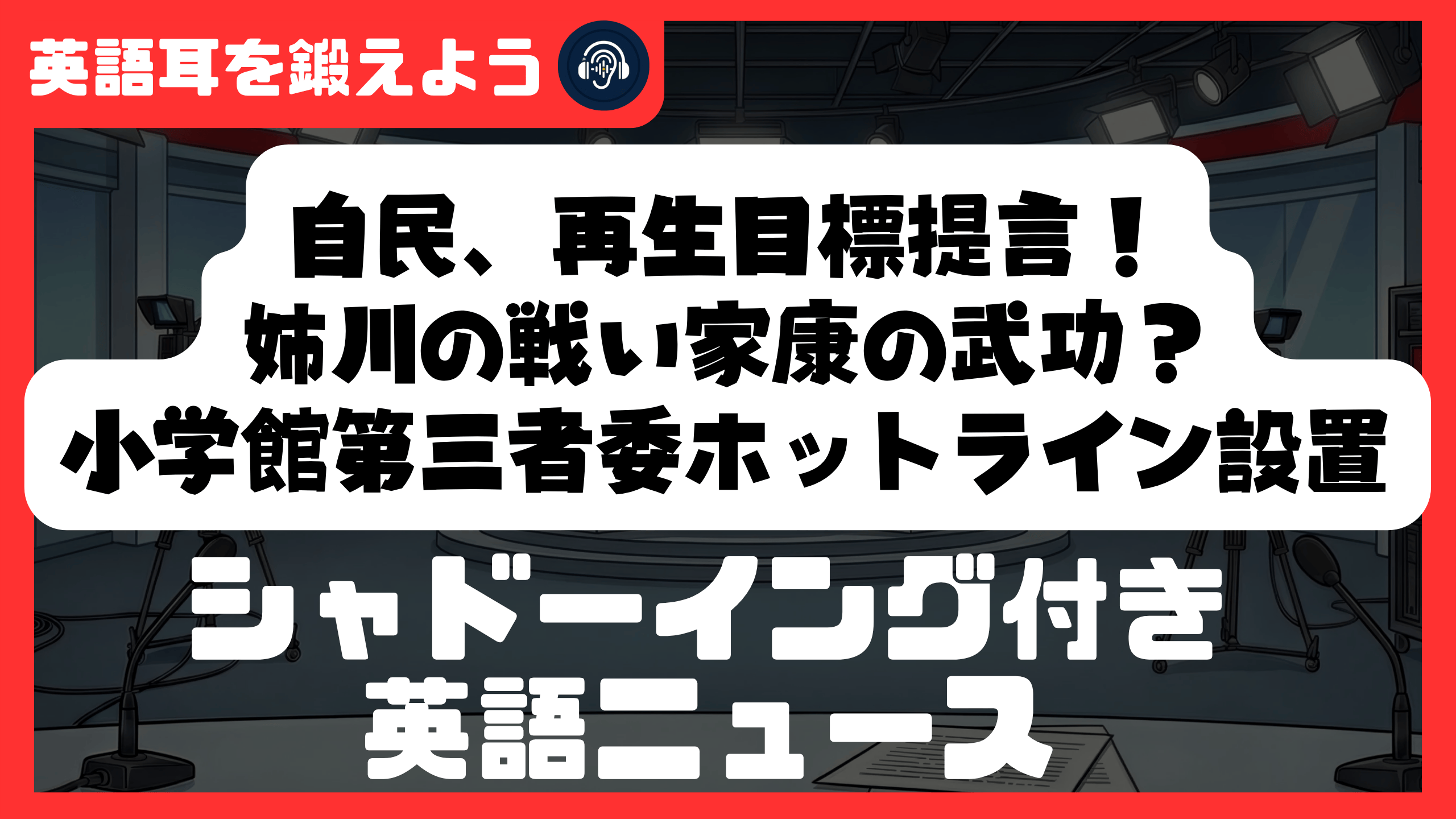
【シャドーイング付き英語ニュース】自民 再生目標提言!姉川の戦い家康の武功?小学館 第三者委ホットライン設置 | リスニング強化
【シャドーイング付き英語ニュース】自民 再生目標提言!姉川の戦い家康の武功?小学館 第三者委ホットライン設置 | リスニング強化
YouTube「スキマ時間で英語を学ぼう」の英語ニュース解説です。
動画と合わせてリスニング・シャドーイングにご利用ください。
スクリプト
Welcome to Sukima English News! I'm Sarah. (スキマ英語ニュースへようこそ!サラです。)
And I'm Marc. (マークです。)
Today, we'll look at recycling targets, a famous samurai battle, and a publisher's new hotline. (今日は、リサイクル目標、有名な侍の合戦、そして出版社の新しいホットラインについて見ていきます。)
Let's get started! (さあ、始めましょう!)
Our first story is about Japan's push for a circular economy, focusing on metals like iron and aluminum. (最初は、鉄やアルミニウムなどの金属に焦点を当てた、日本の循環型経済への取り組みについてです。)
The LDP has proposed recycling targets for these metals by 2030 to Prime Minister Takaichi. (自民党は、鉄やアルミニウムなどの金属について、2030年までのリサイクル目標を高市首相に提言しました。)
This initiative aims to secure resources and build a sustainable society. (この取り組みは、資源を確保し、持続可能な社会を築くことを目指しています。)
That sounds significant. What's the main reason behind this proposal? (それは重要そうですね。この提案の主な理由は何ですか?)
Global resource prices are volatile, and geopolitical risks are increasing. (世界の資源価格は変動しやすく、地政学的なリスクも高まっています。)
Japan relies heavily on imported resources, so resource security is a major concern. (日本は輸入資源に大きく依存しているため、資源の安全保障が大きな懸念事項となっています。)
Utilizing domestic metal scrap effectively is a crucial solution. (国内の金属スクラップを効果的に活用することが、重要な解決策です。)
So, it's about reducing reliance on imports and using what we have. (つまり、輸入への依存を減らし、手元にあるものを使うということですね。)
Exactly. This aligns with broader government goals. (その通りです。これは、より広範な政府の目標とも一致しています。)
The Ministry of the Environment wants to double plastic and metal recycling collection by 2030. (環境省は、2030年までにプラスチックと金属のリサイクル回収量を倍増させたいと考えています。)
And the Ministry of Economy, Trade and Industry has a strategy for a resource-independent economy, strengthening domestic recycling. (そして、経済産業省は、国内リサイクルを強化する、資源自律経済に向けた戦略を持っています。)
It seems like a coordinated effort. (政府全体で連携した取り組みのようですね。)
Yes, it is. And the legal framework is evolving. (はい、そうです。そして、法的な枠組みも整いつつあります。)
Laws like the Plastic Resource Circulation Promotion Act, enacted in 2022, and upcoming revisions to the Resource Recycling Promotion Act are paving the way. (2022年に施行されたプラスチック資源循環促進法や、資源リサイクル促進法の今後の改正などが、その道を開いています。)
These aim to accelerate the transition to a circular economy through measures like eco-design and stronger recycled material usage requirements. (これらは、エコデザインやリサイクル材使用要件の強化といった措置を通じて、循環型経済への移行を加速させることを目指しています。)
That's good to hear. Now, what's the current situation for metal scrap? (それは心強いですね。では、金属スクラップの現状はどうなっていますか?)
For iron scrap, total shipment in 2024 decreased by 3.5 percent to 27.19 million tons. (鉄スクラップについては、2024年の総出荷量は3.5パーセント減少し、2719万トンとなりました。)
This is the third consecutive year of decline, likely due to reduced steel consumption. (これは3年連続の減少で、鋼材消費量の減少が原因と考えられます。)
So, less steel production means less scrap. Japan is known for efficient steel recycling, right? (つまり、鉄鋼の生産が減ればスクラップも減るわけですね。日本は、鉄のリサイクルの効率の高さで知られていますよね?)
It is often called a "recycling star." Over 90 percent of iron and steel products are recovered and recycled. (「リサイクルの優等生」とよく呼ばれています。鉄鋼製品の90パーセント以上が回収され、リサイクルされています。)
This is a closed-loop system, ideal for a circular economy. (資源がぐるりと循環する閉じた仕組みで、循環型経済には理想的です。)
That high recovery rate is impressive. What about aluminum? (その高い回収率はすごいですね。アルミニウムはどうですか?)
Aluminum scrap collection is estimated to increase by 28 percent by 2050, reaching 1.811 million tons. (アルミニウムスクラップの回収量は、2050年までに28パーセント増加し、181万1000トンに達すると推定されています。)
However, Japan is currently an "exporter" of aluminum scrap, mainly to China, Malaysia, South Korea, and Thailand. (しかし、日本は現在、アルミニウムスクラップの「輸出国」であり、主に中国、マレーシア、韓国、タイに輸出しています。)
So, while we might collect more, demand from other countries is drawing our scrap away? (つまり、回収量が増えても、他国の需要に日本のスクラップが引き寄せられてしまうということですか?)
That's right. China's demand is about twenty times larger than Japan's. (その通りです。中国の需要は、日本の約20倍です。)
Although recycled material in domestic aluminum demand is increasing, strong overseas demand means more scrap is exported. (国内のアルミ需要でリサイクル材の割合は増えているんですが、海外の需要が強いせいで、スクラップは海外に輸出されることが多いんです。)
That presents a challenge for domestic recycling. What about the overall market size for metal recycling? (それは国内のリサイクルにとって課題ですね。金属リサイクルの市場全体ではどうなんですか?)
The global metal scrap recycling market is projected to reach 614 billion dollars by 2034, with a 3.9 percent CAGR. (世界の金属スクラップリサイクル市場は、2034年までに6140億ドルに達すると予測されており、年平均成長率は3.9%です。)
Another report forecasts the market to expand from 915.4 billion dollars in 2024 to over 1.29 trillion dollars by 2033, also at a 3.9 percent growth rate. (別のレポートでは、市場は2024年の9154億ドルから2033年までに1兆2900億ドル以上に拡大すると予測しており、こちらも成長率は3.9%です。)
Those are huge numbers, showing a strong global trend. (すごい数字ですね。世界的な大きな流れを示しています。)
Indeed. And the market for recycled metals themselves is also substantial. (ええ。そして、リサイクル金属自体の市場も相当な規模です。)
The recycled metals market was valued at 128.1 billion dollars in 2024 and is expected to reach 200 billion dollars by 2034. (リサイクル金属市場は2024年に1281億ドル規模で、2034年までに2000億ドルに達すると見込まれています。)
So, the LDP's proposal is very much in line with global trends and national strategies. (つまり、自民党の提案は、世界的なトレンドや国の戦略にぴったり沿っているわけですね。)
Precisely. The goal is to enhance Japan's resource self-sufficiency and strengthen its economic security. (まさにその通りです。目標は日本の資源自給率を高め、経済安全保障を強化することです。)
By setting clear targets, the government hopes to encourage more domestic recycling and reduce reliance on unstable foreign supply chains. (明確な目標を設定することで、政府は国内リサイクルをさらに促進し、不安定な海外サプライチェーンへの依存を減らしたいと考えています。)
It makes sense. For businesses and consumers, this could mean more stable material costs and a greater contribution to environmental sustainability. (なるほど。企業や消費者にとっては、資材コストが安定し、環境面での持続可能性にもより貢献できるかもしれませんね。)
That's a great point. It's about building a more resilient and eco-conscious economy for Japan's future. (いい指摘ですね。日本の未来のために、より強くしなやかで、環境に配慮した経済を築こうということなんです。)
Now, let's shift gears to a fascinating historical event in Japan. Our next story delves into the Battle of Anegawa. (さて、話題を日本の興味深い歴史的出来事に移しましょう。次の話は姉川の戦いです。)
The Battle of Anegawa? I'm not very familiar with it. What was the context? (姉川の戦いですか?あまり詳しくないのですが、どのような背景だったんですか?)
It was a major conflict in 1570 between the allied forces of Oda Nobunaga and Tokugawa Ieyasu, and the allied forces of Azai Nagamasa and Asakura Kagetake. (1570年に、織田信長と徳川家康の連合軍と、浅井長政と朝倉景健の連合軍との間で起きた大きな合戦です。)
So, Nobunaga and Ieyasu were allies from the start? (では、信長と家康は最初から同盟を結んでいたんですか?)
Initially, Nobunaga had an alliance with Azai Nagamasa, even marrying his sister, Oichi, to him. This was crucial for Nobunaga's expansion. (最初は、信長は浅井長政と同盟を結んでおり、妹のお市の方を長政に嫁がせていました。これは信長の勢力拡大にとって非常に重要でした。)
What caused Nagamasa to betray Nobunaga then? (それでは、なぜ長政は信長を裏切ったんですか?)
Nobunaga attacked Echizen's Asakura Yoshikage, a long-time friend of the Azai clan. Nagamasa chose to honor his pledge to the Asakura. (浅井家と古くから友好関係にあった越前の朝倉義景を、信長が攻めたんです。長政は、朝倉家との約束を守るほうを選びました。)
That's a significant turning point. So, Nobunaga then relied on Ieyasu's support? (それは大きな転換点ですね。それで、信長は家康の支援に頼るようになったんですか?)
Exactly. Nobunaga, with Ieyasu's reinforcements, faced the Azai-Asakura forces. (ええ。信長は家康の援軍を得て、浅井・朝倉軍と対峙しました。)
Were the Azai-Asakura forces outnumbered? (浅井・朝倉軍は数で劣っていたんですか?)
They were, but they fought fiercely, even overwhelming Nobunaga's army at one point. (そうです。それでも激しく戦い、一時は信長軍を圧倒しました。)
What turned the tide? (何が流れを変えたんですか?)
Tokugawa Ieyasu's skillful flanking maneuver reversed the situation, leading to the victory of the Oda-Tokugawa alliance. (徳川家康の巧みな側面攻撃が状況を逆転させ、織田・徳川連合軍の勝利につながりました。)
That sounds like a crucial contribution from Ieyasu. (家康の重要な貢献だったようですね。)
It was. Nobunaga later rewarded Ieyasu for his military achievements. (ええ。信長は後に、家康の軍功に報いました。)
The article mentions casualty figures. What are they? (記事には犠牲者の数も出ていますね。どのくらいだったんですか?)
Casualty numbers vary across historical records. Some suggest around 1,100 for the Azai-Asakura side and 800 for the Oda-Tokugawa side. (犠牲者の数は歴史記録によって異なります。浅井・朝倉側は約1100人、織田・徳川側は約800人だったという説もあります。)
And the total? (合計では?)
Other accounts estimate the total number of deaths to be around 2,500. (他の資料では、死者の総数は約2,500人だと見積もられています。)
That's a significant number for a single battle. (一つの戦いにしては、かなりの数ですね。)
Yes, but it's also noted that casualty figures in the Sengoku period might be lower than modern expectations, with desertions and prisoner exchanges also occurring. (ええ。ただ、戦国時代の死者数は、今の私たちが想像するより少なかった可能性もあると指摘されています。逃亡や捕虜の交換もあったからです。)
That's an interesting perspective. How did this victory impact Nobunaga's ambitions? (それは興味深い見方ですね。この勝利は信長の野望にどう影響したのですか?)
This victory was a major military and political success for Nobunaga. It secured his control over northern Omi. (この勝利は信長にとって、軍事的にも政治的にも大きな成功でした。これにより、北近江の支配を固めました。)
And it helped him connect his territories? (領地同士をつなぐのにも役立ったんですね?)
Precisely. It stabilized his invasion route between Gifu and Kyoto and also securedLake Biwa water transport, giving him an economic advantage. (その通りです。岐阜と京都を結ぶ進軍ルートを安定させ、琵琶湖の水運も押さえたことで、経済的にも優位に立ちました。)
So, it wasn't just about winning the battle itself, but the strategic advantages gained afterwards. (つまり、単に戦いに勝っただけでなく、その後の戦略的な利点も大きかったということですね。)
That's right. However, the Azai and Asakura clans were not immediately destroyed. (そうです。しかし、浅井氏と朝倉氏はすぐに滅亡したわけではありませんでした。)
They continued to resist? (抵抗を続けたのですか?)
Yes, they continued to fight back. They formed an alliance with figures like Ishiyama Hongan-ji's Kennyo, creating a "Nobunaga encirclement." (ええ、反撃を続けました。石山本願寺の顕如などと手を組み、「信長包囲網」を作り上げました。)
It seems like the struggle for unification was quite prolonged. (統一への道のりはかなり長かったようですね。)
It was a complex period with shifting alliances and ongoing conflicts. The Battle of Anegawa was a critical step, but not the final one. (同盟関係が変化し、紛争が続く複雑な時代でした。姉川の戦いは重要な一歩でしたが、最終段階ではありませんでした。)
This shows how historical battles were not just about fighting, but also about strategic planning and political maneuvering. (これは、歴史的な戦いが単なる戦闘だけでなく、戦略的な計画や政治的な駆け引きでもあったことを示していますね。)
Absolutely. And understanding these historical events can offer insights into leadership and diplomacy even today. (まったくです。そして、これらの歴史的な出来事を理解することは、現代のリーダーシップや外交にも洞察を与えてくれます。)
It's amazing how these events shaped the Japan we know. (これらの出来事が今の日本を形作ったというのは、すごいことですね。)
Indeed. The consequences of these conflicts played a vital role in Japan's unification process. (そうですね。これらの争いの結果は、日本の統一の過程で重要な役割を果たしました。)
Thank you for breaking down this historical battle for us. (この歴史的な戦いを解説してくださって、ありがとうございました。)
You're welcome. It's a reminder of the intricate path to Japan's modern era. (どういたしまして。日本が近代に至るまでの、入り組んだ道のりを感じさせてくれます。)
Let's shift gears to our next story, which involves a major Japanese publisher and an investigation into misconduct. (では、次の話題に移りましょう。日本の大手出版社と不正行為の調査に関する件です。)
What's happening with the publisher? (その出版社では何があったのですか?)
Shogakukan has established a third-party committee to investigate serious allegations. (小学館は、深刻な疑惑を調査するために第三者委員会を設置しました。)
What kind of allegations? (どのような疑惑ですか?)
It stems from a sexual assault case involving their manga app, "Manga One," and a manga artist with a troubling past. (同社の漫画アプリ「マンガワン」と、過去に問題のある漫画家を巡る性的暴行事件に端を発しています。)
That sounds serious. What triggered this? (それは深刻そうですね。何がきっかけになったのですか?)
The issue gained attention when it was revealed the artist had previously been fined for violating child prostitution and pornography laws. (その漫画家が以前、児童買春・ポルノ禁止法違反で罰金刑を受けていたことが明らかになり、問題が注目されました。)
Despite this history, he was reportedly hired under a different name for new works. (その経歴があるにもかかわらず、別名で新作の仕事を任されていたと報じられています。)
So, they hired someone with a past conviction without proper vetting? (つまり、過去に有罪判決を受けた人物を、適切な審査なしに雇ったということですか?)
Exactly. Shogakukan set up this third-party committee on March 19th to clarify facts and check for similar incidents. (その通りです。小学館は、事実を明らかにし、同様の事件がないか確認するため、3月19日にこの第三者委員会を設置しました。)
And what is this committee doing? (その委員会は何をしているのですか?)
They've opened a dedicated hotline for external stakeholders. (社外の関係者向けに、専用のホットラインを開設しました。)
A hotline for external people? Who can use it? (社外の人向けですか? 誰が利用できるんですか?)
It's open from April 17th to May 1st. They are seeking information from business partners, freelancers, and former executives and employees. (受付は4月17日から5月1日までです。取引先やフリーランス、元役員・元社員から情報を募っています。)
So, they're casting a wide net. (つまり、幅広く情報を集めようとしているんですね。)
Yes, and the investigation also covers instances where Shogakukan employees allegedly exploited their positions to solicit sexual favors from business partners. (ええ。調査の対象には、小学館の社員が立場を利用して、取引先に性的な関係を迫ったとされる事例も含まれています。)
That's a broad scope. Have they dealt with something like this before? (調査の範囲が広いですね。以前にも、こうした問題に対応したことはあるんですか?)
They have. Shogakukan previously set up a committee regarding issues around the drama adaptation of "Sexy Tanaka-san." (あります。小学館は以前、『セクシー田中さん』のドラマ化をめぐる問題で委員会を設置しました。)
I remember that. What did that investigation reveal? (覚えてます。その調査では何が明らかになったんですか?)
It pointed to ethical breaches due to excessive agreement between writers and editors, and highlighted issues at various stages of the adaptation process. (作家と編集者の過度な馴れ合いによる倫理上の問題が指摘され、ドラマ化のさまざまな段階での問題が浮き彫りになりました。)
It seems harassment and long working hours are persistent problems in the industry. (業界ではハラスメントや長時間労働が根深い問題のようですね。)
They are. The industry is urged to improve its handling of harassment, especially with external partners, and strengthen compliance awareness. (ええ。業界はハラスメント、特に社外関係者とのやり取りについて改善し、コンプライアンス意識を強化するよう求められています。)
So, this hotline is a concrete step. (つまり、このホットラインは具体的な一歩なんですね。)
It is. The committee is actively gathering information from outside the company during this limited period. (そうです。委員会は、この限られた期間中に社外から積極的に情報を収集しています。)
Are there any statistics showing the extent of harassment in the media and entertainment sector? (メディア・エンターテイメント業界におけるハラスメントの規模を示す統計はありますか?)
Yes. A survey from Chiki Lab found that over 51 percent of individuals in entertainment, reporting, and media fields had experienced sexual harassment or sexual violence. (はい。チキラボの調査によると、エンターテイメント、報道、メディア分野の人の51%以上がセクシュアルハラスメントや性暴力の経験があると回答しています。)
Furthermore, over 77 percent had heard of such cases, and almost 23 percent reported being asked for sexual favors. (さらに、77%以上がそのような事例を聞いたことがあり、約23%が性的な便宜を求められたと報告しています。)
Those numbers are alarming. It suggests a widespread problem. (衝撃的な数字ですね。問題が広く根づいていることがうかがえます。)
They are. Another survey by Job Research Institute indicated that 55.1 percent of respondents experienced workplace harassment. (ええ。ジョブリサーチセンターの別の調査では、回答者の55.1%が職場でのハラスメントを経験したと示されています。)
And 82.9 percent felt that the power harassment prevention law needs strengthening. (そして、82.9%がパワーハラスメント防止法の強化が必要だと感じています。)
That's a high percentage. It highlights the need for better legal protections. (それは高い割合ですね。より良い法的保護の必要性を浮き彫りにしています。)
The situation is similar for performing artists. A study found 88 percent felt anxious about their working conditions and safety. (パフォーミングアーティストにとっても状況は似ています。ある調査では、88%が労働条件や安全について不安を感じていることがわかりました。)
And over 70 percent reported harassment within their work. (そして70%以上が仕事でのハラスメントを報告しています。)
Given these statistics, it's clear why Shogakukan is taking this seriously and looking for external input. (これらの統計を考えると、小学館がこれを真剣に受け止め、外部からの意見を求めている理由がよくわかります。)
Absolutely. The publishing industry is known for its demanding work culture, often leading to long hours. (まったくです。出版業界は、長時間労働につながることが多い厳しい労働文化で知られています。)
This has been a long-standing issue, and reforming working styles and retaining young talent are critical challenges. (これは長年の問題で、働き方の改革と若手の定着が重要な課題になっています。)
I saw past reports mentioning very high monthly overtime hours for Shogakukan employees. (以前、小学館の社員の月あたりの残業時間が非常に長いという報道を見ました。)
Yes, in 2018, some employee reviews mentioned around 80 hours of overtime per month. (ええ、2018年には、一部の社員の口コミで月80時間ほどの残業が挙げられていました。)
That's incredible overtime. It must be difficult to maintain work-life balance. (それは信じられないほどの残業時間ですね。ワークライフバランスを保つのは難しいでしょう。)
It certainly is. The market itself is also shifting, with print sales declining since their peak in 1996. (まったくです。市場自体も変化しており、紙媒体の売上は1996年のピーク以降減少しています。)
However, the e-book market is growing, indicating digitalization is key for the industry's future. (しかし、電子書籍市場は成長しており、デジタル化が業界の未来の鍵であることを示しています。)
So, they're dealing with internal issues of harassment and long hours, while also navigating a changing market. (つまり、ハラスメントや長時間労働といった内部の問題を抱えながら、変化する市場にも対応しなければならないわけですね。)
Precisely. This third-party committee and the hotline are a significant step. They signal a growing awareness of harassment and labor environment problems across the entire publishing sector. (その通りです。この第三者委員会とホットラインは大きな一歩です。出版業界全体で、ハラスメントや労働環境の問題に対する意識が高まっていることを示しています。)
It seems that by investigating these issues, Shogakukan hopes to prevent future problems and rebuild trust. (小学館は、これらの問題を調査することで、将来の問題を防ぎ、信頼を再構築したいと考えているようですね。)
That's the hope. The committee's findings will likely influence practices not just at Shogakukan, but potentially across the wider Japanese publishing landscape. (そう願いたいですね。委員会の調査結果は、小学館だけでなく、日本の出版業界全体のあり方にも影響を与えるかもしれません。)
It's a complex situation, but hopefully, these efforts will lead to a safer and more ethical working environment for everyone involved in creating books and magazines in Japan. (複雑な状況ですが、これらの取り組みが、日本で本や雑誌を作るすべての人にとって、より安全で倫理的な労働環境につながることを願っています。)
今日のキーワード

Now let's look at some key vocabulary from today's stories. (さて、今日のニュースから、いくつかの重要な語彙を見ていきましょう。)
Our first phrase is "circular economy", which means an economic system aimed at eliminating waste and the continual use of resources. (まずは「circular economy(循環型経済)」。廃棄物をなくし、資源を使い続けることを目指す経済の仕組みのことです。)
For example, Japan is aiming for a more circular economy by recycling more metals. (例文:「日本は、金属のリサイクルを増やすことで、より循環型の経済を目指している」。)
That's a clear goal. What's the next useful term? (明確な目標ですね。次に役立つ言葉は何ですか?)
Next, we have "resource security". This refers to the state of having enough resources, like raw materials, to meet a country's needs. (次は「resource security(資源安全保障)」。原材料など、国が必要とする資源を十分に確保できている状態を指します。)
For instance, Japan's reliance on imported resources makes resource security a major concern. (例文:「日本は輸入資源への依存度が高いため、資源安全保障が大きな懸念となっている」。)
It makes sense to want to secure those vital materials. (それらの重要な資源を確保したいと思うのはもっともですね。)
Moving on, from our history story, a key term is "flanking maneuver". This is a military tactic where forces attack the sides of an enemy formation. (次は歴史のニュースから、重要な言葉「flanking maneuver(側面攻撃)」です。敵の陣形の側面を突く軍事戦術です。)
Tokugawa Ieyasu's flanking maneuver was crucial in the Battle of Anegawa. (例文:「徳川家康の側面攻撃は、姉川の戦いで決定的な役割を果たした」。)
So, attacking from the sides. That can be very effective. (つまり、横から攻めるわけですね。とても効果的なことがあります。)
Indeed. Now, from the third story, let's look at "third-party committee". This is a group formed by people outside an organization to investigate issues. (ええ。では、3つ目のニュースから、「第三者委員会」を見てみましょう。これは組織外の人々が問題を調査するために結成されたグループのことです。)
Shogakukan established a third-party committee to investigate misconduct allegations. (例文:「小学館は、不正行為の疑惑を調査するため、第三者委員会を設置した」。)
That provides an independent perspective. (独立した立場からの視点が得られますね。)
And our last one is "external stakeholders". These are people or groups outside an organization who have an interest in its activities. (そして最後は「external stakeholders(外部ステークホルダー)」。組織の外にいて、その活動に利害関係を持つ人や団体のことです。)
The committee is seeking information from external stakeholders like business partners. (例文:「委員会は、取引先などの外部ステークホルダーから情報を求めている」。)
So, anyone affected by or involved with the company. (つまり、その会社に影響を受ける、あるいは関わるすべての人ですね。)
シャドーイング用セクション
A: "Time for our shadowing practice! Let's practice using the key vocabulary we just learned." (「シャドーイング練習の時間です!今学んだ重要な語彙を使って練習しましょう。」)
A: Japan is promoting a circular economy by aiming to set recycling targets for metals. (日本は、金属のリサイクル目標の設定を目指し、循環型経済を推進している。)
B: Let's try that one more time at normal speed. (もう一度、普通のスピードでやってみましょう。)
A: Japan is promoting a circular economy by aiming to set recycling targets for metals. (日本は、金属のリサイクル目標の設定を目指し、循環型経済を推進している。)
A: Japan is pursuing resource security by setting 2030 recycling targets for metals like iron and aluminum. (日本は、鉄やアルミニウムなどの金属について2030年のリサイクル目標を定め、資源安全保障を追求している。)
B: Let's try that one more time at normal speed. (もう一度、普通のスピードでやってみましょう。)
A: Japan is pursuing resource security by setting 2030 recycling targets for metals like iron and aluminum. (日本は、鉄やアルミニウムなどの金属について2030年のリサイクル目標を定め、資源安全保障を追求している。)
A: Tokugawa Ieyasu's flanking maneuver at the Battle of Anegawa reversed the tide and secured victory for Oda Nobunaga. (姉川の戦いでの徳川家康の側面攻撃が戦局を覆し、織田信長に勝利をもたらした。)
B: Let's try that one more time at normal speed. (もう一度、普通のスピードでやってみましょう。)
A: Tokugawa Ieyasu's flanking maneuver at the Battle of Anegawa reversed the tide and secured victory for Oda Nobunaga. (姉川の戦いでの徳川家康の側面攻撃が戦局を覆し、織田信長に勝利をもたらした。)
A: Shogakukan established a third-party committee to investigate misconduct allegations involving its manga app. (小学館は、自社の漫画アプリをめぐる不正行為の疑惑を調査するため、第三者委員会を設置した。)
B: Let's try that one more time at normal speed. (もう一度、普通のスピードでやってみましょう。)
A: Shogakukan established a third-party committee to investigate misconduct allegations involving its manga app. (小学館は、自社の漫画アプリをめぐる不正行為の疑惑を調査するため、第三者委員会を設置した。)
A: Shogakukan's hotline is seeking information from external stakeholders, including business partners and former employees. (小学館のホットラインは、取引先や元社員を含む外部ステークホルダーから情報を募っている。)
B: Let's try that one more time at normal speed. (もう一度、普通のスピードでやってみましょう。)
A: Shogakukan's hotline is seeking information from external stakeholders, including business partners and former employees. (小学館のホットラインは、取引先や元社員を含む外部ステークホルダーから情報を募っている。)
A: The LDP proposed 2030 recycling targets for iron and aluminum to advance Japan's circular economy. (自民党は、日本の循環型経済を進めるため、鉄とアルミニウムの2030年リサイクル目標を提言した。)
B: Let's try that one more time at normal speed. (もう一度、普通のスピードでやってみましょう。)
A: The LDP proposed 2030 recycling targets for iron and aluminum to advance Japan's circular economy. (自民党は、日本の循環型経済を進めるため、鉄とアルミニウムの2030年リサイクル目標を提言した。)
That's all for today's Sukima English News. (今日のスキマ英語ニュースはここまでです。)
We hope you enjoyed learning with us. (私たちと一緒に学ぶのを楽しんでいただけたなら幸いです。)
Keep practicing your English every day! (毎日英語の練習を続けてくださいね!)
And don't forget to subscribe. (そして、チャンネル登録も忘れずに。)
See you next time! (また次回お会いしましょう!)

関連記事
【シャドーイング付き英語ニュース】AI論文チェック!医師のバナナ選び?防衛費増額! | リスニング強化
【シャドーイング付き英語ニュース】AI論文チェック!医師のバナナ選び?防衛費増額! | リスニング強化
【シャドーイング付き英語ニュース】詐欺増加!漫画で注意喚起?ちいかわ大ヒット! | リスニング強化
【シャドーイング付き英語ニュース】詐欺増加!漫画で注意喚起?ちいかわ大ヒット! | リスニング強化
【シャドーイング付き英語ニュース】幻のモグラ発見!韓国映画で唐田えりか?羽田 小型機新規則! | リスニング強化
【シャドーイング付き英語ニュース】幻のモグラ発見!韓国映画で唐田えりか?羽田 小型機新規則! | リスニング強化
【シャドーイング付き英語ニュース】お菓子値上げ!冷しカプヌ秒殺?不発弾騒動解決! | リスニング強化
【シャドーイング付き英語ニュース】お菓子値上げ!冷しカプヌ秒殺?不発弾騒動解決! | リスニング強化
【シャドーイング付き英語ニュース】AI新時代!熊本豪雨!電池発火注意? | リスニング強化
【シャドーイング付き英語ニュース】AI新時代!熊本豪雨!電池発火注意? | リスニング強化
【シャドーイング付き英語ニュース】サムスン新Galaxy!山陽新幹線新デザイン?新世界夏祭り! | リスニング強化
【シャドーイング付き英語ニュース】サムスン新Galaxy!山陽新幹線新デザイン?新世界夏祭り! | リスニング強化