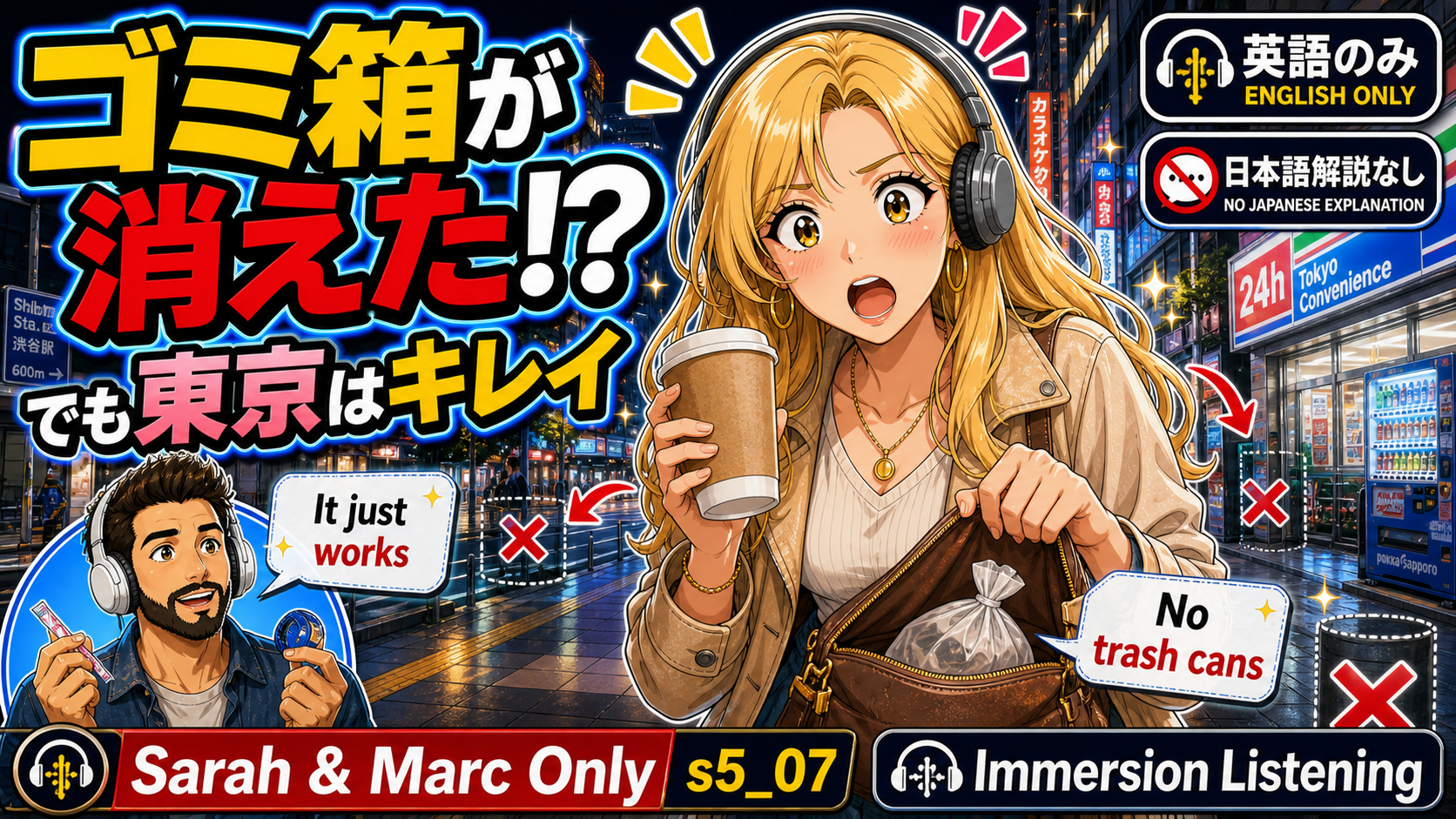
【英語学習】英語のみ | 東京でゴミ箱ゼロ・街がきれいの矛盾に2年半経っても腑に落ちない話 #英語学習 #ネイティブ英語会話 #リスニング強化 #英語耳
ポッドキャスト「すきまイングリッシュ」のスクリプト。「【英語学習】英語のみ | 東京でゴミ箱ゼロ・街がきれいの矛盾に2年半経っても腑に落ちない話 #英語学習 #ネイティブ英語会話 #リスニング強化 #英語耳」の会話全文です。

サラ: Okay. Episode three. "Japan, You're Weird." (日本語訳: はい、第3回。『日本、君はおかしい』。)
Marc: We are doing this again. (日本語訳: またやるんだ。)
サラ: We are doing this again. And today I want to start with a confession. Right now, in my bag, there is an empty paper coffee cup. (日本語訳: またやるよ。で、今日は告白から始めたいの。今、私のバッグの中に、空っぽの紙のコーヒーカップが入ってるの。)
Marc: From today? (日本語訳: 今日の?)
サラ: From this morning. I got coffee at the konbini on my way to meet you, I finished it on the train platform, and then — there was nowhere to throw it. (日本語訳: 今朝の。君に会いに来る途中でコンビニでコーヒーを買って、駅のホームで飲み終わって、それで……捨てる場所がなかったの。)
Marc: So it is in your bag. (日本語訳: だからバッグの中なんだ。)
サラ: It is in my bag. And the wild part is — I am not even frustrated. It is just the bag now. It belongs in the bag. (日本語訳: バッグの中。で、すごいのは、全然イライラしてないってこと。もうバッグの中が定位置なの。バッグの中にあるべきものなのよ。)
サラ: But I am two and a half years in, and I still think about it every single time, like — wait. No trash cans. Right. Of course. (日本語訳: でも、2年半経っても、毎回考えちゃうの。「あれ、ゴミ箱がない。そうだった。当然か」って。)
Marc: You never fully stop thinking about it. (日本語訳: 考えなくなることは、完全にはないよ。)
サラ: Do you? (日本語訳: あなたはそうなの?)
Marc: I have been here five years. I also have something in my bag. (日本語訳: 僕はここに5年いるよ。僕のバッグにも入ってるものがある。)
サラ: What is it? (日本語訳: 何?)
Marc: A bottle cap. And a straw wrapper. (日本語訳: ペットボトルのキャップ。それとストローの袋。)
サラ: Look at us. Two adults, carrying our garbage like responsible children. (日本語訳: 見てよ、私たち。大人が二人、しっかり者の子どもみたいにゴミを持ち歩いてる。)
Marc: Welcome to Tokyo. (日本語訳: 東京へようこそ。)
サラ: Okay, so. Week one. Let me paint you the picture. Day six. I have just figured out how to use my IC card. Got on the right train, got off at the right stop, did not go through the gate the wrong way — I was feeling genuinely competent. (日本語訳: じゃあ。1週目。状況を説明するね。6日目。やっと交通系ICカードの使い方が分かったところ。正しい電車に乗って、正しい駅で降りて、改札を逆から通ったりもしなかった。本当に、自分はちゃんとできてるって感じてたの。)
Marc: That is a good day-six feeling. (日本語訳: 6日目としてはいい気分だね。)
サラ: It was a great day-six feeling. So I celebrate by buying a coffee at the konbini near my apartment. Drink it on the walk back. (日本語訳: 最高の6日目気分だった。だから、お祝いに家の近くのコンビニでコーヒーを買ったの。帰り道で飲んだ。)
サラ: And then I am standing outside my building holding this empty cup, and I think — okay. Trash can. There is definitely a trash can on this corner. (日本語訳: それで、空のカップを持って建物の前に立って、思ったの。よし、ゴミ箱。この角にはきっとゴミ箱がある、って。)
Marc: There was not. (日本語訳: なかったんだね。)
サラ: There was not. So I think — next corner. And I walked. Three more blocks. Nothing. (日本語訳: なかった。だから、次の角だって思って、歩いた。さらに3ブロック。何もなし。)
サラ: And I am in a residential neighborhood. Not some empty street. People, shops, a little fruit stand, a woman walking a very small dog. (日本語訳: しかも住宅街なの。人のいない通りじゃない。人がいて、お店があって、小さな果物屋さんがあって、すごく小さな犬を散歩させてる女の人もいる。)
Marc: No bins. (日本語訳: ゴミ箱がなかった。)
サラ: No bins. So I go back to the konbini, because they have trash cans inside. I walk in, I go to put my cup in the bin next to the register. (日本語訳: ゴミ箱なし。だからコンビニに戻ったの。中にはゴミ箱があるから。入って、レジの横のゴミ箱にカップを入れようとした。)
サラ: And the woman at the counter very quietly says something in Japanese. I did not understand the words. But her eyes went to my cup, then to the bin, then to me. And I understood immediately. (日本語訳: そしたら、レジの女性がすごく小さな声で日本語で何か言ったの。言葉は分からなかった。でも、彼女の目が私のカップに行って、ゴミ箱に行って、私に戻った。それですぐ分かった。)
Marc: That is for konbini products only. (日本語訳: 「当店の商品専用です」ってことだね。)
サラ: That is for konbini products only. I bought this coffee from this exact konbini, twenty minutes earlier. But it is no longer in the branded cup, so it does not count anymore. (日本語訳: 「当店の商品専用です」。そのコーヒー、まさにそのコンビニで20分前に買ったものなのに。でも、もうお店のカップに入った商品じゃないから、対象外ってわけ。)
Marc: That is correct. (日本語訳: そういうこと。)
サラ: I walked back to my apartment, went upstairs, threw the cup in my kitchen trash. And I stood in my kitchen for a moment thinking — okay. What is happening here. Where is the garbage going in this city. (日本語訳: アパートまで歩いて戻って、上の階に上がって、キッチンのゴミ箱にカップを捨てた。それから少しキッチンに立ったまま考えたの。よし、ここでは何が起きてるの? この街のゴミはどこに行ってるの?)
Marc: That is the question. (日本語訳: まさにそれが問題だよね。)
サラ: And it kept coming up. I would finish a snack in the park and hold the wrapper in my hand for the rest of the walk because I was afraid to just — have it on the ground. (日本語訳: それからも何度もあったの。公園でおやつを食べ終わっても、地面に落としておくなんてできなくて、散歩の間ずっと包み紙を手に持ってた。)
Marc: I did the exact same thing. First month, I was in Shibuya. I had a plastic wrapper from something. (日本語訳: 僕もまったく同じことをしたよ。最初の月、渋谷でね。何かのプラスチックの包み紙を持ってた。)
Marc: And I stood on the corner looking for a bin for so long that I accidentally memorized the whole station map. Because I was just standing there, holding my trash, staring at the sign. (日本語訳: で、ゴミ箱を探して角に長いこと立ってたせいで、駅の案内図をうっかり全部覚えちゃったんだ。ゴミを持ったまま、ずっと案内板を見つめて立ってたから。)
サラ: How long? (日本語訳: どれくらい?)
Marc: Probably twenty minutes. On that corner. (日本語訳: たぶん20分。あの角で。)
サラ: In Shibuya. (日本語訳: 渋谷で?)
Marc: Very busy corner. (日本語訳: すごく人の多い角だよ。)
サラ: And nobody said anything? (日本語訳: それで誰も何も言わなかったの?)
Marc: Nobody. They just walked around me. (日本語訳: 誰も。みんな僕をよけて歩いていった。)
サラ: That is also very Tokyo. You can stand frozen on a corner for twenty minutes and people will work around you like you are a street sign. (日本語訳: それもすごく東京っぽいね。角で20分固まってても、みんな道路標識みたいにうまくよけていくんだから。)
Marc: I was basically a street sign with garbage. (日本語訳: 僕はほとんど、ゴミを持った道路標識だったよ。)
サラ: Did you ask anyone about it? Like — Mia? (日本語訳: 誰かに聞いた? ミアとかさ。)
Marc: I asked a coworker. (日本語訳: 同僚に聞いたんだ。)
サラ: I asked Mia. And she said — yeah, that is Japan. And she looked at me like that was a complete answer. Which, for someone who had been here a year longer than me, it kind of was. (日本語訳: 私はミアに聞いたの。そしたら「うん、それが日本」って。それで完璧な答えだって顔で私を見るの。私より1年長くここにいる人にとっては、まあ、完璧な答えだったのかもね。)
Marc: After a while it becomes the baseline. You stop questioning it. (日本語訳: しばらくすると、それが当たり前になるんだ。疑問に思わなくなる。)
サラ: I also asked a coworker. I was teaching at this time, and I asked one of the other teachers — casual, like, hey, where do you throw things away when you are out. (日本語訳: 私も同僚に聞いたよ。その頃は先生をしてて、ほかの先生の一人に、軽い感じで「ねえ、外にいるときってゴミはどこに捨ててる?」って聞いたの。)
サラ: And she looked at me and said — oh, I take it home. Like it was the most obvious thing in the world. (日本語訳: そしたら彼女、私を見て「え、家に持って帰るよ」って。世界で一番当たり前のことみたいに。)
Marc: Because for her it is. (日本語訳: だって彼女にとっては、それが常識なんだから。)
サラ: And coming from New York, where the city infrastructure is everywhere — public bins, trash chutes, recycling in the lobby — the idea that you just carry it home felt almost aggressive. Like, nobody told me this was part of the deal. (日本語訳: ニューヨーク出身の私からすると、街のインフラがどこにでもあるじゃない。公共のゴミ箱、ダストシュート、ロビーのリサイクル箱。そんな環境から来ると、ただ家に持って帰るっていう発想は、ほとんど挑戦的に感じたの。そんな約束があるなんて、誰も教えてくれなかった、って。)
Marc: Nobody tells you. You just figure it out. (日本語訳: 誰も教えてくれないよ。自分で気づくしかない。)
サラ: Or your landlady tells you. But here is the thing — I kept asking, where does the garbage go. And I am walking around confused about this. (日本語訳: もしくは大家さんが教えてくれるか。でもね、私はずっと、ゴミはどこに行ってるのって聞き続けてたの。そのことで混乱しながら歩き回ってた。)
サラ: And at the same time, I am looking at the streets, and the streets are — clean. Like, actually clean. I grew up in Manhattan. I know what a city street looks like. (日本語訳: それと同時に、通りを見てると、通りが……きれいなの。本当にきれい。私はマンハッタンで育ったから、街の通りがどういうものか知ってるのよ。)
Marc: Different situation entirely. (日本語訳: 全然違う状況だね。)
サラ: Completely different. And that is when the question changed from "where is the trash can" to — wait. How is this possible. There is no infrastructure. And the city is immaculate. I still cannot get over that. (日本語訳: 全然違う。それで、疑問が「ゴミ箱はどこ?」から、「待って。どうしてこんなことが可能なの?」に変わったの。インフラはない。なのに街はピカピカ。今でも信じられない。)
Marc: Okay. How did you actually figure out the system? (日本語訳: なるほど。それで、どうやってそのシステムを理解したの?)
サラ: My landlady. Two weeks in, I come home and there is a note on my door. Watanabe-san — she lives on the first floor, she is the one who brought me a towel and tea when I moved in. (日本語訳: 大家さん。来て2週間くらいで、家に帰ったらドアにメモがあったの。渡辺さん、1階に住んでて、私が引っ越してきたときにタオルとお茶を持ってきてくれた人。)
Marc: The towel and tea lady. (日本語訳: タオルとお茶の人だね。)
サラ: Exactly. She left a handwritten note. Neat handwriting. Very specific. With a small diagram. Burnable garbage: Monday and Thursday. Plastic: Tuesday. Cans and bottles: second and fourth Wednesday. (日本語訳: そう。手書きのメモを置いていってくれたの。きれいな字で。すごく具体的で。小さな図まで付いてた。燃えるゴミ:月曜と木曜。プラスチック:火曜。缶・びん:第2・第4水曜。)
サラ: And at the bottom, in English — she wrote this part in English, which I found incredibly touching — "designated garbage bags only." (日本語訳: で、一番下には英語で、ここだけ英語で書いてくれてて、それにすごく感動したんだけど、「指定のゴミ袋のみ」って。)
Marc: Did you know what that meant? (日本語訳: それがどういう意味か分かった?)
サラ: I had to text Mia. And Mia explained — in this ward, you cannot use just any bag. You have to buy specific bags from the konbini. They are color-coded, they come in different sizes, they cost money. (日本語訳: ミアにメッセージしなきゃいけなかった。ミアの説明だと、この区ではどんな袋でもいいわけじゃない。コンビニで指定の袋を買わなきゃいけない。色分けされてて、サイズもいろいろで、有料なんだって。)
Marc: And you separate everything. (日本語訳: それに、全部分別するんだよね。)
サラ: And you separate everything. Burnables in one bag. Plastic packaging in another bag. PET bottles — caps off, label off, crushed — in a different bag. (日本語訳: 全部分別するの。燃えるゴミは一つの袋に。プラスチック包装は別の袋に。ペットボトルは、キャップを外して、ラベルを剥がして、潰して、また別の袋に。)
サラ: Cardboard broken down flat. And everything goes out to the designated collection point, in the right bag, before eight in the morning. (日本語訳: 段ボールは平らにつぶす。で、全部を正しい袋に入れて、朝8時までに指定の集積所に出すの。)
Marc: Eight exactly. (日本語訳: きっちり8時。)
サラ: Eight exactly. Mia told me she once put out burnable garbage at eight fifteen. Came home and the bag was back in front of her door. Unopened. Returned. (日本語訳: きっちり8時。ミアは一度、燃えるゴミを8時15分に出したことがあるんだって。家に帰ったら、袋がドアの前に戻ってきてた。開けられもせずに。返品。)
Marc: The garbage patrol is not joking. (日本語訳: ゴミパトロールは冗談じゃないね。)
サラ: The garbage patrol has zero tolerance. So I went to the konbini, I found the designated bags, I bought the right sizes. Brought them home. (日本語訳: ゴミパトロールに容赦はないの。それで、コンビニに行って、指定の袋を見つけて、合うサイズを買って、持ち帰った。)
サラ: And I read the category chart on the package, and I studied it. I genuinely studied. Like I was preparing for a test. (日本語訳: それから袋に書いてある分別表を読んで、勉強したの。本気で勉強した。試験勉強みたいに。)
Marc: A garbage exam. (日本語訳: ゴミの試験だね。)
サラ: I made notes. I was not going to get another note on my door. Watanabe-san took the time to draw me a diagram in English, and I was not going to let her down. (日本語訳: ノートも取った。もうドアにメモを貼られるわけにはいかなかったから。渡辺さんがわざわざ英語で図を描いてくれたのに、がっかりさせるわけにはいかないでしょ。)
Marc: That note is the most effective piece of communication I can imagine. (日本語訳: あのメモは、考えられる限り一番効果的なコミュニケーションだね。)
サラ: No yelling, no formal complaint. Just — a diagram. And somehow that made me more committed to getting the garbage right than anything anyone has ever yelled at me about in New York. (日本語訳: 怒鳴り声もない、正式な苦情もない。ただの図。なのに、ニューヨークで誰かに怒鳴られたどんなことよりも、ゴミをちゃんと出そうって気持ちにさせられたの。)
Marc: That is completely on-brand for here. (日本語訳: まさにここらしいね。)
サラ: It is. And the system rewards commitment, because it is actually complex. The plastic category alone — I spent so long on plastic. (日本語訳: そうなの。それに、このシステムは本気で取り組む人が報われるの。実際に複雑だから。プラスチックの分類だけでも、ものすごく時間がかかった。)
Marc: Because "plastic" sounds simple, but it is not just plastic. (日本語訳: 「プラスチック」って聞くと簡単そうだけど、ただのプラスチックじゃないからだね。)
サラ: It is so not just plastic. There is plastic packaging, which is one thing. And PET bottles are separate from that. And then regular plastic items — a toy, a container — are different again. (日本語訳: 全然ただのプラスチックじゃないの。プラスチック製の包装、これが一つ。ペットボトルはそれとは別。で、おもちゃとか容器とか、普通のプラスチック製品はまた別。)
Marc: And some things that look plastic are actually burnable. (日本語訳: それに、プラスチックに見えて、実は燃えるゴミっていうものもある。)
サラ: Right. The plastic-looking wrapper around an onigiri? Burnable. Because it is a different type of plastic that burns. I know this because I looked it up at month eighteen. (日本語訳: そう。おにぎりを包んでるプラスチックっぽいフィルム? 燃えるゴミ。燃える種類のプラスチックだから。18か月目に調べたから知ってるの。)
Marc: I have been here five years and I still sometimes hesitate and then just put it in burnable and hope. (日本語訳: 僕はここに5年いるけど、今でもたまに迷って、結局燃えるゴミに入れて祈ってるよ。)
サラ: The universal garbage gambit. (日本語訳: ゴミの万能のかけね。)
Marc: It covers most situations. (日本語訳: たいていの場面はそれで乗り切れる。)
サラ: And I know — okay, this took some research — pizza boxes go with burnable if they are clean, and with oversized garbage if they have grease. (日本語訳: それから、これはちょっと調べたんだけど、ピザの箱は、きれいなら燃えるゴミ、油がついてたら粗大ゴミ。)
Marc: I genuinely did not know the grease distinction. (日本語訳: 油の区別があるなんて、全然知らなかったよ。)
サラ: Month eighteen. Very proud of myself. (日本語訳: 18か月目。自分をすごく誇りに思ってる。)
サラ: Okay. So here is the part that I need to sit with. I want to say it out loud and see if it sounds as strange to you as it does in my head. (日本語訳: よし。ここからは、じっくり考えたいところ。声に出して言ってみるから、私の頭の中と同じくらい変に聞こえるか教えて。)
Marc: Go. (日本語訳: どうぞ。)
サラ: There are no trash cans on the street. You take your garbage home. You sort it. You buy specific bags. You put it out on specific days before eight in the morning. It is the most involved garbage system I have ever encountered. (日本語訳: 通りにゴミ箱がない。ゴミは家に持ち帰る。分別する。指定の袋を買う。決まった曜日の朝8時までに出す。今まで出会った中で、一番手間のかかるゴミのシステムよ。)
Marc: It is thorough. (日本語訳: 徹底してるね。)
サラ: And Tokyo is one of the cleanest cities on earth. It makes no sense on paper. (日本語訳: なのに、東京は世界で一番きれいな都市の一つ。理屈の上では、まったく筋が通らない。)
Marc: It does not. (日本語訳: 合わないね。)
サラ: The math does not add up. In New York, trash bins on every corner. Overflowing. Sometimes there is extra garbage on the ground around the bin because the bin is already full. In summer, certain blocks have a very distinct fragrance. (日本語訳: 計算が合わないの。ニューヨークでは、角ごとにゴミ箱があって、あふれてる。ゴミ箱がいっぱいで、周りの地面にまでゴミがあることもある。夏には、ブロックによってすごく独特のにおいがする。)
Marc: Chicago is the same. (日本語訳: シカゴも同じだよ。)
サラ: Chicago is the same. Bins everywhere, still messy. And here — no bins, clean. I have been trying to figure out the logic. (日本語訳: シカゴも同じ。ゴミ箱はどこにでもあるのに、それでも汚い。で、ここはゴミ箱なしで、きれい。そのロジックをずっと考えてるんだ。)
Marc: What did you come up with? (日本語訳: で、どういう結論になったの?)
サラ: Okay, so my theory. In New York, when there is a bin, I put my garbage in and I stop thinking about it. It leaves my hand, it is gone. Not my problem anymore. (日本語訳: じゃあ、私の説ね。ニューヨークでは、ゴミ箱があれば、ゴミを入れて、それきり考えない。手から離れたら、もう消えたも同然。もう私の問題じゃない。)
サラ: But here — because there is no bin — I hold onto it. I carry my weight. Whatever I made, I own it until I get home. (日本語訳: でもここでは、ゴミ箱がないから、ずっと持ってる。自分の分は自分で背負う。自分が出したものは、家に着くまで自分のもの。)
Marc: And so does everyone else. (日本語訳: しかも、みんなもそうしてる。)
サラ: And so does everyone else. Nobody throws anything on the ground, because the ground is not an option and neither is a bin. The only option is home. And when everyone takes their garbage home — the street stays clean. (日本語訳: みんなもそうしてる。誰も地面に捨てない。地面も選択肢にないし、ゴミ箱もない。選択肢は家だけ。で、みんながゴミを家に持ち帰れば、通りはきれいなまま。)
Marc: There is also something cultural underneath that. (日本語訳: その根っこには、文化的なものもあるね。)
サラ: Say more. (日本語訳: 詳しく聞かせて。)
Marc: There is a thing here about not wanting to make your problem visible to the public. Leaving garbage in the street is a version of — I am making my mess into your problem to deal with. And that is a significant thing here. (日本語訳: ここには、自分の問題を人前にさらしたくないっていう感覚があるんだ。道にゴミを置いていくのは、自分が散らかしたものを、他人が片付ける問題にするってことでしょ。それは、ここではかなり重いことなんだよ。)
サラ: That is on me. Like — whatever I made, it is on me to handle it. (日本語訳: 「それは私の責任」ってことね。自分が出したものは、自分で始末する責任があるって。)
Marc: Right. "That is on me" is basically the underlying philosophy. (日本語訳: そう。「それは私の責任」っていうのが、根っこにある考え方なんだ。)
サラ: Which is the opposite of my natural instinct. My natural instinct is — here is the bin, it is the city's job now. (日本語訳: それって私の本能とは真逆。私の本能は、ほらゴミ箱がある、あとは市の仕事、なの。)
Marc: That is extremely New York. (日本語訳: それは実にニューヨークっぽいね。)
サラ: Very New York, yes. And honestly, I cannot say which approach is more efficient as a system. But I can see the result in front of me every day. (日本語訳: すごくニューヨーク、うん。正直、システムとしてどっちのやり方が効率的かは分からない。でも、その結果は毎日目の前で見てる。)
サラ: And this is what really got to me — a family doing hanami in the park. Full setup, plastic sheets, food, bottles, everything. (日本語訳: それで本当に心を打たれたのが、公園でお花見をしてた家族。シートを敷いて、食べ物、飲み物、何もかも揃えてた。)
サラ: They were there for three hours. And when they packed up and left, the grass looked like nobody had been there. (日本語訳: 3時間もそこにいたのに、片付けて帰ったあとは、誰もいなかったみたいに芝生がきれいだったの。)
Marc: Every time. (日本語訳: 毎回ね。)
サラ: Every time. And then the vending machines. I did not realize this at first, but — there are vending machines everywhere here. Every street corner, every alley. (日本語訳: 毎回。それから自動販売機。最初は気づかなかったんだけど、ここには自販機がどこにでもあるの。どの角にも、どの路地にも。)
Marc: Millions of them. (日本語訳: 何百万台もね。)
サラ: Millions. And you buy a drink, you open it, you drink it — and where does the bottle go? There is no bin next to the machine. (日本語訳: 何百万台も。飲み物を買って、開けて、飲んで、そのボトルはどこへ行くの? 自販機の横にゴミ箱はない。)
Marc: Take it home. (日本語訳: 家に持って帰る。)
サラ: Take it home. And I looked into this because I was curious — apparently some of the older machines used to have bins next to them. But they got removed after security concerns, starting in the nineties. And they just never came back. (日本語訳: 家に持って帰る。気になって調べてみたら、昔は横にゴミ箱がある自販機もあったらしいの。でも90年代から、安全上の懸念で撤去されて、それきり戻ってこなかったんだって。)
Marc: The culture adapted around the absence. (日本語訳: 文化のほうが、ないことに合わせて変わったんだね。)
サラ: The culture adapted. And now the absence is just normal. And everyone has a little bag. And I watched Marc's version of this — tell them the Cubs story. (日本語訳: 文化が合わせたの。で、今はないのが普通になった。みんな小さな袋を持ってる。マークがこれを体験した話も聞いたんだよね。カブスの話、してあげて。)
Marc: Oh, right. I got on a train after a baseball game at a stadium near here. Packed train, everyone coming from the same game. And there was not a single piece of garbage on that train. Everyone had their wrappers and cups in bags or in their pockets. (日本語訳: ああ、そうだね。この近くの球場で野球の試合を見たあと、電車に乗ったんだ。満員で、みんな同じ試合の帰り。なのに、その電車にはゴミが一つも落ちてなかった。みんな、包み紙やカップを袋に入れたり、ポケットにしまったりしてた。)
サラ: After a stadium game. (日本語訳: 球場の試合の後なのに?)
Marc: Full stadium. And the train was clean. That would not happen after a Cubs game. (日本語訳: 満員の球場だよ。それでも電車はきれいだった。カブスの試合の後じゃ、ありえない。)
サラ: That would absolutely not happen. (日本語訳: 絶対ありえないね。)
Marc: I love Chicago. But after a Cubs game, you know there was a game. (日本語訳: シカゴは大好きだよ。でも、カブスの試合の後は、試合があったってすぐ分かる。)
サラ: Right. So I have stopped asking why there are no trash cans. Because the answer is apparently — because there do not need to be. (日本語訳: そうなのよ。だから、なんでゴミ箱がないのかって聞くのはもうやめたの。どうやら答えは、必要ないから、みたいだし。)
Marc: It just works. (日本語訳: それでちゃんと回ってるんだ。)
サラ: It just works. I still do not fully get it. The math still does not add up to me on a logical level. But the result is right there, outside my window every morning. (日本語訳: ちゃんと回ってる。今でも完全には分からない。理屈の上では、やっぱり計算が合わない。でも、その結果は毎朝、窓の外にちゃんとある。)
Marc: And the bag is in your purse. (日本語訳: で、袋は君のバッグの中にある。)
サラ: The bag has been in my purse since month six. Little cloth bag, folded, side pocket. It is a permanent fixture. I do not even think about it anymore. I just — have it. (日本語訳: 袋は6か月目からずっと、バッグに入ってる。小さな布の袋を折りたたんで、サイドポケットに。もう定位置。何も考えずに、ただ持ってる。)
Marc: That is when you know. (日本語訳: そうなったら、もう一人前だね。)
サラ: When you carry a trash bag as a standard accessory. (日本語訳: ゴミ袋を定番の小物として持ち歩くようになったら、ね。)
Marc: Welcome to living here. (日本語訳: ここでの暮らしへ、ようこそ。)
サラ: Okay, phrase check. Because we said some things I want to make sure landed. (日本語訳: よし、フレーズの確認。今日言ったことで、ちゃんと伝わったか確かめたいものがあるの。)
Marc: Go ahead. (日本語訳: どうぞ。)
サラ: "It makes no sense on paper." Which is basically the whole Japan, You're Weird series in one phrase. (日本語訳: 「It makes no sense on paper.(理屈の上では筋が通らない)」。これはもう、『日本、君はおかしい』シリーズ全体を一言で表したようなものだね。)
Marc: It means — on paper, by the logic we thought was universal, this should not work. But it does. (日本語訳: つまり、理屈の上では、僕らが万国共通だと思ってた論理では、これはうまくいかないはず。でも、うまくいってるってこと。)
サラ: "The math does not add up." Which is more specific. I looked at the inputs and the outputs, and they should not produce this result. No trash cans should not equal a clean street. (日本語訳: 「The math does not add up.(計算が合わない)」。こっちはもっと具体的。入力と出力を見ても、この結果になるはずがない。ゴミ箱がないのに、通りがきれいになるはずがないの。)
Marc: And yet. (日本語訳: なのに。)
サラ: And yet. "It just works." (日本語訳: なのに。「It just works.(ちゃんと回ってる)」。)
Marc: Which is where you land after you stop asking why. (日本語訳: 理由を問うのをやめたときに、たどり着くところだね。)
サラ: You accept the result and you carry your weight. Literally. You carry your weight in a little bag all the way home. (日本語訳: 結果を受け入れて、自分の分を背負う。文字通りね。自分の分を小さな袋に入れて、家までずっと運ぶの。)
Marc: "Carry your weight" meaning — take responsibility for your own thing. Do not pass your burden to someone else. (日本語訳: 「Carry your weight(自分の分を背負う)」の意味は、自分のことは自分で責任を持つってこと。自分の重荷を人に押しつけない。)
サラ: Do not make your problem someone else's problem. And "that is on me." Short. Useful. This is my mess, I will handle it. Very Tokyo energy, it turns out. (日本語訳: 自分の問題を、人の問題にしない。それから「That is on me.(それは私の責任)」。短くて、便利。これは私が散らかしたもの、私が片付けます。実はすごく東京っぽい感覚だったのね。)
Marc: "I still do not get it." (日本語訳: 「I still do not get it.(まだよく分からない)」。)
サラ: "I still do not get it." Which is honest. I can describe what is happening. I can observe the result. (日本語訳: 「まだよく分からない」。正直な言葉よね。何が起きてるかは説明できる。結果も見える。)
サラ: But I am not going to pretend I have fully understood how a city with no public trash infrastructure ends up cleaner than cities with bins on every corner. I still do not get it. (日本語訳: でも、公共のゴミ箱のインフラがない都市が、角ごとにゴミ箱がある都市よりきれいになる仕組みを、完全に理解したふりはしない。まだよく分からない。)
Marc: That might be the most honest thing you have said in this whole series. (日本語訳: このシリーズで一番正直なセリフかもね。)
サラ: Two and a half years of not getting it, and arriving at — fine. I will carry the bag. That is my answer. (日本語訳: 2年半、分からないまま過ごして、たどり着いたのは、まあいいか、袋は私が運ぼう、ってこと。それが私の答え。)
Marc: That is enlightenment. (日本語訳: それは悟りだよ。)
サラ: Is it? (日本語訳: そうかな?)
Marc: I think so. You stopped needing to understand. You just adapted. Watanabe-san would be proud. (日本語訳: そう思うよ。理解する必要がなくなった。ただ適応したんだ。渡辺さんも誇らしく思ってるはずだよ。)
サラ: Watanabe-san is definitely proud. I have not gotten a note in over two years. (日本語訳: 渡辺さんは絶対誇らしく思ってる。2年以上、一度もメモをもらってないもん。)
Marc: High praise. (日本語訳: 最高の賛辞だね。)
サラ: Japan — you are weird. Your street is spotless. I still do not understand. Both of those things are true at the same time. (日本語訳: 日本、君はおかしいよ。通りはピカピカ。私はまだ分からない。この二つは同時に本当なの。)
Marc: All three things. (日本語訳: 三つだよ。)
サラ: All three. Thank you for listening to us work through this in real time. (日本語訳: 三つね。私たちがこれをリアルタイムで考えていくのを聞いてくれて、ありがとう。)
Marc: Episode three of — however many it takes. (日本語訳: 第3回。何回かかるか分からないけどね。)
サラ: We will keep going as long as I keep finding things that make no sense on paper. (日本語訳: 理屈の上で筋が通らないことを私が見つけ続ける限り、続けるよ。)
Marc: So — indefinitely. (日本語訳: つまり、終わりなしだね。)
サラ: Probably indefinitely. (日本語訳: たぶん、終わりなし。)
Marc: Alright. Carry your weight out there. (日本語訳: よし。外でも自分の分は背負っていこう。)
サラ: And carry your trash. (日本語訳: それと、自分のゴミもね。)
Marc: See you next time. (日本語訳: また次回ね。)
サラ: See you next time. (日本語訳: またね。)

関連記事
【日常英会話】「感謝していることを一つずつ」アメリカの感謝祭とネイティブの本音 #英語学習 #ネイティブ英語会話 #リスニング強化 #英語耳
ポッドキャスト「すきまイングリッシュ」のスクリプト。「【日常英会話】「感謝していることを一つずつ」アメリカの感謝祭とネイティブの本音 #英語学習 #ネイティブ英語会話 #リスニング強化 #英語耳」の会話全文です。

【日常英会話】英語のみ | ニューヨークと東京のハロウィンを英語で語ると? #英語学習 #ネイティブ英語会話 #リスニング強化
ポッドキャスト「すきまイングリッシュ」のスクリプト。「【日常英会話】英語のみ | ニューヨークと東京のハロウィンを英語で語ると? #英語学習 #ネイティブ英語会話 #リスニング強化」の会話全文です。

【日常の英語】元気のない同僚にかける英語フレーズ12選|声かけから励ましまで #英語学習 #英語フレーズ #英会話 #英語耳
ポッドキャスト「すきまイングリッシュ」のスクリプト。「【日常の英語】元気のない同僚にかける英語フレーズ12選|声かけから励ましまで #英語学習 #英語フレーズ #英会話 #英語耳」の会話全文です。
【日常英会話】住所と道案内を英語で話すと?日本の住所には通りの名前がない #英語学習 #ネイティブ英語会話 #リスニング強化 #英語耳
ポッドキャスト「すきまイングリッシュ」のスクリプト。「【日常英会話】住所と道案内を英語で話すと?日本の住所には通りの名前がない #英語学習 #ネイティブ英語会話 #リスニング強化 #英語耳」の会話全文です。

【日常の英語】日本語解説あり | 席を譲ろうとして、断られた |申し出る英語と、断られたときの英語6つ #英語学習 #英語フレーズ #英会話 #英語耳
ポッドキャスト「すきまイングリッシュ」のスクリプト。「【日常の英語】日本語解説あり | 席を譲ろうとして、断られた |申し出る英語と、断られたときの英語6つ #英語学習 #英語フレーズ #英会話 #英語耳」の会話全文です。

【日常英会話】カウンターには、向かいの椅子がない、「お一人ですか」と聞かれる国 #英語学習 #ネイティブ英語会話 #リスニング強化 #英語耳
ポッドキャスト「すきまイングリッシュ」のスクリプト。「【日常英会話】カウンターには、向かいの椅子がない、「お一人ですか」と聞かれる国 #英語学習 #ネイティブ英語会話 #リスニング強化 #英語耳」の会話全文です。