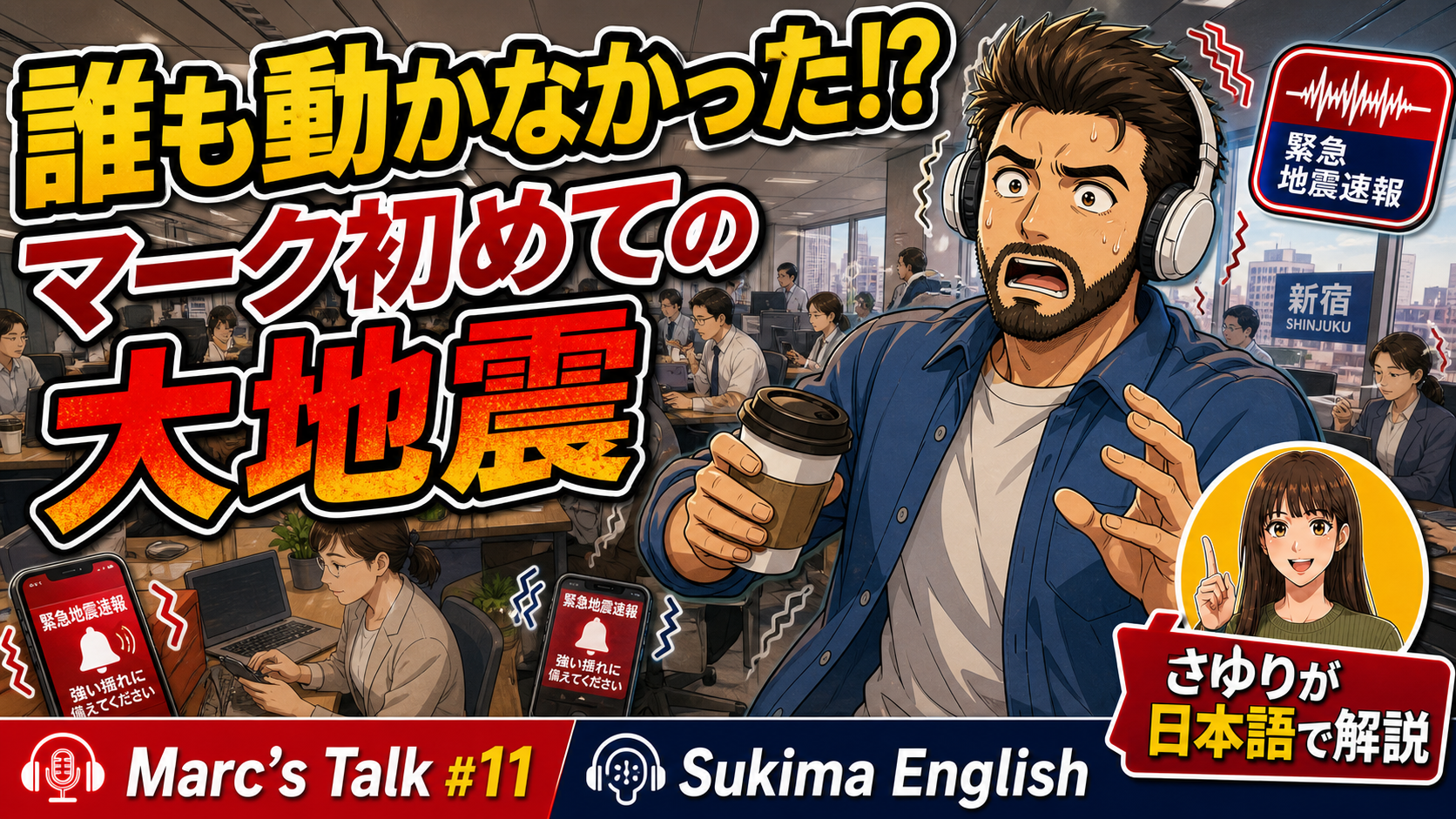
【日常英会話】誰も動かなかった40秒、日常英会話で学ぶ「備え」の話|緊急地震速報・震度・非常用持ち出し袋を英語で語る #英語学習 #ネイティブ英語会話 #リスニング強化 #英語耳
ポッドキャスト「すきまイングリッシュ」のスクリプト。「【日常英会話】誰も動かなかった40秒、日常英会話で学ぶ「備え」の話|緊急地震速報・震度・非常用持ち出し袋を英語で語る #英語学習 #ネイティブ英語会話 #リスニング強化 #英語耳」の会話全文です。

さゆり: こんにちは。Sukima English へようこそ。
さゆり: 今回は、本編に入る前に、お伝えしたいことがあります。
さゆり: 7月28日の午後4時27分、熊本県で大きな地震が発生しました。マグニチュードは7.1、最大震度は7でした。
さゆり: 気象庁はこの地震を「令和8年熊本地震」と名づけました。
さゆり: 8月5日の時点で、38人の方が亡くなり、住宅の全壊は699棟に上っています。今も避難所で過ごしている方がいます。
さゆり: 亡くなられた方々に、心よりお悔やみ申し上げます。被災されたすべての皆さまに、お見舞い申し上げます。
さゆり: 今回のエピソードは、もともと9月1日の防災の日に合わせて準備していた回でした。
さゆり: 日本に住む外国人が、初めて大きな地震を経験したときの話です。
さゆり: 公開を迷いましたが、備えの話だからこそ、今お届けしたいと考えました。
さゆり: 怖がらせるための内容ではありません。今日、家に帰ってできることを、ひとつでも見つけていただけたらと思います。
さゆり: では、マーク、サラ、お願いします。
Marc: Before we start, I want to say something to anyone listening from Kumamoto, or with family there. (日本語訳: 始める前に、熊本から聞いてくれている方、または熊本に家族がいる方に、一つお伝えしたいことがあります。)
Marc: I am very sorry. I hope the people you love are safe. (日本語訳: 心からお悔やみ申し上げます。愛する方々のご無事を祈っています。)
サラ: Same here. To everyone who is still in a shelter this week, we are thinking about you. (日本語訳: 私もです。今週も避難所生活を送っている皆さんのことを、私たちは思っています。)
サラ: Marc, we planned this episode a while ago. Are you still comfortable talking about it today? (日本語訳: マークさん、このエピソードは少し前に計画したものでしたが、今日話すことに抵抗はありませんか?)
Marc: I am. I think it matters more now, not less. (日本語訳: 大丈夫です。むしろ、今だからこそ話す意味があると思っています。)
Marc: But I want to be careful with it. For me, this is a story I can tell. For a lot of people this week, it is not a story. (日本語訳: でも、慎重に進めたいです。私にとっては、これは語れる話です。でも、今週、多くの人にとっては、これは語れるような話ではないのです。)
サラ: That is a fair way to put it. (日本語訳: それは、確かにそうですね。)
Marc: So let us make this about preparation. Not about how dramatic it felt for me. (日本語訳: だから、この話は、私の体験談ではなく、準備についてにしましょう。)
サラ: Deal. Take me back to the beginning. Your first real one. (日本語訳: 了解。最初から話してください。マークさんが経験した、最初の本当の災害について。)
Marc: Month three. A Tuesday afternoon in the fall, around two o'clock. (日本語訳: 3ヶ月目。秋の火曜日のお昼過ぎ、2時頃。)
Marc: I was at my desk in the Shinjuku office. Ninth floor. Completely ordinary day. (日本語訳: 新宿のオフィスにいたんです。9階。いつも通りの平凡な日でした。)
サラ: And then? (日本語訳: それで?)
Marc: First I heard it. There was this low sound, almost under the floor. I assumed a truck had gone by. (日本語訳: まず音が聞こえたんです。床下から聞こえるような、低い音。トラックが通ったのかな、と思ったんです。)
サラ: In Shinjuku that is a completely reasonable assumption. (日本語訳: 新宿なら、それは十分ありえると思います。)
Marc: Right. So I did not react at all. And then every phone in the room went off at once. (日本語訳: そう。だから何も反応しなかったんです。そしたら、部屋中のスマホが一斉に鳴り出したんです。)
サラ: Every phone. (日本語訳: スマホ、全部。)
Marc: Forty phones, one sound. You have never heard it before, and you still understand it immediately. (日本語訳: 40台のスマホが、同じ音で。今まで聞いたことがなくても、すぐにそれが何なのか分かってしまう音です。)
Marc: So the phones go off, and I stand up. Because that is what my body decided to do. (日本語訳: スマホが鳴り出して、私は立ち上がりました。体が勝手にそう動いたんです。)
サラ: Okay. And what did everyone else do? (日本語訳: それで、他の人たちはどうしましたか?)
Marc: Nothing. (日本語訳: 何も。)
サラ: Nothing? (日本語訳: 何も?)
Marc: Nobody moved. Forty people, all of them sitting. A couple of them looked up at the ceiling. That was it. (日本語訳: 誰も動かなかったよ。40人、みんな座ってて。何人かは天井を見てた。それだけ。)
サラ: You were the only person standing. (日本語訳: 君だけ立ってたんだ。)
Marc: The only person standing, in the middle of the room, holding a coffee, looking like I had been called on in class. (日本語訳: 部屋の真ん中で立ってたのは私だけ。コーヒーを持って、授業で当てられたみたいな顔で。)
サラ: Oh, that is a rough way to meet a country. (日本語訳: ああ、それは国と出会うにはキツい方法ね。)
サラ: Mine was month two, at night, in my apartment in Nakano. Only a shindo three, but I was in the hallway in about a second. (日本語訳: 私は2ヶ月目、夜、中野のアパートで。震度3だったけど、1秒で廊下に出たわ。)
Marc: And nobody else came out. (日本語訳: で、誰も出てこなかった?)
サラ: Not one door opened. I stood there alone in my pajamas feeling like I had misread the whole situation. (日本語訳: 一軒もドアが開かなかった。パジャマのままそこに立ってて、状況を全部見間違えたみたいに感じたわ。)
Marc: Welcome to the club. So, back in the office, the shaking started properly. (日本語訳: ようこそ、クラブへ。それで、オフィスに戻ったら、揺れが本格的に始まったんだ。)
Marc: It was not sharp. It was slow and wide, like the whole building was floating. (日本語訳: 鋭い揺れじゃなかった。ゆっくりで幅広かった。建物全体が浮いてるみたいだった。)
Marc: There is a cord on the blinds by the window, and I watched it swing back and forth like a pendulum. (日本語訳: 窓の近くのブラインドについてる紐が、振り子みたいに左右に揺れるのをずっと見てたんだ。)
サラ: How long? (日本語訳: どのくらい?)
Marc: It felt like two minutes. It was probably forty seconds. (日本語訳: 2分くらいに感じたよ。おそらく40秒。)
Marc: Forty seconds is long enough to have a full conversation with yourself about your life choices. (日本語訳: 40秒あれば、自分の人生の選択について、自分自身と十分な会話ができる。)
サラ: And then it stops. (日本語訳: で、止まるんだ。)
Marc: And then it stops, and the room goes back to work. Keyboards, phone calls, someone laughing at something. (日本語訳: 止まるんだ。で、部屋は仕事に戻る。キーボード、電話、誰かが何かで笑ってる音。)
Marc: The guy next to me looks at his screen and says, shindo four, probably. Then back to his spreadsheet. (日本語訳: 隣のやつが画面を見て、震度4くらいだって言って、またスプレッドシートに戻った。)
サラ: See, that is the part I would find unsettling. Not the shaking. The filing. (日本語訳: それが、私が落ち着かなくなる部分よ。揺れじゃなくて。その対応。)
Marc: Exactly. The shaking frightened me for forty seconds. The filing stayed with me for weeks. (日本語訳: まさに。揺れは40秒間私を怖がらせた。その対応は数週間私に残ったよ。)
サラ: The whole office just took it in stride. (日本語訳: オフィス全体が、それを普通のこととして受け止めてたんだ。)
Marc: They did, because this is not an event here. It is a Tuesday. (日本語訳: イベントじゃなくて、ただの火曜日だからね。)
Marc: And that is when it hit me. I did not have a category for any of it. I had nowhere to put it. (日本語訳: それで気づいたんだ。何もかも、どのカテゴリーにも当てはまらなかった。どこにも分類できなかった。)
サラ: I have one from my side, and it is the opposite problem. (日本語訳: 私の方にも、それと逆の悩みがあるんだ。)
サラ: April of 2024. New Jersey, magnitude four point eight. About forty two million people felt it, and I was one of them. (日本語訳: 2024年4月。ニュージャージー州でマグニチュード4.8。約4200万人が揺れを感じて、私もその一人だった。)
サラ: It was the strongest thing to hit New York City since eighteen eighty four. (日本語訳: 1884年以来、ニューヨーク市を襲った中で一番強い揺れだったんだよ。)
Marc: So basically never. (日本語訳: つまり、ほとんどないってことだね。)
サラ: Basically never. And here is my favorite detail. The alert reached everyone's phone about forty minutes later. (日本語訳: ほとんどない。で、私の好きなディテールはここから。アラートがみんなのスマホに届いたのは、40分後だった。)
Marc: Forty minutes after. (日本語訳: 40分後。)
サラ: Phones went off in the middle of a New York Philharmonic concert, long after anyone had felt anything. (日本語訳: ニューヨーク・フィルハーモニックのコンサートの途中でスマホが鳴ったんだけど、もう揺れなんて誰も感じなくなってた後だった。)
Marc: So in New York the alert arrives when the story is already over. (日本語訳: じゃあニューヨークだと、もう話が終わってからアラートが来るんだね。)
サラ: And here it arrives before the story starts. That gap says a lot. (日本語訳: こっちは話が始まる前に来る。そのギャップが物語ってるよ。)
さゆり: マークが今言った "it hit me" という表現、聞こえましたか?
さゆり: 直訳すると「それが私を打った」ですが、英語では「はっと気づいた」「実感として腑に落ちた」という比喩で使います。
さゆり: 頭では知っていたことが、体験を通して急に本当のことになる。そういう瞬間の言い方です。
サラ: Okay, I want to go back to that alert sound, because it is one of the strangest things about living here. (日本語訳: よし、そのアラート音に戻りたいんだけど、ここでの生活で一番奇妙なことの一つだから。)
Marc: The chime. (日本語訳: あのチャイムね。)
サラ: Describe it for someone who has never heard it. (日本語訳: 聞いたことない人に説明してみて。)
Marc: Two notes. Low, then lower. It repeats, and it does not sound like a phone. It sounds like a warning from a much older machine. (日本語訳: 2つの音。低い音、それからもっと低い音。繰り返すんだけど、電話の音じゃないんだ。もっと古い機械からの警告音みたいなんだ。)
Marc: It does not tell you what to do, either. It just tells you to brace yourself. (日本語訳: 何をすればいいか教えてくれるわけでもない。ただ身構えろって言ってるだけ。)
サラ: It sounds like something is about to come out of the ocean. (日本語訳: 海から何かが現れそうな音だよね。)
Marc: That is honestly what I thought. I turned to a coworker and said, is that the Godzilla alarm. (日本語訳: 正直、私もそう思ったよ。同僚に「ゴジラ警報?」って聞いたんだ。)
サラ: Please tell me you did not say that out loud. (日本語訳: まさか、口に出して言ったんじゃないでしょうね。)
Marc: I said it out loud. And I was closer than I deserved to be. (日本語訳: 口に出して言ったよ。しかも、その時、私は思っていたよりずっと近くにいたんだ。)
サラ: Meaning what? (日本語訳: どういう意味?)
Marc: Kenji told me this in my fourth year, and I did not believe him until I looked it up. (日本語訳: 健二が4年目の時に教えてくれたんだけど、自分で調べなかったら信じなかったよ。)
Marc: The chime was made by an engineer named Toru Ifukube. A professor, an acoustics researcher, not a musician. (日本語訳: あのチャイムは、工学者の伊福部徹っていう人が作ったんだ。音楽家じゃなくて、教授で音響研究者だよ。)
Marc: His uncle was Akira Ifukube. The composer. The man who wrote the Godzilla theme. (日本語訳: 叔父さんは伊福部昭。あの作曲家。ゴジラのテーマを書いた人だよ。)
サラ: You are joking. (日本語訳: まさか。)
Marc: I am not. The chime is based on one of his uncle's orchestral pieces, and the Godzilla theme itself was considered and set aside. (日本語訳: 本当だよ。チャイムは叔父さんのオーケストラ曲を元にしてるし、ゴジラのテーマ自体も検討されたけど、見送られたんだ。)
サラ: So the country's earthquake alarm is a family project. (日本語訳: じゃあ、国の地震警報はファミリープロジェクトなんだ。)
Marc: A family project that won a design award in 2020. (日本語訳: 2020年にデザイン賞を受賞したファミリープロジェクトだよ。)
サラ: That is the most Japan sentence I have heard this month. (日本語訳: 今月聞いた中で一番日本らしいセリフだね。)
サラ: How does the warning actually work? Because it cannot predict an earthquake. (日本語訳: じゃあ、この警報って実際どうやって機能するの?地震を予測できるわけじゃないんでしょ?)
Marc: It is not predicting anything. It is racing. (日本語訳: 予測してるんじゃない。競争してるんだよ。)
サラ: Racing what? (日本語訳: 何と競争するの?)
Marc: The earthquake. A quake sends out two kinds of waves. The fast one is small. The slow one is what shakes your building. (日本語訳: 地震だよ。地震は2種類の波を出すんだ。速い波は小さい。遅い波が建物を揺らす方なんだ。)
Marc: Sensors catch the fast wave, computers estimate how big this will be, and the warning travels by network. Which beats the ground. (日本語訳: センサーが速い波を捉えて、コンピューターがどれくらいの大きさになるか推定して、警報がネットワークで伝わる。それが地面より速いんだ。)
サラ: So the message physically outruns the shaking. (日本語訳: つまり、揺れよりもメッセージの方が物理的に速いってこと?)
Marc: That is the whole idea. Sometimes it buys you a few seconds, sometimes a few tens of seconds. (日本語訳: それが狙いだよ。数秒稼げる時もあれば、数十秒稼げる時もある。)
サラ: And a few seconds is worth something? (日本語訳: それで、数秒でも価値があるの?)
Marc: A few seconds is a train slowing down. It is a surgeon lifting their hands. It is you getting under a table. (日本語訳: 数秒あれば電車が減速できる。外科医が手を上げることもできる。君がテーブルの下に隠れることもできる。)
サラ: When did they start doing this? (日本語訳: いつから始まったの、これ?)
Marc: Nationwide, October of 2007. Younger than my first phone. (日本語訳: 全国規模では2007年10月。私の最初のスマホより若いね。)
Marc: And once you have lived with it a while, it sits in the back of your mind. You are not thinking about it, but it never leaves. (日本語訳: そして、しばらくそれと一緒に暮らしていると、それはあなたの心の奥底に定着します。考えてはいないけれど、決して離れないんです。)
サラ: And in Kumamoto? (日本語訳: 熊本では?)
Marc: The agency put the warning out three point eight seconds after the sensors first detected it. (日本語訳: センサーが最初に検知してからわずか3.8秒後に、その機関は警告を発した。)
サラ: Under four seconds. (日本語訳: 4秒以内。)
Marc: Under four seconds. I keep coming back to that number. (日本語訳: 4秒以内。その数字に何度も戻ってしまいます。)
サラ: The other thing I want you to explain is shindo, because I got this wrong for a long time. (日本語訳: もう一つ説明してほしいのは震度について。私は長い間これを間違えていました。)
Marc: You and me both. For my first two years I thought shindo and magnitude were the same idea in two languages. (日本語訳: 私もだよ。最初の2年間は、震度とマグニチュードが2つの言語で同じ概念だと思っていたんだ。)
Marc: They are completely different. Magnitude is the energy the earthquake released. One earthquake, one number. (日本語訳: 全く違うんだ。マグニチュードは地震が放出したエネルギーのこと。地震は1つ、数字は1つ。)
Marc: Shindo is how hard the ground actually shook where you are standing. One earthquake, hundreds of numbers. (日本語訳: 震度は、立っている場所の地面が実際にどれだけ揺れたかということ。地震は1つ、数字は数百。)
サラ: So the same quake can be small for you and enormous for someone an hour away. (日本語訳: つまり、同じ地震でも、あなたにとっては小さくても、1時間離れた場所にいる人にとっては甚大なものになり得るってことね。)
Marc: Exactly. The scale runs zero to seven, but there are ten steps, because five and six each split into a weaker and a stronger version. (日本語訳: その通り。スケールは0から7までだけど、5と6はそれぞれ弱いバージョンと強いバージョンに分かれるから、10段階になるんだ。)
サラ: Why split them? (日本語訳: なぜ分けたの?)
Marc: Because that gap is the difference between books falling off a shelf and not being able to stand up. (日本語訳: その差が、本棚から本が落ちるか、立っていられなくなるかの違いだからだよ。)
サラ: That is worth having a word for. (日本語訳: それは言葉にする価値があるわね。)
Marc: When I see the number now, I know what the room looked like. And Kumamoto was a seven. (日本語訳: 今、その数字を見ると、部屋がどんな様子だったか分かるんだ。そして熊本は震度7だった。)
サラ: Is there an eight? (日本語訳: 8はあるの?)
Marc: There is no eight. Seven is the top of the scale. (日本語訳: 8はない。7がスケールの最高値なんだ。)
さゆり: マークが使った "brace yourself" も、覚えておきたい表現です。
さゆり: もともとは、揺れや衝撃に備えて体を支えるという意味です。
さゆり: そこから広がって、悪い知らせの前に「心の準備をしてね」と伝える場面でよく使われます。
サラ: So walk me through what actually changed for you. Because you clearly did not stay the guy standing up in the middle of the office. (日本語訳: それで、あなたにとって実際に何が変わったのか、順を追って教えてくれる?だってあなたは明らかにオフィスで立ち尽くす男のままじゃいなかったんでしょ。)
Marc: The first change was not mine. It was my partner's. (日本語訳: 最初の変化は私じゃなかった。パートナーのものだったんだ。)
サラ: Of course it was. (日本語訳: やっぱりね。)
Marc: Year two, she puts a bag by the front door. Water, a battery pack, coins, copies of our passports and prescriptions, and a pair of sneakers. (日本語訳: 2年目になると、彼女は玄関にバッグを置いたんだ。水、バッテリー、コイン、パスポートと処方箋のコピー、そしてスニーカー。)
サラ: Sneakers? (日本語訳: スニーカー?)
Marc: Sneakers. If you have to leave in the middle of the night, you do not want to be walking on broken glass in slippers. (日本語訳: スニーカーだよ。夜中に避難しなきゃいけなくなった時、スリッパで割れたガラスの上を歩きたくないだろ?)
サラ: That is grim and completely correct. (日本語訳: それは、不吉だけど、全くその通りね。)
さゆり: 今マークが言った "my partner" は、奥様のことです。
さゆり: 英語の partner は、結婚相手・同棲相手・長く付き合っている相手のどれにも使える、便利な言葉です。
Marc: I looked at that bag for a month and thought, this is a little dramatic. (日本語訳: 俺はそのバッグを1ヶ月くらい見て、「ちょっと大げさだな」って思ってたんだ。)
Marc: Her whole argument was better safe than sorry. Now it is the most normal object in my apartment. (日本語訳: 彼女の言い分は「転ばぬ先の杖」ってことだった。今じゃ俺のアパートで一番普通のものだよ。)
サラ: What made it stop feeling dramatic? (日本語訳: 何がきっかけで、大げさじゃなくなったの?)
Marc: The drills at work. Once a year, the whole building. Helmets, stairs, a roll call outside. (日本語訳: 会社の避難訓練だよ。年に一度、ビル全体でやるんだ。ヘルメット、階段、外での点呼。)
Marc: My first one, I thought it was a fire drill with extra steps. Then at the end they walked us past the storage room. (日本語訳: 初めての時、火事の避難訓練に何か足したのかと思ったよ。そしたら最後に、備蓄倉庫の前を通らされたんだ。)
Marc: Water, food, and blankets for three days. (日本語訳: 3日分の水と食料、毛布。)
サラ: Three days for the whole office? (日本語訳: オフィス全体で3日分?)
Marc: For the whole office. And that number is not random. It comes from national guidance for companies in big cities. (日本語訳: オフィス全体だよ。その数字は適当じゃなくて、大都市の企業に対する国の指針から来てるんだ。)
サラ: Why three? (日本語訳: なんで3日?)
Marc: Because the policy after a big quake in Tokyo is that you do not walk home. You stay at work. (日本語訳: 東京で大地震があった後の方針は、家に歩いて帰らないことだからだよ。会社に留まるんだ。)
サラ: You just stay in the office? (日本語訳: オフィスにそのままいるの?)
Marc: If millions of people start walking at once, the roads fill up and the emergency vehicles cannot move. (日本語訳: 何百万人もが一斉に歩き始めたら、道路は人で埋まって、緊急車両が動けなくなるだろ。)
サラ: So staying put is not laziness. It is getting out of the way. (日本語訳: じゃあ、とどまるのは怠慢じゃなくて、邪魔にならないようにするってことなのね。)
Marc: Tokyo wrote that into a city rule in 2013, after the March 2011 quake stranded around a hundred thousand people in the region. (日本語訳: 東京は、2011年3月の地震で10万人くらいが立ち往生した後、2013年に市の規則にそれを盛り込んだんだ。)
サラ: A hundred thousand people with nowhere to go. (日本語訳: 行く当てもない10万人がいたってことね。)
Marc: In March, at night. That is where three days comes from. It was not a theory. It happened. (日本語訳: 3月、夜のことだよ。だから3日分なんだ。それは仮説じゃなくて、実際に起きたことなんだ。)
サラ: Practical question. When it starts now, what do you actually do? (日本語訳: 現実的な質問なんだけど、いざ始まったらどうするの?)
Marc: I do less than I used to, which is the whole lesson. (日本語訳: 昔より動かなくなったかな。それが学びそのものなんだけど。)
Marc: My instinct in year one was to move. Stand up, go somewhere, open the door, do something. (日本語訳: 1年目の頃の僕の本能は、とにかく動くことだった。立ち上がって、どこかに行って、ドアを開けて、何か行動する。)
Marc: What they teach here is to protect your head first, get under something solid, and ride it out until it stops. (日本語訳: ここで教えられているのは、まず頭を守って、頑丈なものの下に隠れて、止まるまでやり過ごすこと。)
サラ: And do not run. (日本語訳: 走らないと。)
Marc: Do not run. Most of what hurts people is not the building. It is the things inside the room, and people moving through them. (日本語訳: 走らない。人を傷つけることのほとんどは、建物そのものではないんだ。部屋の中にあるものや、人がその中で動くことなんだよ。)
サラ: What about opening the door so it does not jam? (日本語訳: ドアが開かなくなるのを防ぐために、ドアを開けておくとかは?)
Marc: You do that when the shaking stops, not while you are being thrown around. That was a useful correction. (日本語訳: 揺れが止まってからやるんだよ、体が吹っ飛ばされている最中じゃない。それは為になる指摘だった。)
サラ: And the furniture? (日本語訳: 家具は?)
Marc: Two years ago I finally strapped the tall shelf to the wall. It took eleven minutes. (日本語訳: 2年前に、やっとあの背の高い棚を壁に固定したんだ。11分かかったよ。)
サラ: Eleven minutes. (日本語訳: 11分。)
Marc: After three years of walking past it thinking, I should do that. (日本語訳: 3年間、それを見ては「やらないとな」と思いながら通り過ぎた後でね。)
サラ: Marc, that is every single one of us. (日本語訳: マーク、それ、私たちみんなのことだよ。)
Marc: It really is. And those eleven minutes bought me a lot of peace of mind. (日本語訳: 本当にそうなんだ。で、その11分が、僕にすごく安心感を与えてくれたんだ。)
Marc: This is the part I want to say clearly, because of this week. (日本語訳: ここが、今週の件があったから、はっきり言いたい部分なんだ。)
Marc: Being calm is not the same as being ready. I got calm years before I got ready. (日本語訳: 落ち着いていることと、準備ができていることは同じじゃない。僕は準備ができる何年も前に落ち着けるようになっていた。)
サラ: That is a real distinction. (日本語訳: それは本当の区別だね。)
Marc: I could sit through a shindo four without my heart rate changing, and my shelf was still not attached to anything. (日本語訳: 震度4でも、心拍数が変わらずに座っていられたよ。でも棚はまだどこにも固定されていなかったんだ。)
サラ: So what did last week look like for you? (日本語訳: それで、先週はどうだったの?)
Marc: My father called. He is seventy, he lives in Chicago, and he has no sense of the geography at all. (日本語訳: 父から電話があったんだ。70歳で、シカゴに住んでいるんだけど、地理感覚が全くないんだよ。)
Marc: He asks the same thing every time. Are you close to that? (日本語訳: 毎回同じこと聞くんだよ。もうそこまで近い?)
サラ: And you are not. (日本語訳: で、あなたはそうでもないと。)
Marc: I am about as close to Kumamoto as Chicago is to Miami. I have told him this maybe six times. (日本語訳: 俺なんて、熊本とシカゴとマイアミくらいの距離感だよ。もう6回ぐらい言ったんだけどな。)
サラ: And he still calls. (日本語訳: なのにまだ電話してくるんだ。)
Marc: He still calls. This time I did not correct him. I just said, I am fine, Dad, thank you for checking. (日本語訳: そう。それでも電話してくる。今回は訂正しなかったんだ。ただ「大丈夫だよ、父さん、気にかけてくれてありがとう」って言っただけ。)
Marc: My mother does not call. She sends a screenshot of a map with a circle drawn on it. (日本語訳: うちの母さんは電話してこないんだ。代わりに地図のスクリーンショットを送ってくる。そこに丸が描いてあってね。)
サラ: Karen is running her own operations center out of a kitchen in Chicago. (日本語訳: カレンはシカゴのキッチンから、自分のオペレーションセンターを運営してるんだね。)
Marc: And then I messaged a couple of people at work with family down there, just to check in on them. (日本語訳: それで、会社にいる家族がそっちにいる人たちに何人かメッセージして、様子を聞いてみたんだ。)
サラ: You do not need a big message. (日本語訳: 長文のメッセージなんていらないよ。)
Marc: You need one line. Are you okay? That is enough, and it means a lot on the other end. (日本語訳: 一文でいいんだよ。「大丈夫?」って。それだけで十分だし、向こうにとってはすごく意味があるからね。)
さゆり: 今マークが使った "check in on someone" は、日本語の「様子を見る」「気にかけて連絡する」にあたる表現です。
さゆり: 長い文章を送る必要はありません。ひとこと聞くだけで成立する、そういう温度感の言葉です。
さゆり: それでは、今日の会話に出てきた表現をまとめていきましょう。
Marc: Number one. "It hit me." — When something you already knew suddenly becomes real. (日本語訳: 一つ目。「It hit me.」— 何か知ってたことが、突然現実になるってこと。)
サラ: "It hit me halfway through the meeting that I had booked the wrong flight." (日本語訳: 「会議の途中で、フライトを間違えて予約してたことに気づいたの。」)
さゆり: 「はっと気づいた」「実感としてわかった」。頭の理解が、体験を通して腑に落ちる瞬間に使います。
Marc: Number two. "Brace yourself." — Get ready, because something hard is coming. (日本語訳: 二つ目。「Brace yourself.」— 何か大変なことが来るから、覚悟して。)
サラ: "Brace yourself, the numbers from last quarter are not good." (日本語訳: 「覚悟して、去年の決算の数字は良くないから。」)
さゆり: もとは揺れに備えて体を支えるという意味。そこから「心の準備をしてね」という前置きとして使われます。
Marc: Number three. "Ride it out." — Stay where you are and get through the bad part without panicking. (日本語訳: 三つ目。「Ride it out.」— パニックにならずに、悪い時期を乗り切るために、そのままいる。)
サラ: "The storm was loud, but we just stayed inside and rode it out." (日本語訳: 「嵐はうるさかったけど、私たちはただ家の中にいて、やり過ごしたんだ。」)
さゆり: 「やり過ごす」「持ちこたえる」。逃げるのではなく、その場で耐えて通り過ぎるのを待つ、というニュアンスです。
Marc: Number four. "In the back of your mind." — Something you are not thinking about, but never fully forget. (日本語訳: 四つ目。「In the back of your mind.」— 考えてはいないけど、忘れきれないこと。)
サラ: "The deadline was in the back of my mind the entire vacation." (日本語訳: 「休暇中ずっと、締め切りが頭の片隅にあったんだ。」)
さゆり: 「頭の片隅にある」。意識していないのに、消えてもいない。そういう気がかりの置き場所を表します。
Marc: Number five. "Better safe than sorry." — Take the small precaution, even if you probably will not need it. (日本語訳: 五つ目。「Better safe than sorry.」— 多分必要ないと思っても、念のために用意しておく。)
サラ: "I saved the file three times before I closed it. Better safe than sorry." (日本語訳: 「ファイルを閉じる前に3回保存したんだ。念のためね。」)
さゆり: 「念のため」「用心するに越したことはない」。日本語の「転ばぬ先の杖」と同じ感覚で使えます。
Marc: Number six. "Check in on someone." — Contact a person just to make sure they are all right. (日本語訳: 6番。「check in on someone」誰かの様子をうかがう。相手の安否を確認するために連絡を取ること。)
サラ: "The typhoon passed, so I am going to check in on my neighbor." (日本語訳: 「台風が通り過ぎたから、近所の人の様子を見に行くつもり」)
さゆり: 「様子を見る」「気にかけて連絡する」。用件がなくても、相手を心配して連絡する時の言い方です。
Marc: Number seven. "Take it in stride." — Handle something difficult without letting it knock you off balance. (日本語訳: 7番。「take it in stride」動揺せずに物事に対処する。困難な状況に直面しても、冷静さを失わないこと。)
サラ: "They changed the whole schedule on her, and she took it in stride." (日本語訳: 「彼女はスケジュールを丸ごと変更されたんだけど、動揺せずにうまく対処したわ」)
さゆり: 「動じずに受け止める」。慌てず、いつもの調子を崩さずに対応する、という褒め言葉です。
Marc: Number eight. "Peace of mind." — The calm you get from knowing you are prepared. (日本語訳: 8番。「peace of mind」心の平穏。準備ができているとわかっているから得られる落ち着き。)
サラ: "I keep a spare key at my neighbor's place, just for peace of mind." (日本語訳: 「念のため、スペアキーを隣人のところに預けてるの」)
さゆり: 「安心」。備えがあることで得られる、気持ちの落ち着きを指す名詞表現です。
さゆり: 今日は、マークが初めて大きな地震に遭った日の話から、備えの話まで聞いてきました。
さゆり: 印象に残ったのは、「落ち着いていることと、備えができていることは別だ」というマークの言葉です。
さゆり: 棚を壁に固定するのに、かかった時間は11分でした。3年間、通り過ぎていた11分です。
さゆり: 玄関に靴を一足、水を何本か、それだけでも今日できることがあります。
さゆり: 熊本で被災された皆さまが、少しでも早く落ち着いた日常に戻れることを願っています。
Marc: If you take one thing from this, do not make it the story about me standing up in an office. (日本語訳: ここから一つだけ持ち帰るとしたら、オフィスで立ち上がった俺の話じゃないぜ。)
Marc: Make it the eleven minutes. Whatever your version of the shelf is, it is probably eleven minutes. (日本語訳: 「11分間」にしろよ。君にとっての「棚」が何であれ、おそらく11分間なんだ。)
サラ: And check in on somebody today. One line is enough. (日本語訳: そして今日、誰かの様子をうかがってみて。一行で十分だから。)
Marc: That is all it takes. (日本語訳: それで十分なんだよ。)
さゆり: それでは、また次回お会いしましょう。
サラ: Thanks for listening, everyone. (日本語訳: 皆さん、聞いてくれてありがとう。)
Marc: Take care of each other. (日本語訳: お互いを大事にしてね。)

関連記事

【日常英会話】カウンターには、向かいの椅子がない、「お一人ですか」と聞かれる国 #英語学習 #ネイティブ英語会話 #リスニング強化 #英語耳
ポッドキャスト「すきまイングリッシュ」のスクリプト。「【日常英会話】カウンターには、向かいの椅子がない、「お一人ですか」と聞かれる国 #英語学習 #ネイティブ英語会話 #リスニング強化 #英語耳」の会話全文です。
【日常英会話】英語のみ | 台風と計画運休を英語で語ると?台風が来る前の二日間 #英語学習 #ネイティブ英語会話 #リスニング強化
ポッドキャスト「すきまイングリッシュ」のスクリプト。会話全文です。
【日常の英語】日本語解説あり | 財布をなくしたときの英語フレーズ12選|駅・警察・カード会社への電話まで #英語学習 #英語フレーズ #英会話 #英語耳
ポッドキャスト「すきまイングリッシュ」のスクリプト。「【日常の英語】日本語解説あり | 財布をなくしたときの英語フレーズ12選|駅・警察・カード会社への電話まで #英語学習 #英語フレーズ #英会話 #英語耳」の会話全文です。
【日常英会話】英語のみ | なぜ日本人は10分前に着くのか?時間に正確な国の、終わらない会議 #英語学習 #ネイティブ英語会話 #リスニング強化
ポッドキャスト「すきまイングリッシュ」のスクリプト。「【日常英会話】英語のみ | なぜ日本人は10分前に着くのか?時間に正確な国の、終わらない会議 #英語学習 #ネイティブ英語会話 #リスニング強化」の会話全文です。

【日常英会話】日本語解説あり | 二年半、顔を知らない隣人|六時十分の目覚ましが鳴りやまなかった朝 #英語学習 #英語フレーズ #英会話 #英語耳
ポッドキャスト「すきまイングリッシュ」のスクリプト。「【日常英会話】日本語解説あり | 二年半、顔を知らない隣人|六時十分の目覚ましが鳴りやまなかった朝 #英語学習 #英語フレーズ #英会話 #英語耳」の会話全文です。
【日常英会話】アドバイスが通じなかった話|口を挟む・そっけなくあしらう・胸にこたえる #英語学習 #ネイティブ英語会話 #リスニング強化 #英語耳
ポッドキャスト「すきまイングリッシュ」のスクリプト。「【日常英会話】アドバイスが通じなかった話|口を挟む・そっけなくあしらう・胸にこたえる #英語学習 #ネイティブ英語会話 #リスニング強化 #英語耳」の会話全文です。