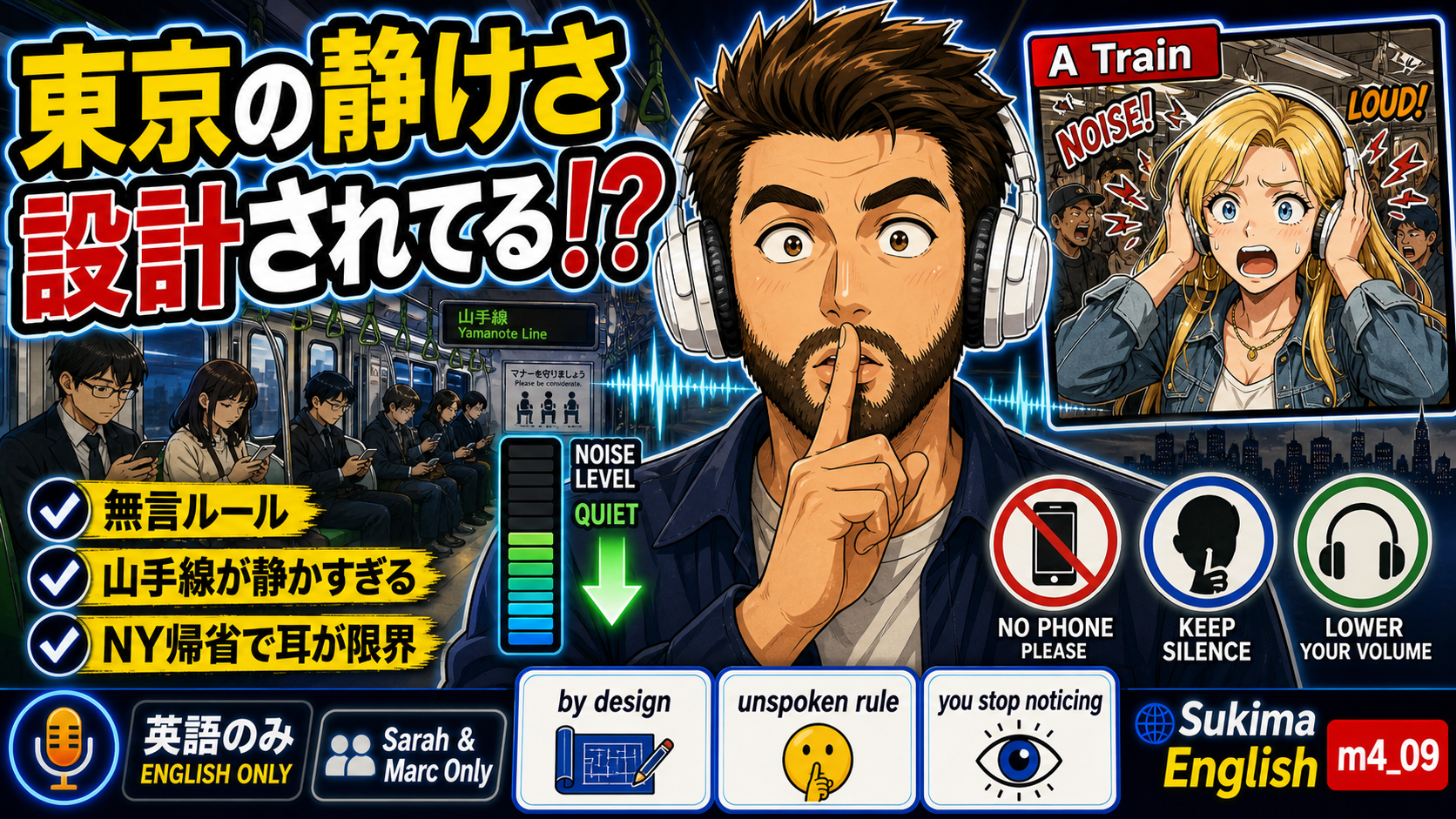
【日常英会話】英語のみ | 山手線はなぜ図書館より静かなのか、誰も命令していないのに東京の音量が低い理由 #英語学習 #ネイティブ英語会話 #リスニング強化 #英語耳
ポッドキャスト「すきまイングリッシュ」のスクリプト。「【日常英会話】英語のみ | 山手線はなぜ図書館より静かなのか、誰も命令していないのに東京の音量が低い理由 #英語学習 #ネイティブ英語会話 #リスニング強化 #英語耳」の会話全文です。

Marc: Sarah, you have that face again. (日本語訳: サラ、またその顔してるよ。)
サラ: What face? (日本語訳: どんな顔?)
Marc: The face you make when you've been somewhere else and you're still processing it. (日本語訳: どこかに行ってきて、まだ気持ちの整理がついてない時の顔。)
サラ: I went back to New York last month to see my family. And on the first morning, I took the A train in from Queens. (日本語訳: 先月、家族に会いにニューヨークに帰ったんだ。で、最初の朝、クイーンズからAトレインに乗って市内に向かったの。)
Marc: And? (日本語訳: それで?)
サラ: Within about ninety seconds on that train, I genuinely wanted to get off. (日本語訳: 電車に乗って90秒くらいで、本当に降りたくなった。)
Marc: Was it that bad? (日本語訳: そんなにひどかった?)
サラ: I have taken that train hundreds of times in my life. Thousands, maybe. I grew up on the New York subway. And now it just hit differently. The noise, the speed, the general feeling of the car. (日本語訳: 人生で何百回も、いや、何千回も乗ったことがある。ニューヨークの地下鉄で育ったんだから。なのに、今は全然違う感じがした。騒音、スピード、車両全体の雰囲気。)
Marc: Two and a half years in Tokyo will do that to you. (日本語訳: 東京に2年半住んでると、そうなるよね。)
サラ: Something got recalibrated. I don't know when it happened. I didn't notice it happening. But I got on that train and I thought — oh no. I've changed. (日本語訳: 何かの基準が調整し直されてたんだと思う。いつそうなったのかはわからない。変わっていく途中も気づかなかった。でも、あの電車に乗って思ったの。「うわ、まずい。私、変わっちゃった」って。)
サラ: And I've been thinking about it ever since I landed back here. (日本語訳: こっちに帰ってきてからずっと、そのことを考えてるんだ。)
Marc: Because it's not just the train, right? (日本語訳: 電車だけじゃないんだろ?)
サラ: It is not just the train. Tokyo is quiet in this very specific, very consistent way. And I don't think most people notice it, because it is so baked in. (日本語訳: 電車だけじゃない。東京って、すごく独特で、すごく一貫した静けさがあるんだ。ほとんどの人は気づいてないと思う。あまりにも染みついてるから。)
Marc: Hidden in plain sight. (日本語訳: 目の前にあるのに見えていない、ってやつだね。)
サラ: Hidden in plain sight. Again. (日本語訳: 目の前にあるのに見えていない。またね。)
Marc: Welcome back to the series. (日本語訳: シリーズへ、おかえり。)
サラ: Today we are talking about the silence. (日本語訳: 今日は静けさについて話すよ。)
Marc: Quiet by design. (日本語訳: 意図的な静けさ、だね。)
サラ: Let's get into it. (日本語訳: さあ、始めよう。)
Marc: The train. Start there. (日本語訳: 電車。そこから始めよう。)
サラ: The Yamanote Line is one of the quietest moving vehicles I have ever been on. And it runs through one of the most densely populated cities on earth. Packed. Full of people. Almost no ambient noise. (日本語訳: 山手線って、今まで乗った中で一番静かな乗り物の一つなんだよ。しかも、地球上で最も人口密度の高い都市の一つを走ってる。満員で、人でいっぱいなのに、周りの物音がほとんどしないんだ。)
Marc: When I first got here — first or second week — I was on the Chuo Line coming back from somewhere. And I kept waiting for the car to wake up. (日本語訳: 僕がこっちに来たばかりの頃、1週目か2週目かな、どこかからの帰りに中央線に乗ってたんだ。で、車内がにぎやかになるのをずっと待ってたんだよ。)
サラ: In New York, you get on the train and within thirty seconds something is happening. Someone's on a call, someone's eating, someone's playing music out loud. (日本語訳: ニューヨークだと、電車に乗って30秒もしないうちに何かが起きてるんだ。電話してる人がいたり、何か食べてる人がいたり、大音量で音楽をかけてる人がいたり。)
Marc: Chicago is the same. The L is not a quiet vehicle. There is always ambient human noise. (日本語訳: シカゴも同じだよ。「L」は静かな乗り物じゃない。いつも人の立てる音がしてる。)
Marc: The Chuo Line was just still. Not empty — full of people. But still. (日本語訳: 中央線は、ただしんとしてた。空いてたわけじゃない。人でいっぱい。でも、しんとしてたんだ。)
サラ: And then you had the phone call moment. (日本語訳: そして、あの電話の一件があったんだよね。)
Marc: Third week. My dad called. I picked up without thinking — because at home, you just pick up. And I felt the entire car become very quietly, very gently aware of my existence. (日本語訳: 3週目。父さんから電話がかかってきて、何も考えずに出ちゃったんだ。地元じゃ普通に出るからね。そしたら、車両全体が、すごく静かに、すごくさりげなく、僕の存在に気づいたのを感じたんだ。)
サラ: Nobody said a word. (日本語訳: 誰も何も言わなかったんでしょ。)
Marc: Not a word. Nobody looked over. Nobody made a face. But I could feel about twelve people register that I was there. (日本語訳: 一言も。誰もこっちを見なかったし、顔をしかめる人もいなかった。でも、12人くらいが僕の存在に気づいたのがわかったんだ。)
Marc: And I said, "Dad, let me call you back." And I hung up. (日本語訳: それで、「父さん、あとでかけ直すよ」って言って切ったんだ。)
サラ: Learned the rule in one moment. (日本語訳: 一瞬でルールを学んだんだね。)
Marc: One moment. Nobody taught me. I absorbed it from the environment. There is an official layer — the train companies ask you not to make calls and to set your phone to silent. (日本語訳: その一瞬でね。誰かに教わったわけじゃない。周りの空気から身につけたんだ。公式なルールもあるよ。鉄道会社が、通話は控えて、携帯はマナーモードにしてくださいって呼びかけてる。)
Marc: But the actual silence goes far beyond that. Nobody posted a rule about conversation volume. Nobody put up a sign about how loud you can eat. (日本語訳: でも、実際の静けさはそれをはるかに超えてる。会話の音量について決まりを貼り出した人はいないし、食べる時の音について看板を立てた人もいない。)
サラ: And yet you don't eat on the train either. (日本語訳: それなのに、電車の中で食べることもしないよね。)
Marc: I did. First month. An onigiri, on the Chuo Line. Nobody said anything. But nobody else was eating. And I looked around, and I put the onigiri in my bag. And I never did it again. (日本語訳: したんだよ。最初の月。中央線で。おにぎりをね。誰も何も言わなかった。でも、他に食べてる人は誰もいなかった。周りを見回して、おにぎりをバッグにしまったんだ。それ以来、二度としなかった。)
サラ: Learned from the absence of behavior. (日本語訳: 誰もやってないのを見て学んだんだね。)
Marc: That's how the whole system works. You learn what the norm is by watching everyone else not do the thing you were about to do. (日本語訳: そういう仕組みなんだよ。自分がやろうとしていたことを、他の誰もやっていないのを見て、それが普通なんだって学ぶんだ。)
サラ: The unspoken rule. Nobody writes it down. But it's completely real. (日本語訳: 暗黙のルールね。誰も書き留めないけど、ちゃんと存在する。)
Marc: And once you've got it, it feels obvious. It feels like something that has always existed. (日本語訳: そして、一度それを理解すると、当たり前に感じられるんだ。まるでずっと前から存在していたかのようにね。)
サラ: Which is exactly when you stop noticing it. (日本語訳: そこでちょうど、気づかなくなるんだよね。)
Marc: Five years in, I had this moment on the Shinkansen. I was sitting next to a tourist who was having a phone conversation at a completely normal speaking volume. And I felt this discomfort I couldn't immediately explain. (日本語訳: 5年経った頃、新幹線でこんなことがあったんだ。隣に座ってた旅行者が、まったく普通の声の大きさで電話してた。そしたら、すぐには説明できない居心地の悪さを感じたんだよ。)
サラ: Because they weren't doing anything wrong by outside standards. (日本語訳: 外の基準で言えば、その人は何も悪いことをしてないからね。)
Marc: By any global standard, totally fine. Just a phone call. But in that car, on the Shinkansen, it stood out like something was broken. And I sat there thinking — five years, and I am fully inside this system now. (日本語訳: 世界のどの基準で見ても、まったく問題ない。ただの電話だよ。でも、新幹線のあの車両の中では、何かが壊れてるみたいに浮いて見えた。そこに座りながら思ったんだ。5年経って、僕はもうすっかりこの仕組みの中にいるんだなって。)
サラ: You stopped noticing the norm until someone stepped outside it. (日本語訳: 誰かがその外に出るまで、普通のことに気づかなくなってたんだね。)
Marc: That is exactly when it becomes visible. (日本語訳: まさにその時、見えるようになるんだ。)
Marc: And five years is a long time to be inside something. When I first got here, I was the noise. Picking up calls, talking at Chicago volume. I was that tourist on the Shinkansen. (日本語訳: それに5年って、何かの中にいるには長い時間だよ。来たばかりの頃は、僕が騒音の側だった。電話に出るし、シカゴの声量で話すし。僕があの新幹線の旅行者だったんだ。)
サラ: And now you're the one feeling the discomfort. (日本語訳: で、今は居心地の悪さを感じる側になったんだね。)
Marc: Full circle. (日本語訳: 一周回ったよ。)
サラ: So when did it flip? When did you go from being the person making the mistake to the person feeling the discomfort? (日本語訳: じゃあ、いつ入れ替わったの? ミスをする側から、居心地の悪さを感じる側になったのは?)
Marc: Somewhere in year two. I started to feel the absence of the quiet when something broke it — in a different way than before. Before, I was the one breaking it without knowing. Later, I was on the receiving end. (日本語訳: 2年目のどこかだね。何かが静けさを壊した時に、前とは違う形でそれを感じるようになったんだ。前は、自分が知らずに壊す側だった。そのうち、壊される側になったんだ。)
サラ: What kind of feeling? (日本語訳: どんな感じ?)
Marc: Hard to describe. Not quite annoyance. More like — the air changed. Like when a song cuts out mid-phrase. You become aware of the silence you were in, right at the moment it's interrupted. (日本語訳: 説明しにくいな。イライラとはちょっと違う。どちらかというと、空気が変わる感じ。曲がフレーズの途中でブツッと切れた時みたいに。途切れたその瞬間に、自分が静けさの中にいたことに気づくんだ。)
サラ: That's a good way to put it. (日本語訳: いい言い方だね。)
サラ: But I want to talk about beyond the train. Because this is what I really noticed after New York. (日本語訳: でも、電車以外の話もしたいんだ。ニューヨークから戻って、本当に気づいたのはそこだから。)
Marc: You were doing the inventory. (日本語訳: 全部チェックしてたんだね。)
サラ: I was doing the full inventory. Cafés. Waiting rooms. The pharmacy. Casual restaurants. The ambient volume in all of those spaces is just lower here. (日本語訳: 全部チェックしたよ。カフェ。待合室。薬局。気軽なレストラン。どこでも、周りの音の大きさが、ここはとにかく低いの。)
Marc: I want to be precise about this. Tokyo is not a silent city. Go to an izakaya on Friday night and it is loud. Stand outside a pachinko parlor and your ears will ring. Festivals are genuinely, powerfully loud. (日本語訳: ここは正確に言っておきたいんだけど、東京は静まり返った街じゃない。金曜の夜の居酒屋はうるさいし、パチンコ屋の前に立てば耳がキーンとする。お祭りなんて本当に、とんでもなくうるさい。)
サラ: But those are exceptions to a default. The default is lower. (日本語訳: でも、それは基本の状態からの例外でしょ。基本の音量が低いんだよ。)
Marc: The baseline is lower. And you operate at it without deciding to. (日本語訳: 基準が低いんだ。しかも、自分で決めたわけでもないのに、その基準で動いてる。)
サラ: I had coffee with my sister my first morning back in New York. She was talking at a completely normal New York volume, across a small table, in a quiet enough coffee shop. And I kept leaning in toward her. (日本語訳: ニューヨークに戻った最初の朝、妹とコーヒーを飲んだの。小さなテーブルを挟んで、そこそこ静かなコーヒーショップで、妹はまったく普通のニューヨークの声量で話してた。なのに私、ずっと身を乗り出してたんだ。)
Marc: Like she was far away. (日本語訳: まるで遠くにいるみたいに。)
サラ: She was right across from me. I had just lost my reference point. (日本語訳: 目の前にいたのにね。私の基準がずれちゃってただけ。)
Marc: Same thing happened to me in Chicago last spring, at a café with my brother Mike. Normal American café volume around us. And I kept wanting to lower my voice, even though I was the only one doing it. (日本語訳: 僕も去年の春、シカゴのカフェで兄のマイクといた時に、まったく同じことがあったんだ。周りは普通のアメリカのカフェの音量。なのに僕は、声を落としたくて仕方なかった。そんなことしてるのは僕だけなのに。)
サラ: Did he notice? (日本語訳: お兄さん、気づいてた?)
Marc: He kept asking if I was okay. I said I was great. I was just — running at Tokyo volume in a Chicago room. (日本語訳: 大丈夫かってずっと聞かれたよ。絶好調だって答えたんだけど、ただ、シカゴの部屋で東京の音量のまま動いてただけなんだ。)
サラ: Being too quiet for the city you grew up in is a strange feeling. (日本語訳: 育った街で、自分だけ静かすぎるって、変な感じだよね。)
Marc: Very strange. Mike eventually said, "You've gone soft." Which, to be fair, is probably accurate. (日本語訳: すごく変だよ。マイクには最後に「お前、やわになったな」って言われた。まあ、たぶん当たってるんだけどね。)
サラ: And you don't notice the recalibration while it's happening. You only feel it after, when you step back into the old environment. (日本語訳: そして、その調整が起きてる間は自分では気づかない。古い環境にまた戻った時に、初めて感じるんだ。)
Marc: Right. It happens gradually, and then all at once, when the contrast shows up. (日本語訳: そう。少しずつ進んで、対比が見えた瞬間に、一気に実感するんだ。)
サラ: The contrast is everything. I think I could have lived in Tokyo for ten years and never consciously noticed the quiet — if I hadn't gone back to New York. (日本語訳: コントラストって、すべてだよね。東京に10年住んでても、ニューヨークに帰らなかったら、この静かさには気づかなかったと思う。)
Marc: The A train did you a favor. (日本語訳: Aトレインが、君にいいことをしてくれたんだね。)
サラ: A very loud favor. (日本語訳: すっごくうるさい親切だけどね。)
Marc: One place I really notice it now is kombini. Convenience stores. (日本語訳: 今すごく気づく場所の一つがコンビニなんだ。)
サラ: Which is interesting because they are loud in one specific way. (日本語訳: 面白いね。コンビニって、ある意味ではうるさいから。)
Marc: They are loud in one specific way. The automatic greeting every time someone walks in. The checkout music. All of that is designed to be heard. (日本語訳: ある意味ではうるさい。誰かが入るたびに決まって聞こえる挨拶。レジの音楽。全部、聞こえるように作られてる。)
サラ: But the people inside are quiet. (日本語訳: でも、店内にいる人たちは静かなんだ。)
Marc: The people inside are quiet. You walk into a New York deli at seven in the morning and it is a conversation. People are shouting their orders, the TV is on, someone is having an argument. (日本語訳: 中にいる人たちは静かなんだ。朝7時にニューヨークのデリに入ると、会話が飛び交ってる。注文を叫ぶ人がいて、テレビがついてて、誰かが言い争ってる。)
Marc: At a kombini, you walk in, you find your stuff, you pay, you leave. And the only human noise is the staff greeting. (日本語訳: コンビニだと、入って、商品を見つけて、会計して、出る。そして、唯一の人の声は店員さんの挨拶だけ。)
サラ: The ambient sound is built in, but the human volume is low by default. (日本語訳: 環境音は組み込まれてるけど、人の声の音量はデフォルトで低いんだね。)
Marc: Exactly that. And you stop noticing the contrast after a while. But once you see it, it's everywhere. (日本語訳: まさにそれ。そして、しばらくするとそのコントラストに気づかなくなる。でも、一度気づいてしまうと、どこにでもあるんだ。)
Marc: Here is the question I keep thinking about. Is this a cultural norm that developed on its own over time? Or is it something more intentional? (日本語訳: ずっと考えてる疑問があるんだ。これは自然発生した文化的な規範なのかな?それとも、もっと意図的なもの?)
サラ: What's the difference? (日本語訳: どう違うの?)
Marc: A cultural norm just accumulates. Generations of behavior, no one planned it. But what I see in Tokyo feels almost deliberate. Like someone thought through the design. (日本語訳: 文化的な規範っていうのは、ただ積み重なっていくものだよね。何世代にもわたる振る舞いで、誰も計画してない。でも東京で見るものは、ほとんど意図的に感じるんだ。まるで誰かが設計を考え抜いたみたいに。)
サラ: The train companies do run manner campaigns. There are posters, announcements. (日本語訳: 鉄道会社はマナーキャンペーンをやってるよね。ポスターとか、アナウンスとか。)
Marc: There are. And that is the official layer. But the behavior extends far beyond the official layer. Into spaces where there are no posters. (日本語訳: やってる。それが公式な層。でも、人々の振る舞いは公式な層をはるかに超えてる。ポスターなんてない場所にまで。)
サラ: Cafés with no signs. (日本語訳: 看板のないカフェとか。)
Marc: Pharmacy waiting rooms with no announcements. Convenience stores with no stated rule about volume. (日本語訳: アナウンスのない薬局の待合室。音量について何のルールも書かれてないコンビニ。)
サラ: So what's doing it, if not the rules? (日本語訳: じゃあ、ルールじゃなくて、何がそれをやってるの?)
Marc: The unspoken rule. Which is different from a regular rule. A regular rule has a sign, a fine, a person who enforces it. An unspoken rule has none of those things. It just exists. You absorb it. (日本語訳: 暗黙のルールだよ。普通のルールとは違う。普通のルールには、看板や罰金や取り締まる人がある。暗黙のルールには、そのどれもない。ただ存在してて、自然と身につくんだ。)
サラ: You absorb it without knowing you're absorbing it. (日本語訳: 身についてることにも気づかないうちに、身につくんだよね。)
Marc: And once you have it, it feels completely natural. Like something you've always known. (日本語訳: で、一度身につくと、完全に自然に感じられる。ずっと前から知ってたことみたいに。)
サラ: You perform it without thinking. I don't decide to lower my voice on the train. I just do. (日本語訳: 無意識にやってるんだ。電車で声のトーンを下げることを自分で決めてるわけじゃない。ただやってるだけ。)
Marc: You don't think, "I will now be considerate of the stranger next to me." You don't make the call. They don't make the call. The whole car runs quietly without anyone coordinating. (日本語訳: 「隣の知らない人に配慮しよう」なんて考えるわけじゃない。自分が決めてるわけでも、相手が決めてるわけでもない。誰もまとめ役がいないのに、車両全体が静かに回ってるんだ。)
サラ: That is the design. Nobody drew it up. But it functions like it was planned. (日本語訳: それが設計なんだね。誰かが図面を引いたわけじゃないけど、計画されたみたいに機能してる。)
Marc: What I find remarkable is that it's an act of consideration that you're not consciously choosing. It has been absorbed so completely that it operates as reflex. (日本語訳: 僕がすごいと思うのは、それが意識して選んでるわけじゃない配慮だってこと。あまりにも深く身についてて、反射みたいに働いてるんだ。)
サラ: An automatic act of consideration. Which might be the most efficient kind. (日本語訳: 自動で働く配慮。それが一番効率のいい形かもしれないね。)
Marc: Because it requires no reminder. No enforcement. It just — runs. (日本語訳: 念を押す必要も、取り締まる必要もないからね。ただ、回っていく。)
サラ: There's something I find beautiful about that. A system that works without an enforcer is a different kind of system. It's not compliance. It's more like participation. (日本語訳: そこがすごく素敵だと思うんだ。取り締まる人がいなくても機能する仕組みって、別の種類の仕組みだよね。従ってるんじゃなくて、参加してる感じ。)
Marc: You're not following a rule. You're joining a practice. (日本語訳: ルールに従ってるんじゃない。習慣に加わってるんだ。)
サラ: And once you're in the practice, you maintain it. Not because anyone is watching. Because you're part of it. (日本語訳: で、一度その習慣に加わったら、それを守っていく。誰かに見られてるからじゃなくて、自分がその一部だから。)
Marc: That's the thing about real norms. They don't need a camera. They just need enough people who have already internalized them. (日本語訳: それが本物の規範ってものなんだ。カメラはいらない。すでにそれを身につけた人が十分いればいい。)
サラ: And new arrivals absorb it from those people. And then they maintain it for the next wave. It propagates without anyone teaching it. (日本語訳: で、新しく来た人は、そういう人たちから身につける。そして次に来る人たちのために、それを守っていく。誰も教えなくても広がっていくんだ。)
Marc: Self-sustaining. (日本語訳: ひとりでに続いていくんだね。)
Marc: And I think part of it is the physical context. Tokyo trains, cafés, waiting rooms — these are spaces where you are genuinely very close to strangers. Sometimes touching distance. (日本語訳: それに、物理的な状況も理由の一つだと思う。東京の電車、カフェ、待合室。どこも、知らない人と本当に近い距離にいる場所なんだ。触れそうなくらいの時もある。)
サラ: The proximity is real. (日本語訳: その近さは本物だよね。)
Marc: And in that proximity, noise becomes something you share whether you want to or not. (日本語訳: そしてその近さの中で、騒音は、望むと望まざるとにかかわらず、共有するものになる。)
Marc: If I raise my voice in that train car, I'm occupying other people's space without asking. And I think the culture adapted to that density by developing a very strong norm around not doing that. (日本語訳: あの車両で僕が声を張り上げたら、断りもなく他人の空間を占領することになる。この文化は、その密集に適応して、そうしないっていう強い規範を育てたんだと思う。)
サラ: I've been thinking about why Tokyo went this direction and New York went the other. Because they're both extremely dense cities. The same pressure. (日本語訳: なんで東京はこっちの方向に行って、ニューヨークは逆に行ったのか、ずっと考えてたんだ。どっちもものすごく人口密度の高い都市で、同じプレッシャーがあるのに。)
Marc: Different adaptation. (日本語訳: 適応の仕方が違ったんだね。)
サラ: New York's answer was almost the opposite. You are also packed in next to strangers, and everyone just got loud together. Like everyone agreed to be noise. (日本語訳: ニューヨークの答えは、ほぼ正反対だった。同じように知らない人とぎゅうぎゅうに詰め込まれて、みんなで一緒にうるさくなった。まるで全員で騒音になろうって合意したみたいに。)
Marc: And there's a kind of camaraderie in that. It's not wrong. It's just — a different contract. (日本語訳: それはそれで、一種の仲間意識があるんだよね。間違ってるわけじゃない。ただ、契約の中身が違うんだ。)
サラ: Different adaptation to the same problem. Tokyo adapted toward quiet. Toward giving other people acoustic space rather than claiming it. (日本語訳: 同じ問題に対する、違う適応。東京は静けさの方向に適応した。音の空間を自分のものにするんじゃなくて、他の人に譲る方向に。)
サラ: And once that norm settled in, it self-reinforced. Because everyone inside it is already running it. (日本語訳: そして、その規範が定着すると、自己強化されるんだ。なぜなら、その中にいる誰もが、すでにそれを実行しているから。)
Marc: The poster just reminds you of what you already know. (日本語訳: ポスターは、自分がすでに知っていることを思い出させてくれるだけなんだ。)
サラ: I caught myself doing it somewhere I didn't expect. I had a layover in London. I was in a café for a couple of hours. And I noticed I was talking just under the ambient volume of the room. Not over it. (日本語訳: 思いがけない場所で、自分がそうしてるのに気づいたの。ロンドンで乗り継ぎがあって、カフェに2時間くらいいたんだけど、気づいたら、店内の音より少しだけ小さい声で話してた。上回らないように。)
Marc: Without deciding to. (日本語訳: 意識せずに。)
サラ: I caught myself doing it after the fact. And I thought — Tokyo is traveling with me now. (日本語訳: 気づいたのは後になってからだった。それで思ったんだ。東京が、今は私と一緒に旅してるんだなって。)
Marc: That is the full recalibration. When it shows up in a third city. (日本語訳: それが、完全に基準が切り替わったってことだよ。3つ目の都市でも出てくるなら。)
サラ: And it didn't feel strange. It felt appropriate. Even in a London café, I didn't want to be noise that someone else had to filter out. (日本語訳: しかも、変な感じはしなかった。それが自然に思えたの。ロンドンのカフェでも、誰かが聞き流さなきゃいけない騒音にはなりたくなかった。)
Marc: An act of consideration. Even when no one asked for it. (日本語訳: 配慮の行動だね。誰も求めていないのに。)
サラ: Even when no one was watching. (日本語訳: 誰も見てない時でさえね。)
サラ: What I keep coming back to is — the systems we don't notice are often the ones doing the most work. (日本語訳: 私がいつも行き着くのは、気づかない仕組みほど、実は一番大きな仕事をしてるってこと。)
Marc: The Yamanote quiet is invisible until it's gone. Or until the A train shows you the contrast. (日本語訳: 山手線の静けさは、なくなるまで見えない。あるいは、Aトレインが対比を見せてくれるまではね。)
サラ: And once you see it, you can't stop seeing it. I notice it in kombini now. In the way people walk through corridors. Even in how people stand in line. (日本語訳: そして一度それに気づくと、もう見ずにはいられなくなる。今ではコンビニでも、廊下を歩く人の様子でも、列に並ぶ人の姿でさえ、それに気づく。)
Marc: The baseline is everywhere, once you've recalibrated. (日本語訳: 基準が変わると、それがどこにでも見えるんだ。)
サラ: I started paying attention to how people move through hallways here. Even in office buildings. There's a kind of lateral awareness — people move to avoid each other without looking directly at each other. Nobody claims the full width of a corridor. (日本語訳: こっちで人が廊下をどう歩くか、気にするようになったんだ。オフィスビルの中でも。横への気配りみたいなものがあって、相手をまっすぐ見なくても、お互いにすっとよける。誰も廊下の幅いっぱいを占領しないんだ。)
Marc: You're noticing it everywhere now. (日本語訳: 今はどこでも気づくようになったんだね。)
サラ: I'm noticing it everywhere. And I couldn't have seen it before the A train reminded me it existed. (日本語訳: どこでも気づいてる。でも、Aトレインがその存在を思い出させてくれるまでは、見えてなかったんだ。)
サラ: What's the moment you feel it most? After five years. (日本語訳: 5年経って、一番それを感じる瞬間はいつ?)
Marc: Coming back from trips. Every time I land at Haneda and get on the train in, there's this settling. Like something clicks back into place. The quiet just arrives. (日本語訳: 旅行から帰ってきた時。羽田に着いて都心に向かう電車に乗るたびに、すっと落ち着くんだ。何かがカチッと元の位置に戻るみたいに。静けさが、ただそこにやってくる。)
サラ: Like coming home. (日本語訳: 家に帰るみたいに。)
Marc: Like coming home to a particular kind of quiet. I didn't expect to miss it the first time I left. But I did. (日本語訳: ある種の静けさのある家に帰ってくる感じ。初めてここを離れた時は、恋しくなるなんて思ってなかった。でも、恋しくなったんだ。)
サラ: I think that is the hidden in plain sight thing. You stop noticing it. Something snaps you out of it. You appreciate it again. And then slowly, it becomes invisible again. (日本語訳: それが「目の前にあるのに見えていない」ってことなんだと思う。気づかなくなって、何かでハッとして、また大切に思う。そしてまた少しずつ、見えなくなっていく。)
Marc: Until someone leaves their wallet on the train and rides home on the A train. (日本語訳: 誰かが電車に財布を忘れて、Aトレインで家に帰るまで、ね。)
サラ: And loses their mind a little. (日本語訳: で、ちょっと取り乱すまでね。)
Marc: Good teachers, both. (日本語訳: どちらもいい先生だね。)
サラ: Next time you ride the Yamanote, just pay attention. Not to what's there. To what isn't there. (日本語訳: 次に山手線に乗る時は、ただ注意を払ってみて。そこにあるものじゃなくて、ないものに。)
Marc: If you've just arrived in Tokyo and the quiet feels strange — give it time. It takes some getting used to. (日本語訳: もし東京に今着いたばかりで、この静けさが奇妙に感じるなら、時間をかけてみて。慣れるのに少し時間がかかる。)
サラ: But once it settles in, you carry it with you. Even in places that didn't ask for it. (日本語訳: でも、それが馴染むと、どこにでも持っていくんだ。それを求めていない場所でさえ。)
Marc: Drop a comment if you've had a moment like this. When the quiet hit you somewhere unexpected. (日本語訳: こんな瞬間があったら、コメントで教えて。思いがけない場所で、静けさにハッとした時のこと。)
サラ: We'd love to hear it. Thanks for listening. (日本語訳: ぜひ聞かせてほしいな。聞いてくれてありがとう。)
Marc: See you next time. (日本語訳: また次回ね。)

関連記事

【日常英会話】「感謝していることを一つずつ」アメリカの感謝祭とネイティブの本音 #英語学習 #ネイティブ英語会話 #リスニング強化 #英語耳
ポッドキャスト「すきまイングリッシュ」のスクリプト。「【日常英会話】「感謝していることを一つずつ」アメリカの感謝祭とネイティブの本音 #英語学習 #ネイティブ英語会話 #リスニング強化 #英語耳」の会話全文です。

【日常英会話】英語のみ | ニューヨークと東京のハロウィンを英語で語ると? #英語学習 #ネイティブ英語会話 #リスニング強化
ポッドキャスト「すきまイングリッシュ」のスクリプト。「【日常英会話】英語のみ | ニューヨークと東京のハロウィンを英語で語ると? #英語学習 #ネイティブ英語会話 #リスニング強化」の会話全文です。

【日常の英語】元気のない同僚にかける英語フレーズ12選|声かけから励ましまで #英語学習 #英語フレーズ #英会話 #英語耳
ポッドキャスト「すきまイングリッシュ」のスクリプト。「【日常の英語】元気のない同僚にかける英語フレーズ12選|声かけから励ましまで #英語学習 #英語フレーズ #英会話 #英語耳」の会話全文です。

【日常英会話】住所と道案内を英語で話すと?日本の住所には通りの名前がない #英語学習 #ネイティブ英語会話 #リスニング強化 #英語耳
ポッドキャスト「すきまイングリッシュ」のスクリプト。「【日常英会話】住所と道案内を英語で話すと?日本の住所には通りの名前がない #英語学習 #ネイティブ英語会話 #リスニング強化 #英語耳」の会話全文です。

【日常の英語】日本語解説あり | 席を譲ろうとして、断られた |申し出る英語と、断られたときの英語6つ #英語学習 #英語フレーズ #英会話 #英語耳
ポッドキャスト「すきまイングリッシュ」のスクリプト。「【日常の英語】日本語解説あり | 席を譲ろうとして、断られた |申し出る英語と、断られたときの英語6つ #英語学習 #英語フレーズ #英会話 #英語耳」の会話全文です。

【日常英会話】カウンターには、向かいの椅子がない、「お一人ですか」と聞かれる国 #英語学習 #ネイティブ英語会話 #リスニング強化 #英語耳
ポッドキャスト「すきまイングリッシュ」のスクリプト。「【日常英会話】カウンターには、向かいの椅子がない、「お一人ですか」と聞かれる国 #英語学習 #ネイティブ英語会話 #リスニング強化 #英語耳」の会話全文です。